|
|
|

|
by Stephen S. Mehler, M.A. from GizaPyramid.com Website
Most Egyptologists and lay people know that Egypt is derived from the Greek word Aegyptos. But few have ever traced the origin of this word.
Ptah was the title of one of the so-called "Creator Gods" or Neters.
R.A. Schwaller de Lubicz translated Neter to mean,
The Greeks derived their word "nature" from Neter, therefore receiving the teaching from the ancient
Egyptians of there not being a separation of nature and the divine.
This term is found
as an inscription on a stela near the modern Egyptian village of Mit Rahaina situated near the ruins of the ancient
Egyptian capital city the Greeks named Memphis, known
to the ancients as Men-Nefer (The Generation of
Harmony).
The ancients referred to their "country" as KMT, which has been written many different ways:
It literally meant "the Black Land" and referred to the rich, black alluvial soil deposited by the Nile River, which allowed the agricultural basis of the civilization to flourish.
The
indigenous tradition of Egypt tells us the civilization was Khemit, the people and language were called Khemitian.
This is a beginning paradigm for the presentation of a whole new discipline, based on the teachings of indigenous wisdom keepers, not Greco-Roman historians as espoused by academic Egyptology.
from GizaPyramid.com Website
Both
academic Egyptologists and I would agree this statement is
incorrect, but I would strongly disagree with most Egyptologists
on the true origin of the word.
The word Pyramidos has been
translated as "Fire In The Middle". This meaning is
very interesting and I will return to it later.
But MR, usually written as Mer, is commonly translated as beloved, as in Meriamen (Beloved of Amen, The Hidden) or Meritaten (Beloved of Aten, The Wiser). Our indigenous sources tell us Mer meant "beloved" and had nothing to do with pyramid.
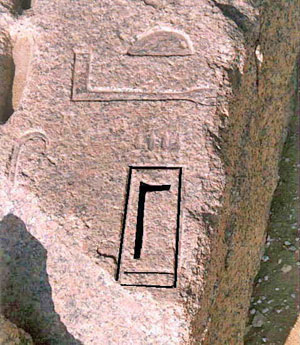
Glyph of Per-Neter, House of Nature, Energy. Taken by author at Abusir,1997.
My Indigenous Wisdom Keeper teacher, Abd’El Hakim Awyan, states unequivocally that the ancient Khemitians used the term PR.NTR, Per-Neter, for pyramid.
Per means "house" and Neter we have discussed in the previous article.
Neter has been translated by Egyptologists as "God" or "Goddess" but we reject this mistranslation. In alignment with the indigenous tradition, we use the interpretation "House of Nature, House of Energy" for Per-Neter. The temple was Per-Ba (House of the Soul) and the tomb was Per-Ka (House of the Physical Projection) according to the indigenous tradition.
With this understanding of Per-Neter as House of Nature, I state categorically that no one was ever intended to be buried in a pyramid in its original intent!
Even Mark Lehner has admitted that no
evidence of an original burial in any of the major Khemitian
pyramids has ever been found. Also no inscriptions or
reliefs either depicting or stating that any king was ever
buried in a pyramid have ever been found.
Although Egyptologists base their pyramid-as-tomb theories on the writings of Greek historians such as Herodotus, the Greek word Pyramidos is closer to the true meaning.
Indeed, if we support Dunn’s ideas that the energy reactions in the Great Pyramid took place in the so-called Queen’s and King’s Chambers, then certainly it was Fire In The Middle.
|