|
Project Chariot
The Nuclear Legacy of Cape Thompson, Alaska
by Norman Chance
http://arcticcircle.uconn.edu/SEEJ/chariotseej.html
"In 1957, the U.S. Atomic Energy
Commission [AEC] established the 'Plowshare Program' to
"investigate and develop peaceful uses for nuclear
explosives." In early 1958, the AEC selected a site at the
mouth of the Ogotoruk Creek near Cape Thompson,
approximately 30 miles southeast of the Inupiat Eskimo
village of Point Hope.
Shortly thereafter, they
developed plans for an experimental harbor excavation to be
called Project Chariot. Late in 1962, after extensive
scientific studies, the AEC announced that it "would defer
further consideration of the proposed Chariot experiment,"
due in part to public criticism....
Douglas L. Vandegraft
U.S. Fish and Wildlife Service
Part One of this case study traces the
process of events from the initial design of Project Chariot to its
cancellation in 1962.
Part Two addresses recent developments stemming from a 1990s
investigation of contaminated radioactive soil that had been left at
the site thirty years previously.
Also included is a Postscript analyzing
allegations that without their knowledge, the Inupiat and other
Alaskan Natives were injected with radioactive iodine/131 in the
1950s as part of a U.S. military research project to determine
whether soldiers "could be better conditioned to fight in cold
conditions."
Part One
[There was] a general atmosphere
and attitude that the American people could not be trusted
with the uncertainties, and therefore the information was
withheld from them. I think there was concern that the
American people, given the facts, would not make the right
risk-benefit judgments.
Peter Libassi,
Chairman, Interagency Task
Force on the Health Effects of Ionizing Radiation
We should be on our guard not to
overestimate science and scientific methods when it is a
question of human problems, and we should not assume that
experts are the only ones who have the right to express
themselves on questions affecting the organization of
society.
Albert Einstein,
Scientist
Introduction
In recent decades, increasing numbers of people have expressed
concern about threats to the natural environment of the Arctic. In
the 1970s, sharp criticism followed the above ground nuclear bomb
tests by the People's Republic of China; tests which resulted in an
eight-fold increase in radioactive pollution of Alaskan lichens,
affecting the caribou that ate them; and a year later, the inland
Inupiat Eskimo subsistence hunters.
In the 1980s, international research was initiated to study the
growing problem of Arctic haze, a form of atmospheric pollution that
absorbs light from the sun and thereby alters the temperature of
Arctic air, a significant determinant of weather conditions
throughout the globe. In the spring of 1989, the worst oil spill in
American history occurred in Alaska's Prince William Sound when the
tanker Exxon Valdez went aground spilling more that 10 million
gallons of North Shore crude oil in the sea and surrounding
shoreline.
In the 1990s, even greater concern is being expressed over the
production of human made chemicals that have affected the Arctic's
atmospheric ozone layer, which is so vital to protecting organisms
from lethal violet rays. Such threats to the Arctic environment
carry implications not only for those living in the North, but for
peoples throughout the globe.
In Arctic Circle's presentation on 'northern development and the
global economy,' I addressed some of the key factors promoting this
environmental degradation -concluding with the proposition that
economic growth cannot indefinitely be sustained on a finite planet.
Hence, the wisest course of action would be to distinguish between
growth and development in which the latter represents an improvement
in the quality of life without necessarily increasing the quantity
of resources consumed.
However, at that time, I said little about the environmental
injustice inflicted on northern Native peoples stemming the
degradation to their homelands in the wake of recent development
practices. Nor did I actively discuss the role played by governments
in this degradation. This omission is addressed in the following
case study. Indeed, the story of Project Chariot provides an
immensely powerful illustration of how governments, caught up in the
social and political events of the time, can act in ways that are
highly detrimental to the Arctic and its peoples. It is also a
portrayal of resistance, courage, and eventual success.
Perhaps most important is the implicit
question it poses: To what extent are the underlying political
motivations and social forces present at that time still with us
today?
The Problem - Part I
One afternoon in early August of 1958, while standing on the bluff
overlooking the Beaufort Sea, an Inupiat Eskimo from Kaktovik,
Alaska watched as an umiaq with two men in it pointed their skin
boat toward the village from the northwest. Propelled by a large
outboard motor, it slowly made its way past the lagoon, eventually
reaching the shoreline directly in front of the small settlement.
A tall, well-built man then leapt from
the bow and, with anchor in hand, deftly drove its point firmly into
the sand. Joined by the other Inupiaq, both men began unloading food
and supplies on to the beach. Soon, the visitors were surrounded by
excited villagers of all ages, many of whom greeted them with
considerable enthusiasm.
Stories had been circulating f or some time
that two people from Point Hope were planning to make the long
journey north to Barrow and then 300 miles along the Beaufort Sea to Kaktovik. One of these expected voyagers was Dan Lisburne, a
well-known leader from Point Hope. Now, he and his partner had
finally arrived.
Situated at the end of a long spit of land projecting out into the
Chukchi Sea 125 miles above the Arctic Circle, Point Hope was the
farthest west from Kaktovik of any Inupiat settlement on the North
Slope. It also had a well-deserved reputation as a close-knit
community with strong leadership and local spirit. Lisburne had
taken the trip partly for enjoyment; but more significantly, he
wanted to share his experiences and learn those of other villagers
living along the Arctic coast.
One issue discussed with the Kaktovik
Inupiat concerned problems the latter were facing following the
forced relocations of their village by the Air Force. Of greater
long range concern was the withdrawal of 4500 acres of land for a
military reserve -an area encompassing the entire surface of Barter
Island including the village and cemetery. As one local villager
described the event later on: "No one knew what this was about, or
why.
We were just told to move.
"If I had known English then, as I
do now, I would have fought to keep the village. We got nothing
for having to move. It was not fair of them to do this."
While in Kaktovik, Dan Lisburne shared a
similar apprehension about the possibility of the government taking
over land south of Point Hope. This concern had arisen two months
earlier, after several Inupiat returned home from a hunting trip to
Ogotoruk Creek, 30 miles southeast of the village.
Lisburne indicated that the Ogotoruk
Creek valley was an important hunting ground for Point Hope people,
providing them with large numbers of caribou. While in the area, the
Inupiat had come across government scientists undertaking a local
survey. When asked what they were doing, the surveyors informed the
hunters they were engaged in geologic research for the U.S. Atomic
Energy Commission [AEC].
Not knowing why scientists from the AEC were interested in Ogotoruk
Creek, the Point Hope residents were curious. This curiosity
eventually turned to anxiety as rumors began spreading that Ogotoruk
Creek had been chosen by the AEC as the site for the detonation of a
large nuclear bomb. Although precise information was unavailable,
the rumors appeared to be true.
The Atomic Energy Commission was indeed
actively exploring the detonation of a massive atomic device. The
blast, expected to be 100 times more powerful than the one at
Hiroshima, was tentatively scheduled to take place in 1962. Ground
Zero was Ogotoruk Creek, 31.5 miles southeast of the Inupiat village
of Point Hope.
Partly in response to broad popular opposition to the hazards of
above ground testing of atomic weapons by both the U.S. and the
USSR, the AEC had decided it could improve its public image by
establishing a new program called `Operation Plowshare' -drawing on
the biblical narrative in which swords were beaten into plowshares.
From this "peaceful use of the atom" suggested the AEC, would come
"a new age of atomic progress." The Program was formally inaugurated
on June 19, 1957. Still, no specific plan had as yet emerged.
Then, in October of that year, following Russia's space launch of
Sputnik I, the American scientific community came under considerable
pressure to achieve a major technological accomplishment of its own.
At the University of California's Lawrence Radiation Laboratory,
scientists responded by recommending to the AEC that earth
excavation offered the "highest probability of early beneficial
success" in the Plowshare Program.
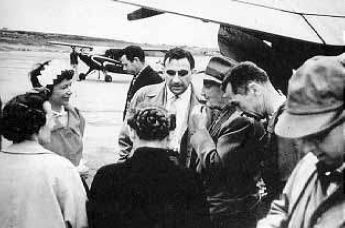
Teller en route to
the Project Chariot site
[Lawrence Livermore
National Laboratory photo]
Actively supporting the proposal, Dr.
Edward Teller, ‘father of the hydrogen bomb’ and director of the
Radiation Laboratory, suggested that the AEC detonate a 2.4 megaton
atomic device on t he northwest coast of Alaska in the region of
Cape Thompson.
Such an explosion would create a deep water hole to
be used as a harbor for the eventual shipment of coal, oil, and
other non-renewable resources thought to exist along this part of
the coast. After exploring several other possibilities, the AEC
accepted Teller’s proposal and on June 9th, 1958 publically gave it
a name - ‘Project Chariot.’
Four days previously, unknown to the
people of Point Hope and other nearby Inupiat villages, Lewis Straus
s, then chairman of the AEC, had requested the withdrawal from the
public domain of 1600 square miles of land and water in the area of
Cape Thompson - including land villagers had earlier sought under
the Alaska Native Allotment Act.
That summer, while scientists were surveying the area surrounding
Cape Thompson, nuclear physicist Teller and others connected with
the AEC and California’s
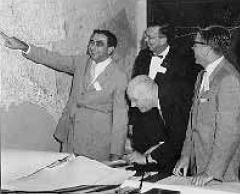 Lawrence
Radiation Laboratory made speeches in Alaskan cities pointing out
the financial benefits the state would receive from the
multi-million dollar investment of federal funds. Further assuring
his audiences, Teller told them that “The blast will not be
performed until it can be economically justified. “ Lawrence
Radiation Laboratory made speeches in Alaskan cities pointing out
the financial benefits the state would receive from the
multi-million dollar investment of federal funds. Further assuring
his audiences, Teller told them that “The blast will not be
performed until it can be economically justified. “
Gaining support of the press, Teller and his associates were less
successful in getting a positive endorsement by the state’s
financial leaders. Some were doubtful of the commercial viability of
mineral deposits thought to be available along the coast.
Others
rejected the idea that a harbor was needed to ship out whatever
minerals were found. Still other dissenters associated with the
science faculty of the University of Alaska at Fairbanks, concerned
citizens, environmentalists, and a few government officials, were
more vocal in their criticism of the blast itself and its
implications for the safety of the people and wildlife of the
region.
But Dan Lisburne and other Inupiat
leaders from Point Hope, Noatak and Kivalina, the villages closest
to the proposed blast, were not directly informed and thus remained
largely ignorant about the plan. It wasn’t until the spring of 1959,
after watching a local movie, that Point Hope residents were called
to an impromptu meeting by a visiting missionary from Kotzebue and
told the rumor about the blast was true.
Although AEC officials excluded Inupiat villagers from early
discussions about Project Chariot, they did continue to promote it
before Alaska’s financial community and state legislature - knowing
their support was essential to its successful implementation. After
holding numerous discussions with public officials and private
industrial leaders, the Commission eventually succeeded in gaining
approval from the state as well as Fairbanks and other city Chambers
of Commerce.
Plans for the detonation progressed.
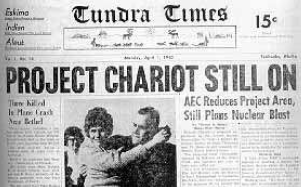
Acknowledging the skepticism of those
questioning the Project’s accruing any commercial benefit, the AEC
also shifted the basis of its argument for the detonation away from
possible economic advantages toward the experimental - calling it a
massive test in “geographical engineering."
As John A. McCone, the AEC's newly
appointed chairman testified before the U.S. Congress Joint
Committee on Atomic Energy,
"We are seeking an alternative to
the harbor in Alaska because, as I said to the committee once
before , we couldn't find a customer for the harbor."
Under the revised plan, presented in
June of 1959, the Project's Environmental Studies Program director
stated that an effort would be made,
"...to determine the effects of a
nuclear explosion on the environment -its rock substrata, soils,
atmosphere, and biota, including man."
 In
the fall, Don Charles Foote, a young geographer working under
contract to the Environmental Studies Program of the AEC, was asked
by Commission staff to explain what he knew of Project Cha riot to
the Point Hope village council. In
the fall, Don Charles Foote, a young geographer working under
contract to the Environmental Studies Program of the AEC, was asked
by Commission staff to explain what he knew of Project Cha riot to
the Point Hope village council.
But it was not until the spring of 1960 that official
representatives of the Atomic Energy Commission came to the village
to explain the details of the proposed blast.
Foote described what happened in his
follow-up report to the AEC:
To the detriment of the Commission
and Project Chariot, the officials who spoke in March, 1960,
made several statements which could not be substantiated in
fact.
Among other things the Point Hope
people were told:
-
that the fish in and around
the Pacific Proving Grounds were not made radioactive by
nuclear weapons tests and [there would not be]... any
danger to anyone if the fish were utilized
-
that the effects of nuclear
weapons testing never injured any people, anywhere
-
that once the severely
exposed Japanese people recovered from radiation
sickness... there were no side effects
-
that the residents of Point
Hope would not feel any seismic shock at all from
Project Chariot
-
that copies of the
Environmental Program studies would be made immediately
available to the Point Hope council upon the return of
the AEC officials to California
Foote's report went on to describe the
AEC delegation's evaluation of how Project Chariot would affect the
lives of the people of Point Hope.
They were told that although
there was no need to restrict the area where the men did their
hunting, and that the detonation would occur at a time outside the
normal caribou hunting cycle, it would be essential that hunters and
dogs remain clear of "any remotely dangerous area;" and that it
would be days, weeks, or months before hunters could pass through Ogotoruk Creek.
Finally, the residents were informed that, although the AEC would
compensate them for damage to structures, there was little
possibility, short of long and costly law suits, that awards could
be made for personal or property damages. Still, a statement was
made that some direct compensation would be forthcoming to the
villagers prior to the explosion.
Not surprisingly, assurances that Chariot would not be a hazard to
the subsistence way of life of the Point Hope Inupiat were sharply
rejected by the village council. Immediately following the close of
the meeting, the council voted unanimously to oppose detonation of
the bomb.
As Foote summarized the results of the meeting in his
report of the event:
The net result of the first official presentation of Project Chariot
to the people of Point Hope was to produce a profound lack of
confidence in the sincerity of the AEC.
Shortly thereafter, protests became more widespread. William Pruitt
and other scientists at the University of Alaska, along with those
working within the AEC itself, pointed out that the tundra's "food
chain" was peculiarly susceptible to radioactive fall out from
recent atomic testing. Alaska's caribou, for example, were found to
contain approximately seven times as much strontium 90 as the meat
of domestic cattle in the southern part of the United States.
This
was because caribou fed on lichens, rootless plants deriving their
nutriment from the dust in the air as it was carried down by rain
and snow, thus directly absorbing the radioactive fallout before it
became diluted in the soil.
Since the Inupiat ate the caribou, they already had a considerably
greater intake of strontium 90 than any other Americans. Further
above ground testing would only add to the already existing danger.
The inland Inupiat of Anaktuvuk Pass, several hundred miles
northeast of Cape Thompson, also spoke out sharply against
additional testing. Located high in the Brooks Range, they relied
more heavily on the caribou for their subsistence than an y other
Arctic villagers.
In a plea to the outside world, Simon Paneak, head of the village council, noted that the radiation
levels,
"...keep getting higher and higher,
and we just don't know what to do."
Finally, on March 3rd, 1961, the Point
Hope village health council wrote to President John Kennedy opposing
the proposed chain explosion stating that such a detonation would
be:
...too close to our hunting and
fishing areas. We read about the cumulative and retained isotope
burden in man that must be considered. We also know about
strontium 90, how it might harm people if too much of it gets
into our body... We are deeply concerned about the health of our
people now and for the future that is coming.
The Inupiat of Point Hope and other
North Alaskan villages all feared that the successful detonation of
a large nuclear "device" at Cape Thompson would cause serious health
hazards, immediately making the region and their way of life
untenable.
Within a year, Project Chariot was set
aside by the AEC, due in large part to the rising chorus of protest
mounted against the project by Alaska's northern Natives and many
other organizations across the United States and throughout the
world.
Part Two
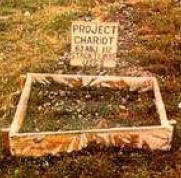
...One of the [Project Chariot]
studies performed was called the "tracer experiment" in
which radioactive materials from a Nevada test site were
applied to small plots in the Ogotoruk Creek basin. These
plots were then spinkled with water and the resulting runoff
was analyzed to determine the dispersion of the radioactive
material throughout the area. At the conclusion of the
experiment, the soil at the test plots was dug up and buried
in a single mound near the junction of Snowbank and Ogotoruk
Creeks.
The site was used by the Department of the Navy as a
logistical support base for the Naval Arctic Research
Laboratory from 1965 to 1970. In 1980, the area became part
of the Chukchi Sea Unit of the Alaska Maritime National
Wildlife Refuge and is now known as the Cape Thompson
Subunit.
In August of 1992, Dan O'Neill, a University of
Alaska-Fairbanks researcher, obtained recently declassified
documents and letters describing the burial of soil
contaminated with radioactive materials. Following this
public disclosure, the former AEC, now the Department of
Energy, assumed responsibility for the cleanup of this
contaminated soil.
The process was completed in 1994.
Douglas L. Vandegraft
U.S. Fish and Wildlife Service
Part Two of this case study addresses
the results of a 1990s investigation of contaminated radioactive
soil left at the Chariot site thirty years previously.
The
'postscript' describes a serious violation of medical ethics
occurring in the late 1950s, when the Inupiat and other Alaskan
Natives were injected with radioactive Iodine 131 without their
knowledge of the possible risks involved.
This experiment was undertaken as part
of a U.S. military research project to determine whether soldiers
"could be better conditioned to fight in cold conditions."
We, the Inupiat of Point Hope, have the ability to face the arrogant
policies of the former Atomic Energy Commission and its Project
Chariot.
We will not be willing victims for the genocidal and
inhuman policies of the Nuclear Energy Commission.
Press Release
Village of Point Hope
Alaska, October 17, 1992
By now most are aware of Project Chariot, a project dating from
the 1950s that envisioned the use of nuclear detonations to
build a harbor at Cape Thompson, Alaska. This was part of the
old Plowshare or "Atoms for Peace" program. Although the nuclear
detonations were never carried out, 26 millicuries of
radioactive tracers left over from ecological experiments were
deposed of at the site. When news of these disposed radioactive
tracers broke, the headlines told of a nuclear waste "dump." The
worst fea rs of the local people living near Cape Thompson were
awakened....
The Project Chariot episode, while apparently not a serious
human or environmental threat, is a case study that we can learn
from: It demonstrates the need to be completely truthful with
the public. It provides a preview of the public reaction we may
face as new sources of Arctic contamination are uncovered."
U.S. Senator Frank H. Murkowski
speaking at the Workshop on
Arctic Contamination, Anchorage, Alaska, May 3, 1993.
The Legacy of Project Chariot
After the Atomic Energy Commission [AEC] was dissuaded from
exploding their thermonuclear bombs at Ogotoruk Valley in 1962, AEC
scientists decided to bring fresh radioactive fallout to Alaska
drawn from an earlier thermonuclear explosion at the large Nevada
test site.
In August of 1962 approximately 26 milliCuries (mCi) of
isotopes and mixed fission products were transported to the Chariot
location and buried.
As later reported by Douglas Vandegraft
(1993) of the U.S. Fish & Wildlife Service, this included a maximum
of: 10 mCi of mixed fission products, 6 mCi of Cesium 137, 5 mCi of
Iodine 131, and 5 mCi of Strontium 185. All together, this
represented 17.5 pounds of sediment, sand, and dust along with small
"segregated quantities" of Iodine 131, Strontium 85, and Cesium
137, mixed with sand.
The experiment was basically designed to determine "the dispersal,
in an hydrologic environment, of radioactive products from a buried
nuclear explosive." In so doing, it would answer a question the AEC
had earlier posed to the United States Geological Survey (USGS):
Would the bombs contaminate local drinking water?
The response of
the USGS was that,
"under some situations, effects... could be
substantial and a serious handicap to Man's activities."
After these
amounts of radioactive fallout were placed in measured plots of
ground at Ogotoruk Valley, the ground was watered to simulate
rainfall.
In his report on the Project Chariot, Douglas Vandegraft (1993)
stated that,
"The scientists had used Iodine 131,
Strontium 85, and Cesium 137 which were not permitted according
to the USGS license, and the quantities of radioactive isotopes
buried in the mound were larger than permitted -perhaps as much
as 1,000 times more strontium and cesium as allowed by federal
regulations. Also, the BLM permit to the AEC did not allow the
use of radioactive materials."
When questioned about this, Arthur
Baker, acting Director of the USGS in Washington, D.C., responded
that the radioactive material had been dispersed to harmless
background levels, and,
"the extreme cold coupled with the
permafrost in the area causes disturbed ground to freeze solid
early in the winter and to remain frozen...It is our opinion
that...this material does not constitute a hazard."
In 1992, Dan O'Neill, a researcher at
the University of Alaska, learned about this burial from recently
declassified Department of Energy documents.
Shortly thereafter, the
burial mound was excavated. At the two foot level, radiation
counters detected low levels of radiation. At this point, Inupiat
leaders from Point Hope and the North Slope Borough demanded
immediate action to remove radioactive materials from the site.
Native residents of Point Hope were particularly angry - in part
because that village had experienced a high rate of cancer related
deaths in the past 30 years. Further studies undertaken by the
federal and state governments concluded that no hazard existed.
However, if the Natives of Arctic Alaska insisted, all radioactive
material would be removed.
Jessie Kaleak, mayor of the North Slope Borough, responded:
"We Alaskans believe this action is
the very least the government can do. [However] The plan doesn't
address health issues and the monitoring of our oceans and land
and marine animals. That is something we pushed for and we are
not going to give up on it."
Shortly thereafter, at a considerable
expense, all the radioactive components were removed from the buried
site.
The health and monitoring of oceans, land, and marine animals
issues raised by Mayor Kaleak have yet to be thoroughly addressed.
Return to Contents
Why no tsunami
warning?
Friday, January 07, 2005
from
http://xymphora.blogspot.com/2005/01/why-no-tsunami-warning.html
From
an article debunking the crazy
tsunami theories found on the internet:
"The Free Internet Press, which
claims to offer 'uncensored news for real people', has an
article saying the US military and the US State Department
received advanced warning of the tsunami, but did little to warn
Asian countries.
America's Navy base on the Indian Ocean jungle atoll of Diego
Garcia was notified and escaped unscathed, it said, asking 'why
were fishermen in India, Sri Lanka and Thailand not provided
with the same warnings?'.
'Why did the US State Department remain mum on the existence of
an impending catastrophe?,' author Michel Chossudovsky pondered.
'Probably because fishermen in India, Sri Lanka and Thailand
don't have multimillion dollar communications equipment handy,'
one respondent said as readers posted angry replies."
Ah, but of course they do. Fishermen
have cell phones, which gives them access to multimillion dollar
communications networks.
The cellphone penetration throughout the
whole area of the disaster was such that if SMS messaging had been
used to give a warning, tens of thousands of lives might have been
spared. The U. S. had enough time to notify its naval base on Diego
Garcia.
Why did it not make even the slightest
attempt to notify anyone else? Even a partly successful attempt
would have saved many lives, particularly in coastal cities and
resorts.
The advantages of the tsunami to the
United States:
-
it further weakens the 'Asian
tigers', countries whose success was an embarrassment to the
American rapacious model of world development;
-
it provides lots of
opportunities for friends of the Bush Administration to
enrich themselves in lucrative 'emergency' supply contracts
for the rescue mission;
-
it gives American ships an
excuse to be in places they would not otherwise have an
excuse to be, and plenty of opportunity to unload whatever
cargo they might later find useful around the Indian Ocean;
-
it provides the chance for an
ostentatious show of American goodwill which can be used in
the propaganda campaign to restore the image of the United
States in the world.
Return to Contents
Conspiracy theorists
come out
http://www.cdnn.info/news/industry/i050105.html
JUST 11 days after Asia's
tsunami catastrophe, conspiracy theorists are out in force, accusing
governments of a cover-up, blaming the military for testing
top-secret eco-weapons or aliens trying to correct the Earth's
"wobbly" rotation.
In bars and Internet chat rooms around the world questions are being
asked, with knowing nods and winks, about who caused the undersea
earthquake off Sumatra on December 26, and why governments did not
act in the minutes and hours before tsunamis slammed into their
shores, killing almost 150,000.
"There's a lot more to this. Why is
the US sending a warship? Why is a senior commander who was in
Iraq going there?" whispered designer Mark Tyler, drinking a
pint of beer at a bar in Hong Kong's Wan Chai district.
"This happened exactly a year after Bam," said Tyler, referring
to the earthquake in Iran which killed 30,000 on December 26
last year. "Is that a coincidence? And there was no previous
seismic activity recorded in Sumatra before the quake, which is
very strange," he said, nodding somberly.
After every globally shocking event –
from the bombing of Pearl Harbour to the assassination of John F
Kennedy, the death of Princess Diana and the September 11, 2001
terrorist attacks in the United States – conspiracy theorists emerge
with their own sinister take on events.
This time the Indian and US military are in the frame, while the
governments of countries from Australia to Thailand stand accused of
deliberately failing to act on warnings of the impending earthquake
or the tsunamis it unleashed around Asia.
Among the more common suggestions is that eco-weapons, which can
trigger earthquakes and volcanoes remotely through the use of
electromagnetic waves, were being tested. More outlandish theories
include one that aliens caused the earthquake to try and correct the
"wobbly rotation of the Earth".
Scientists give such theories short shrift.
"This was a natural disaster," said
Dr Bart Bautisda, chief science research specialist at
Philippine Institute of Volcanology and Seismology, debunking
the idea that an "ecoweapon" could be used to cause an
earthquake or such large-scale tsunamis.
"You would need a very huge amount of energy. It's impossible. A
billion tonnes could not do it," Dr Bautisda said.
He said wave activity might be able to
be triggered very close to the scene of a giant explosion, but the
effect would be a tiny fraction of the tsunamis which travelled
thousands of kilometers at the speed of a jet after tectonic plates
shifted off Sumatra.
"It's possible to cause vibration,
but not sufficient to cause disruption," he said.
"We can tell the difference between an artificial explosion and
an earthquake. The mechanisms are different."
Scientific evidence, however, cuts
little ice with many conspiracy theorists.
The Internet – which has proved invaluable in dealing with the
disaster by aiding rescues, providing witness accounts from bloggers
and allowing grieving relatives to comfort each other through chat
rooms – is abuzz with more sinister explanations.
The Free Internet Press, which claims to offer "uncensored news for
real people", has an article saying the US military and the US State
Department received advanced warning of the tsunami, but did little
to warn Asian countries.
America's Navy base on the Indian Ocean jungle atoll of Diego Garcia
was notified and escaped unscathed, it said, asking,
"why were fishermen in India, Sri
Lanka and Thailand not provided with the same warnings?".
"Why did the US State Department remain mum on the existence of
an impending catastrophe?," author Michel Chossudovsky pondered.
"Probably because fishermen in India, Sri Lanka and Thailand
don't have multimillion dollar communications equipment handy,"
one respondent said as readers posted angry replies.
"Maybe rescuers will find Elvis and the gunman form the grassy
knoll," jibed another, referring to those who believe Elvis
Presley is still alive and that former US president Kennedy was
shot by someone other than Lee Harvey Oswald.
The India Daily's website joined the
conspiracy theorists noting, "it seems the whole world decided to
fail to do anything together at the same time. Are we missing
something?
"Can it be that all the government
agencies knew what was happening but were told not to do
anything? Who told them? Or is this just a tragic coincidence?"
wrote Sudhir Chadda, a correspondent.
"Recent alien contacts have been reported with the South Asian
Governments especially India. UFO sightings have been rampant
over the region affected," Chadda wrote.
"Some in Nicobar Island say that it was an experiment conducted
by the alien extraterrestrial entities to correct the wobbly
rotation of the earth. And some of the Indian scientists are
actually seeing that wobbly rotation of the earth has been
corrected since the massive underwater earthquake and tsunami."
In Hong Kong, Tyler laughed at the alien
idea, but remained convinced humans had a hand in this disaster.
"Wait and see. There will be a lot
more to come out," he said.
Return to Contents
Egyptian paper
- Israel-India nuke test caused tsunami
by Joseph Nasr
The Jerusalem Post
Monday January 17, 2005
http//www.jpost.com/servlet/Satellite?pagename=JPost/JPArticle/ShowFull&cid=1104981578311
The earthquake that struck the Indian Ocean on December 26,
triggering a series of huge waves called tsunami, "was possibly"
caused by an Indian nuclear experiment in which "Israeli and
American nuclear experts participated," an Egyptian weekly magazine
reported Thursday.
According to Al-Osboa', India, in its heated nuclear race with
Pakistan, has lately received sophisticated nuclear know-how from
the United States and Israel, both of which "showed readiness to
cooperate with India in experiments to exterminate humankind."
Since 1992, the magazine argued, leading geological centers in
Britain, Turkey and other countries, warned of the need "not to hold
nuclear experiments in the region of the Indian Ocean known as 'the
Fire Belt,' in which the epicenter of the earthquake lies.
Geologists labeled that region 'The Fire Belt' for being "a
dangerous terrain that can move at anytime, without human
intervention," Al-Osboa' wrote.
Despite warnings not to carry out nuclear experiments in and around
the 'Fire Belt',
"Israel and India continue to conduct nuclear tests
in the Indian Ocean, and the United States has recently decided to
carry out similar tests in the Australian deserts, which is included
in the 'Fire Belt', the Egyptian weekly magazine wrote.
"Last year only, Arab and Islamic
states have asked the United States to stop its nuclear
activities in that region, and to urge Israel and India to
follow suite," Al-Osboa' reported.
Although Al-Osboa' does not rule out the
possibility that the tsunami could have been caused by a natural
earthquake it speculates however that,
"while it has not been proved yet,
there has been a joint Israeli-Indian secret nuclear experiment
[conducted on December 26] that caused the earthquake."
The Egyptian weekly magazine concludes
in its report that,
"the exchange of nuclear experts
between Israel and India, and US pressure on Pakistan which is
exerted by supplying India with state-of-the-art nuclear
technology and preventing Islamabad from cooperating with Asian
and Islamic states in the nuclear field, pose a big question
mark on the causes behind the violent Asian earthquake."
Incitement against Israel and Jews in
Egyptian media is usually limited to the context of the
Israeli-Palestinian conflict yet exceptions are known to occur.
In August 2002, the Paris Supreme Court summoned Ibrahim Naafi',
editor of the Egyptian daily Al-Ahram, for having authorized the
publication of a controversial article entitled 'Jewish matza is
made from Arab blood' in the October 28, 2000 edition of the paper.
Naafi' was charged with incitement to anti-Semitism and racist
violence.
Return to Contents
US island base
given warning Bulletins sent to Diego Garcia 'could have saved
lives'
by Richard Norton-Taylor
The Guardian
January 7, 2005
http://globalresearch.ca/articles/NOR501A.html
A British-owned American base on an island in the Indian Ocean
received prior warning of the tsunami from the US, the Guardian has
established. Unlike countries devastated by the huge wave, the
military base on Diego Garcia was alerted by America's tsunami
warning centre on Hawaii in the Pacific .
The base -officially called the British Indian Ocean Territory and
described by the American military as the "best-kept secret in the
navy" -was warned because it is linked to the US Pacific Command,
according to American officials.
A spokesman for the Ministry of Defense in London insisted that
British military personnel on the island received "no advance
warning" of the tsunami. British forces were first alerted to the
earthquake via the internet, he added.
A spokesman for the US national weather service confirmed to the
Guardian that the Hawaii centre, part of America's National
Oceanic and Atmospheric Administration (NOAA) had alerted
the Diego Garcia base. He did not know if American military
personnel at the base alerted anyone else in the region to the
danger.
According to the base website:
"Personnel on board Naval Support
Facility Diego Garcia in the Indian Ocean are safe following the
earthquake and subsequent tsunami that had devastating effects
on south-east Asia. Facilities and operations were not
affected."
An NOAA log shows that the US Pacific
Command, including Diego Garcia, was given a specific warning about
the tsunami some two and three quarter hours after the earthquake.
This was shortly after the tsunami had struck Sri Lanka and well
after it hit Indonesia and Thailand. It gave Diego Garcia advance
warning of about an hour.
But, ironically, the one community which received a warning did not
need it. As the base website put it:
"Favorable ocean topography
minimized the tsunami's impact" on the Chagos archipelago of
which Diego Garcia is a part.
The atoll is just to the west of one of
the deepest parts of the Indian Ocean.
Professor Michel Chossudovsky of Ottawa University said the
argument put forward by other experts that countries hit by the
tsunami could not have been warned of the approaching waves because
they had no sensors or special buoys in the Indian Ocean was a "red
herring".
Prof Chossudovsky, who helps run the Centre for Research on
Globalization , added:
"We are not dealing with information
based on ocean sensors. The emergency warning was transmitted in
the immediate wake of the earthquake based on seismic data."
With modern communications,
"the information of an impending
disaster could have been sent round the world in a matter of
minutes, by email, by telephone, by fax, not to mention by
satellite television", he said.
He said the US military had advanced
systems "which enables it to monitor in a very precise way the
movement of the seismic wave in real time".
Related articles:
Foreknowledge of a Natural Disaster -
Washington was aware that a deadly Tidal Wave was building up in the
Indian Ocean
Return to Contents
|