|
12.- TESLA -
THE FORGOTTEN GENIUS
Some day I will harness Niagara Falls. — Tesla THIS WAS THE STATEMENT
MADE BY THE greatest electrical genius that ever lived, to one of
his fellow students, in Budapest, in 1882.
Nikola Tesla, born 9 July
1856, was then aged twenty-five and about to commence a lifetime
career in the advancement of electrical knowledge which was to
transform the world.
If it were not for this one man, almost all
modern-day electrical devices would not exist. It therefore seems
strange that Tesla’s name is known to so very few students in our
universities. Many times I have mentioned Tesla to groups of
students, during discussions, and have been met with a blank stare,
and the question — “Who is Tesla?”
His birthplace was a small village called Smiijan in the country now
called Yugoslavia. His father was a minister in the local church.
His mother was illiterate, but was known in the village as one who
had a clever and inventive mind. It is said that she invented a
considerable number of labor saving devices, which could be used in
the home. In later years Tesla stated that he inherited his
inventive genius from his mother.
In one stupendous lifetime he gave us the whole foundation upon
which to build the industrial empires of the world. It was he who
invented the alternating-current motors that power every factory and
production centre. He that designed the transmission systems that
enabled power to be sent out over vast areas of countryside from a
central generating source; the mass production systems and robot
control that freed man from the slavery of labor; the basis for
radio and radar, and remote control by wireless; modern lighting
systems by use of high-frequency currents. The list is endless. No
limit has been found to the electronic marvels which can be produced
from the basic discoveries which issued from this one fertile mind.
The whole world owes Tesla its future — and he has been forgotten,
because he was a man who lived before his time.
Tesla was one of five children and even at an early age showed signs
of a lively mind. He found that in many things he could surpass
other boys of his own age, and this tended to isolate him from his
contemporaries. He found it hard to find others to share in his
interests and his intellectual attainments were often in advance of
his years. Nevertheless, it seems that he still got up to all the
other foolish escapades that young boys find to fill in their time -
myself included.
One of the more dangerous ones was trying to emulate a bird. He
discovered that when he breathed deeply he began to feel very light
and buoyant. He considered that this discovery, plus the application
of daring and an old umbrella, should suffice to free him from the
pull of gravity and allow him to sail through the air with a certain
amount of grace and dignity. He climbed up on the roof of a local
barn with the trusty old umbrella, breathed a few deep breaths and
jumped off into space. The umbrella, not being aerodynamically
designed, folded inside out and Tesla carried out a very undignified
plummet to the ground. This cost him six weeks in bed, and much
embarrassment.
His next accomplishment was the invention of a special frog-catching
hook which was immediately copied by all his friends and helped to
ensure the demise of most of the frogs in the village pond. Then
followed a series of gadgets attractive to small boys, which
included very efficient blowguns and popguns the size of small
howitzers. Damage to local property caused the sudden end to the
production of such warlike weapons, and punishment administered to
the end of Tesla.
At the advanced age of nine years he
con-structured his first motor. The prime mover of this wondrous
machine was a formation of sixteen may-bugs. I suppose in a way they
could have been termed galley bugs, as they had to perform in much
the same way as the galley slaves of old to produce forward movement
to the parts of Tesla’s machine. The design was quite ingenious. He
glued two long thin bits of wood together to form a cross, much like
the arms of a windmill. Another thin spindle was attached to this
with a very small pulley glued to it.
This was connected by a belt made from
cotton to a larger pulley on another thin spindle. The engines (or
maybugs) were then glued four abreast, facing forward, on each of
the four arms. The poor bugs, no doubt dismayed at such cavalier
treatment, beat their wings at panic speed and turned the windmill
at a surprising rate. It was Tesla’s intention to add more bugs, and
thus more power to this truly remarkable machine, but a young friend
decided to eat his jarful of spare bugs. This nearly caused Tesla to
throw up, and he ended up destroying his invention in disgust.
The first stage of his schooling ended in 1870, when he was
fourteen. The college he attended was called the Real Gymnasium, at
Gospic. Already he was showing that he was well above the average in
his abilities. He continued his studies at the higher Real
Gymnasium, completing the full four-year course in three years. It
was at this time that he became fascinated with physics and
electrical experimentation and made the decision to devote his life
to electricity. His father was anxious for him to enter the ministry
and make a career of the church, but finally relented and promised
Nicola that he would not prevent him from having his wish.
The boy had overworked himself so much
with his studies that he had weakened his body and been attacked,
first by malaria then a severe bout of cholera. When nearly at
death’s door he whispered to his father, “I will get well again if
you will let me study electrical engineering.” He was promised by
his father that he would attend the most advanced engineering school
in the world. Tesla was nineteen when he began his studies in
electrical engineering at the Polytechnic Institute at Gratz,
Austria.
It was at the Institute that particular insights into the mysteries
of electricity by Tesla first began to show themselves. A Professor
Poeschl was demonstrating a gramme machine that could be used as
either a dynamo or a motor. It was run by direct current and
suffered a great loss of efficiency due to sparking at the commutator. (The
commutator was necessary in all direct current
machines to change the flow of electricity at the correct instant to
obtain rotary motion.)
An argument developed between the
professor and Tesla as to the design of the machine and the
necessity to use direct current. Why cannot alternating current be
used, suggested Tesla? This would eliminate the need for commutators
and thus increase efficiency. The alternating current produced by
the dynamos could be fed direct to the motors without the use of the
reversing mechanisms.
The professor set up a special set of experiments to prove to Tesla
that his idea was completely impractical and made the statement:
“Mr. Tesla will accomplish great things, but he certainly will never
do this. It would be equivalent to converting a steady pulling force
like gravity into rotary effort. It is a perpetual motion scheme, an
impossible idea.”
Tesla had no answer to this at the time, but instinct told him he
was right and that some day in the future he would create such a
machine. He continued his studies at the University of Prague
concentrating on mathematics and physics. Always in the back of his
mind was the idea of the alternating-current motor, and in his
imagination he contemplated many different methods of building such
a device, each time to fail.
On leaving the university Tesla obtained a position with the central
telegraph office in Budapest. His genius for invention was not long
in being noticed and in 1881 he was placed in charge of the new
telephone exchange. It was while working for this company that he
had the first flash of inspiration that was to rocket him to
short-lived fame.
He was walking with a friend late in the afternoon in the city park
of Budapest. It was February 1882, and a glorious day. Tesla was in
a particularly happy frame of mind and gave vent to his joy by
prancing about, and reciting poetry. Suddenly, he stopped in his
tracks and exclaimed, “Watch me! Watch me reverse it.” He appeared
to be in some kind of a trance and his friend got quite alarmed at
his antics, believing him to be ill. When Tesla finally calmed down
he said, “No, you do not understand. I have solved the problem of my
alternating-current motor.” He then explained how he could see the
whole concept in front of him, as if in a vision.
A rotating
magnetic field which would clutch the armature of a motor with
invisible fingers and cause it to rotate in harmony with it. A
concept sublime in its simplicity. There and then, he drew a diagram
of his motor in the snow to show his friend the technical aspects of
his invention. This moment was the beginning of man’s leap forward
in the industrialization of the world. It was soon after this that
Tesla was offered a position with the Continental Edison Company and
spent much of his time improving the designs of the Edison
direct-current motors.
He also invented a system for automatically
regulating the dynamos. He had been promised a substantial fee for
all the new innovations he had produced for the company, and when
this was not forthcoming on demand, he immediately resigned. If the
payment had been made at the time, Tesla would possibly have
remained with the company and they would have benefited immensely
from his genius.
It was suggested by a member of the company that Tesla should
emigrate to the United States and work with Edison himself. There
were not many opportunities left open to him in Europe, so in 1884
the young Tesla arrived in New York with four cents in his pocket
and a mind bursting with new ideas. At this stage he had already
worked out the whole alternating-current electrical system in his
mind. This included step-up and step-down transformers for the most
economical transmission of electric power, alternators, and
alternating-current motors to supply mechanical power.
When he
finally met the famous Edison, he gave him an enthusiastic
description of his alternating current system, only to be told that
he was “wasting his time messing around with such things. Edison was
committed to the direct-current system and would not be swayed by
the arguments put forth by Tesla. The whole of the Edison empire was
built on the premise that direct current was superior to alternating
current.
He spent almost a year working for Edison, again improving and
inventing new techniques for the production of the Edison dynamos
Promises had been made to him, for the second time to repay him
adequately for his services. It is said that Edison had undertaken
to pay $50,000 to Tesla when all the improvements were completed and
the machines ready for production. When the time came for
settlement, Edison treated the whole thing as a joke, so the
disillusioned Tesla once again resigned.
It was now 1885. The fortune he was seeking in the promised land was
not to come easily. He spent a year taking any menial job he could
find just to keep himself alive. At one stage he even resorted to
digging ditches. The foreman on the ditch-digging project was
fascinated by the visionary descriptions of the new electrical
innovations that Tesla related to him, and introduced him to as
executive of the company named A. K. Brown. This man had enough
faith to finance an experimental laboratory at 33-35 South Fifth
Avenue, New York.
Tesla set to work and in a short time had a complete demonstration
of his system ready for assessment. Included were alternating
current generators, motors, transformers, transmission lines and
lights. After examination by Professor W. A. Anthony of Cornell
University, it was announced that the Tesla system was equal is
efficiency to any of the best direct-current machines then in
production. In 1887 Tesla applied for full patent rights for all of
his electrical inventions. This was not approved by the patent
office as the considered a single patent to cover such a great array
of ideas was too unwieldy. They insisted that each important section
be covered by a separate patent. Within the next six months seven
USA patents were granted, and in 1888 twenty-two more were to
follow.
The Institute of Electrical Engineers were now aware of this genius
among them and invited Tesla to give a demonstration lecture on his
alternating-current system in New York. This was a tremendous
success. It was now recognized by the engineers of the world that
there need be no limit to the transmission of power over long
distances. The way was now open to develop the whole industry beyond
men’s wildest dreams.
Tesla was thirty-two when he was approached by George Westinghouse,
who offered him one million dollars for all his alternating current
patents, plus certain royalties. Tesla agreed, on the proviso that
the royalty was to be one dollar per horsepower. Although this
royalty was later withdrawn because of financial difficulties in the
Westinghouse empire, a bond of mutual trust remained between these
two great men for the rest of their lives. Tesla, at last, was being
given the credit he deserved. America was his to conquer.
The
General Electric Company, founded by the Edison interests, saw the
writing on the wall and for their very survival had to negotiate a
license from Westinghouse to compete in the rapidly expanding
electrical industry being built on the concepts of alternating
current. No future remained for those who thought in terms of direct
current only.
In 1890 the scientist Lord Kelvin was appointed chairman of the
International Niagara Commission set up to determine the most
efficient way of using the force of Niagara Falls to generate
electricity. In 1892 Westinghouse won the contract for the
Installation of the 5000-horsepower hydro-electric generators. The
transmission system was contracted to the General Electric Company.
The whole complex was designed according to the ideas of Tesla. The
massive alternators with external revolving fields and internal
stationary armatures were personally designed by him; the
transmission line including the step-up and step-down transformers
was constructed to Tesla’s two-phase concept. His childhood dream
had been fulfilled — he had harnessed the power of Niagara Falls.
Now in his early thirties Tesla was a wealthy man and felt free
he devote more of his time to pure research. Throughout his life he
give no indication of any type of business sense. The mere making
of money was never a primary object with him, and as long as he
had the necessary funds to buy all the equipment he needed for his
experiments he was happy. His whole makeup was that of the
discoverer.
He was at one with the environment itself and had a
compelling, restless urge to pry all the secrets from nature and
harness them, in order to help his fellow man progress towards
higher level of being. He had a vision of the cosmos as consisting
of myriad octaves of electrical vibration. It was his desire to be
able to understand the interplay of harmonic oscillations that
formed the basis of the universe. The lower octaves he had already
explored with his 60 cycle per second alternating current. He was
now read to reach into the unknown and probe into the regions of
ultra high frequency of light and beyond.
For these experiments he constructed a great range of electrical
oscillators to produce high-frequency currents, and coils tuned to
set frequencies or wavelengths in order to discover the
characteristic of each energy level and the particular uses to which
each could be applied. He found that the interlocking harmonics were
similar to the musical scale and that his coils responded not only
to the transmissions of the original waveforms, but resonated at
harmonic intervals above and below the original frequency. He had
discovered the harmonic nature of matter.
He felt ready to take the next step in the practical application of
his theoretical discoveries. During an interview in 1894 he said:
You will think me a dreamer and very far gone if I should tell you
what I really hope for. But I can tell you that I look forward with
absolute confidence to sending messages through the earth without
any wires. I have also great hopes of transmitting electrical force
in the same way without waste. Concerning the transmission of
messages through the earth I have no hesitation in predicting
success: I must first ascertain exactly how many vibrations to the
second are caused by disturbing the mass of electricity which the
earth contains. My machine for transmitting must vibrate as often to
put itself in accord with the electricity in the earth.
He had previously addressed a meeting of the National Electric Light
Association and had said, in part:
I am becoming more and more convinced of the scheme,
and though I know full well that the great majority of
scientific men will not believe that such results can be
practically and immediately realized, yet I think that all
consider the developments in recent years by a number of workers to
have been such as to encourage thought and experiment in
this direction. My conviction has grown so strong that I no longer
look upon the plan of energy or intelligence transmission as a mere
theoretical possibility, but as a serious problem to electrical
engineering, which must be carried out some day...
We now know that electrical vibrations may be transmitted through a
single conductor. Why then not try to avail ourselves of the earth
for this purpose? We need not be frightened of the idea of distance.
To the weary wanderer counting the mile posts, the earth may appear
very large; but to the happiest of all men, the astronomer, who
gazes at the heavens, and by their standards judges the magnitude of
our globe, it appears very small.
And so I think it must seem to the
electrician; for when he considers the speed with which an
electrical disturbance is propagated through the earth, all his
ideas of distance must completely vanish. A point of great
importance would be first to know what is the capacity of the earth,
and what charge does it contain if electrified. Though we have no
evidence of a charged body existing in space without other
oppositely electrified bodies being near, there is a fair
probability that the earth is such a body, for whatever process it
was separated — and this is the accepted view of its origin — it
must have retained a charge, as occurs in all processes of
mechanical separation.
If we can ever ascertain at what period the
earth’s charge, when disturbed, oscillates, with respect to an
oppositely charged system, or known circuit, we shall know a fact
possible of the greatest importance to the welfare of the human
race. I propose to seek the period by means of an electrical
oscillator, or a source of alternating currents.
One of the terminals of this source would be connected to
the earth, as, for instance, the city water mains, the other
to an insulated body of large surface. It is possible that the
outer conducting air strata, or free space, contain an opposite
charge, and that, together with the earth, they form a
condenser of large capacity. In such case the period of
vibration may be very low and an alternating dynamo machine might serve for the purpose of the experiment. I
would then transform the current to a potential as high as
it would be found possible, and connect the ends of the high
tension secondary coil to the ground and to the insulated body.
By
varying the frequency of the currents and carefully observing the
potential of the insulated body, and watching for the disturbance at
various neighboring points of the earth’s surface, resonance might
be detected. For the experiments,
Tesla chose a site on the
outskirts of the town of Colorado Springs, Colorado. To the present
day it has been thought that he selected this particular area just
out of pure convenience. It was said that he was attracted by the
dryness of the air which made it an excellent position for
electrical experiment (violent electrical storms were common in the
mountainous terrain around Colorado Springs and nearby Pikes Peak).
But I believe this was not his prime reason, as will be
demonstrated. A large barn-shaped structure was built on the site to
Tesla’s specifications. It was just on 100 feet square, with sides
twenty-five feet high. The roof then sloped upward to a high peak in
the centre A pyramid-shaped tower extended upward from the centre
peak for a height of about eighty feet through which a mast was
supported reaching to a height of around 200 feet. On top of the
mast was a copper ball three feet in diameter. A heavy duty wire was
run from this copper ball down the mast, then connected to the large
secondary coil of the electrical apparatus in the shed.
Power,
which was supplied by a generator from the Colorado Springs Electric
Power Company a few miles away, was fed into transformer system and
stepped up to around 30,000 volts. This was then fed into a
condenser. When the condenser reached capacity it discharged into a
coil. This provided a continually oscillating high-frequency
current. The primary coil was constructed of heavy wire on a
circular fence like arrangement about seventy-five feet in diameter.
At the centre, the secondary coil, about ten feet in diameter, was
wound with approximately seventy-five turns on a frame ten feet
high. This inner coil was attached to a copper plate buried deep in
the ground at one end and the other end connected to the copper ball
at the top of the mast. The two coils were tuned perfectly with each
other and created electrical resonances in the order of 100 million
volts.
The whole system acted as a gigantic electrical pump, and
enabled Tesla to cause massive discharges of energy to oscillate
between the earth and the surrounding atmosphere. During his
experiments
with this fantastic piece of equipment he caused huge
bolts of lightning to issue forth from the copper ball into the air,
and manmade thunder to scare the living daylights out of the
populace for miles around. He finally succeeded in burning out the
generating plant at Colorado Springs due to the electrical overload
placed upon it. This did not, of course, make him too popular with
the local council, and he had to carry out extensive repairs to the
plant before he was able to continue with his work.
He discovered that a rate of 150,000 oscillations a second, which
produced electrical pulsations with a wavelength of 2000 meters, was
necessary to produce the effects he required in the transmission of
usable power through the earth.
If we convert the wavelength of 2000 meters to a minute of arc, or
nautical mile equivalent on the earth’s surface the result is
1.0792237. The experimental value was therefore very close to 1.08
minutes of arc, or one twenty thousandth of the circumference of the
earth. 21600 minutes divided by 1.08.
The exact number of cycles to obtain a 1.08 minute wavelength would
be 149892.18 per second. This would tune the transmitter in harmony
with the world grid system.
In the early stages of my work I wondered why I could not obtain
pure harmonics from all my calculations when dealing with physical
substance — that is, exactly 144 for the light harmonic etc. Tesla
stated that it was not possible to obtain pure resonance or harmonic
vibrations, because if this were so then matter itself would
disintegrate. A certain amount of resistance must be allowed for to
prevent complete destruction of physical substance. He tested his
theory of power transmission by lighting 200 incandescent lamps at a
distance of twenty-six miles from the laboratory while the giant
oscillator was operating — the energy being extracted directly from
the earth. Each lamp required about 50 watts of power — a total of
13hp. The claimed efficiency was 95 percent.
The Century Magazine ran an article in the June edition of 1900
stating comments made by Tesla regarding his Colorado experiments:
“However extraordinary the results shown may appear, they
are but trifling compared with those obtainable by apparatus
designed on these same principles. I have produced electrical discharges the actual path of which, from end to end, was probably
more than 100 feet long; but it would not be difficult to reach
lengths
100 times as great. I have produced electrical movements occurring
at the rate of approximately 100,000 horsepower, but rates of one,
five or ten million horsepower are easily practicable. In these
experiments, effects were developed incomparably greater than ever
produced by any human agencies and yet these results are but an
embryo of what is to be.”
Tesla now had all the information he required to set up a station to
transmit power to any point in the world, but before we move on to
discuss his later activities let us have a closer look at the site
he chose in Colorado where he tested all his theories and found
positive proof of the harmonic structure of nature. In one of his
unpublished articles he had stated in part that:
“Long ago he (man) recognized that all perceptible matter comes from a primary
substance, of a tenuity beyond conception, filling all space, the
Akasha or Luminiferous Ether, which is acted upon by the life-giving
prana or creative force, calling into existence, in never-ending
cycles, all things and phenomena. THE PRIMARY SUBSTANCE, THROWN
INTO INFINITESIMAL WHIRLS OF PRODIGIOUS VELOCITY, BECOMES GROSS MATTER;
THE FORCE SUBSIDING. THE MOTION CEASES AND MATTER DISAPPEARS,
REVERTING TO THE PRIMARY SUBSTANCE.”
His experiments had shown him (as I had found in my own bumbling
way) that matter was nothing more than a complex matrix of
wave-forms locked together by harmonic resonance. The energy
inherent in matter could be tapped if the secret of the geometric
structure of the wave-forms could be broken. It appears that, by
calculation, he had found that to tune in, so to speak, to this
energy ball we call earth, he had to set up his apparatus on a
particular point on its surface to ensure that the waves he proposed
to transmit were in step with the natural medium.
Colorado Springs
was one of the ideal positions which was accessible to him. The
position of Colorado Springs is given as 38 degrees 50 minutes North
latitude and 104 degrees 50 minutes West longitude. Calculations
which have been carried out recently for this arcs show that a
theoretical position of 38° 49’ 31.629” North latitude and 104° 52’
22” West longitude would be the ideal position to set up a Tesla
type experiment.
The exact positions where Tesla built his transmitter is unknown to
me, but I believe it was not too far from the theoretical one.
During my years of research I have discovered that some of the
scientific establishments have been positioned in such a way that
the latitude value sets up a harmonic due to the relative distance
from the Equator and the North or South Pole. Also I have found
that there are harmonic intervals above and below the normal units
of degrees, minutes and seconds in circular measure. Division or
multiplication is carried out by the harmonic value of 6.
So: for the theoretical latitude position we have:
Distance to the North Pole = 51.174548 degrees
Distance from the equator = 38.825453 degrees
Difference = 12.349095 degrees
Divided by 6 = 2.0581825 units
Multiplied by 2 = 4.116365 units
Squared = 16.9444 units
The harmonic 169444 is related to MASS, GRAVITY and COMMUNICATION
and is demonstrated many times in my later works. The method of
calculation also follows a regular pattern. The great circle
displacement between longitude 104° 52’ 22” west and 90° 00’ 00”
west, at the same latitude, also sets up an important harmonic. The
value: 694.44 minutes of arc. This is the reciprocal harmonic of the
Grid speed of light, 144000 minutes of arc per Grid second, in free
space.
Tesla must have been well aware of the importance of the position he
chose, but kept the reasons a closely guarded secret. It is
interesting to note that in this same area the military have chosen
to set up the greatest electrical complex in the world — the North
American Defense Command, NORAD. I am not telling tales out of
school here because other publications have already pointed this
fact out.
The caption on a photo of the command post, in publication
which I have, free to any of the public who wish to buy one, states:
“The main battle staff position in the
combat operations centre (COC)
at headquarters North American Defense Command (NORAD), Colorado
Springs, Colorado, fronts a display area which allows observers to
see the positions of airborne objects thousands of miles away. NORAD
(COC) is hooked to all of NORAD’s subordinate units and to every
major command post on the continent. I am sure the Russians are also
fully aware of the significance of this position and that they have
similar military command posts set up on the Russian continent, so I
am not releasing anything that could in the remotest sense be termed
a military secret. From a public point of view though, one of the
reasons becomes clear why the work and discoveries of Tesla remain
suppressed: the military application of his discoveries has been
considered far more important ant than the welfare of the ordinary
citizen of the world.
Tesla was now ready to build his world power system. With a cash
grant of $150,000 donated by the banker J.P. Morgan he was able to
commence construction of his world wireless power and broadcasting
station.
The site he picked for this station was to be on a tract of land
owned by James S. Warden, a lawyer and banker. This was at Shoreham,
in Suffolk County, Long Island. Tesla’s idea was to create a radio
city from which information would be broadcast on all wavelengths. I
find once more that far better than my own inadequate description of
the system, the reported words of Tesla himself give more of an idea
of the magnitude of the enterprise:
The world system has resulted from a combination of several original
discoveries made by the inventor in the course of long continued
research and experimentation. It makes possible not only the
instantaneous and precise wireless transmission of any kind of
signals, messages or characters to all parts of the world, but also
the interconnection of the existing telegraph, telephone and other
signal stations without any change in their present equipment.
By
its means for instance, a telephone subscriber here may call up any
other subscriber on the globe. An inexpensive receiver, not bigger
than a watch, will enable him to listen anywhere on land or sea to a
speech delivered, or music played, in some other place, however
distant. These examples are cited merely to give an idea of the possibilities of this great scientific advance, which annihilates
distance and makes that perfect conductor, the earth, available for
all the innumerable purposes which human ingenuity has found for a
line wire.
One far-reaching result of this is that any device
capable of being operated through one or more wires (at a distance
obviously restricted) can like wise be activated, without artificial
conductors, and with the same facility and accuracy, at distances to
which there are no limits other than those imposed by the physical
dimensions of the globe. Thus, not only will entirely new fields for
commercial exploitation be opened up by this ideal method of
transmission, but the old ones vastly extended.
The world system is based on the application of the following
important inventions and discoveries.
-
The Tesla Transformer: This apparatus is in the production of
electrical vibrations, as revolutionary as gunpowder was in
war-fare. Currents many times stronger than any ever generated in
the usual ways, and sparks over 100 feet long, have been produced by
the inventor with an instrument of this kind.
-
The Magnifying
Transmitter: This is Tesla’s best invention — a peculiar transformer
specially adapted to excite the earth, which is, in the transmission
of electrical energy, what the telescope is in astronomical
observation. By the use of this marvelous device he has already set
up electrical movements of greater intensity than those of
lightning, and passed a current sufficient to light more than 200
incandescent lamps around the globe.
-
The Tesla Wireless System: This system comprises a number of
improvements and is the only means known for transmit-ting,
economically, electrical energy to a distance without wires. Careful
test and measurements in connection with an experimental station of
great activity, erected by the inventor in Colorado, have
demonstrated that power in any desired amount can be conveyed clear
across the globe if necessary, with a loss not exceeding a few per
cent.
-
The Art of Individualization: This invention of Tesla, is to
primitive tuning what refined language is to inarticulated
expression. It makes possible the transmission of signals or
messages absolutely secret and exclusive both in active and passive
aspect, that is, non-interfering as well as non-interferable. Each
signal is like an individual of unmistakable identity and there is
virtually no limit to the number of stations or instruments that can
be simultaneously operated without the slightest mutual disturbance.
-
The Terrestrial Stationary Waves: This wonderful discovery,
popularly explained, means that the earth is responsive to
electrical vibrations of definite pitch, just as a tuning fork is to
certain waves of sound. These particular electrical vibrations,
capable of powerfully exciting the globe, lend themselves to
innumerable uses of great importance commercially and in many other
respects.
The first world system power plant can be put in operation in
nine months. With this power plant it will be practical to attain
electrical activities up to ten million horsepower and it is
designed to serve for as many technical achievements as are possible
without undue expense. Among these the following may be mentioned:
-
Interconnection of the existing telegraph exchanges or offices
all over the world.
-
Establishment of a secret and non-interferable Government
telegraph service.
-
Interconnection of all the present telephone exchanges or offices
all over the globe.
-
Universal distribution of general news, by telegraph or
telephone, in connection with the press.
-
The establishment of a world system of intelligence
transmission
for exclusive private use.
-
Interconnection and operation of all stock tickers of the world
-
Establishment of a world system of musical distribution, etc.
-
Universal registration of time by cheap clocks indicating the time
with astronomical precision and requiring no attention whatever.
-
Facsimile transmission of type or handwritten characters,
letters, cheques etc.
-
Establishment of a universal marine service enabling navigators
of all ships to steer perfectly without compass, to determine the
exact location, hour and speed, to prevent collisions and disasters
etc.
-
Inauguration of a system of world printing on land or sea
-
Reproduction anywhere in the world of photographic picture and all
kinds of drawings or records.
The complex that Tesla planned to build
on Long Island to bring all this to fruition was at that time like
something out of some science-fiction
drama. The tower for the transmitter was constructed on a wide
circular base from strong wooden beams, with all the necessary metal
fittings produced from copper. It tapered toward the top and rose to
a height of 154 feet. Surmounted upon this was a colossal
hemispherical structure to form the electrode.
The skeleton of this
was also formed from wood and was to be sheathed in copper. Not far
from the base of the tower was a large brick building designed to
house all the intricate machinery necessary to generate the massive
amount of power required to run the station. Most of the equipment
was of special design and Tesla had a great deal of trouble in
having some of it manufactured. By 1902 the tower and the control
building were completed.
Soon after this everything started to go wrong for Tesla. He had
trouble getting supplies of equipment he required and the financial
hackers, who up till then had been highly enthusiastic about the
project, withdrew their support. The whole project crashed. A plan
that Tesla had for creating a similar station at Niagara Falls for
Canadian interests was also abandoned. He never fully recovered from
this setback. He was never again to receive the money he needed to
carry out large-scale experiments.
The reasons for this were, and still are, veiled in mystery, and in
1943 he died alone, in a hotel room in New York, a poor and almost
forgotten man.
This small resume of the life of Nicola Tesla does not give anything
like the coverage of his achievement that it deserves. A large
volume would have to be written to do anything like justice to this
electrical genius who spent his life trying to give his fellow men a
basis for a new and wonderful world. Why was he stopped? Would the
dreams of a universal power system have allowed the poorer nations
to advance too quickly? Could it be that the large international
companies would have found it difficult to control such a system?
Many questions — but no answers. I only hope that the students of
the future will take time to study the works of Nicola Tesla and one
day endeavor to complete his dream. The reason for the location of
the transmitter of the world power system at Wardenclyffe, in the
Shoreham area of Long Island, would also have been because of the
geometries involved. If the station were to operate at maximum
efficiency, it had to be set up in a position that ensured the
propagation of the electromagnetic-wave-forms was in perfect harmony
with the atomic structure of the Earth. The electrons in every atom
of every element had to be resonated in order to transmit the energy
being imparted.
During the first world war the Wardencliffe Tower was dynamited for
some obscure reason, and most traces of Tesla’s activity in the area
completely obliterated.
At the time of writing the initial draft for this chapter I was
unable to find the exact location of the tower site, because of the
scanty records left behind for public viewing.
I did publish a theoretical position in my earlier works which
showed a series of harmonics but was never really satisfied with the
results. One of my readers in England decided to help me with the
problem and wrote to a friend of his who lives on Long Island
asking if it were possible to pin-point the site. He sent the
results of his query on to me and I quote a section of his letter:
“I mentioned to my friend that you were unable to locate the site of
Tesla’s Tower. Well this produced an unexpected reaction from my
friend because it is just around the corner from where she lives in
the grounds of the Peerless Company. In fact the road that runs on
the other side of the boundary fence, 50 yards from the octagonal
concrete base, is called Tesla Street.
Peerless replied that according to the
highways department
(presumably Suffolk County) the coordinates are as follows:
40° 56’ 50.3” north/ 72° 53’ 55.6” west.”
At last a position was available for study, although I have not been
able to check the accuracy. If any reader can supply more
information, I would be most grateful.
Computer calculations indicated that Tesla was in possession of
knowledge far in advance of his time. If the position of the
transmitter was near correct then the geometric placement was
directly related to the unified equations discovered in my work on
the world grid system.
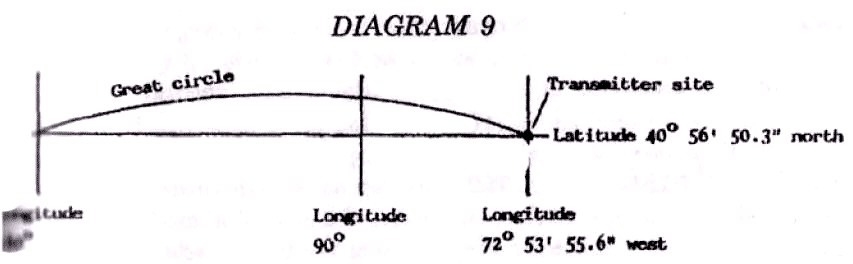
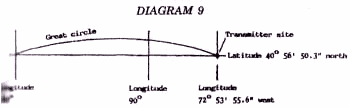
The great circle displacement from the transmitter to a point of
longitude 180° 00’ 00” at the same latitude, was:
269375.57 seconds of arc.
This was extremely close to the energy harmonic derived from the
unified equation in relation to the speed of light at the Earth’s
surface, found in my latest research.
269364.5 harmonic.
The difference of around eleven seconds of arc would give as error
of about 800 feet, which is not too bad for normal map reference.
See Diagram.
The longitudinal placement indicated that Tesla had chose a position
harmonically tuned to the reciprocal of the Greenwich meridian.
An article published in the “Arizona Republic” on Sunday, September
2, 1984, regarding Tesla’s experiments, contained some interesting
information, which showed a relationship with grid harmonics.
Quote:
With a pocket sized vibrator, he
told reporters, he could generate resonant tremors that could
split the Earth in two. He gave its resonance frequency as one
hour and 49 minutes. Whatever the plausibility of his
Earth-splitting scheme, the rather precise estimate of the
Earth’s frequency turned out to be close to the mark, as was
demonstrated during the great Chilean earthquake of
1960, when geophysicists were able to measure the time it took waves
to travel back and forth through the Earth.
Unquote.
I wondered just what time base the Earth frequency was based on and
after several calculations discovered that it was related directly
with the yearly cycle of the Earth round the Sun of 365.25 days.
One Earth year = 365.25 days
= 8766 hours
One hour 49 minutes = 1.8166 hour
8766 divided by 1.8166 = 4825.3211
Square root of 4825.32 = 69.464
In grid terms the reciprocal harmonic of the speed of light (144,000
minutes of arc per grid second, in free space, relative to the
Earth’s surface) is 69444444.
If we work backwards from this harmonic value, then:
69.444444 squared = 4822.5308
8766 divided by 4822.5308 = 1.8177178
1.8177178 hours = One hour 49 minutes
03.7842 seconds
The results are so close that I would venture to say that the
resonant frequency of the Earth is directly related to the speed of
light.
Another interesting point that I believe we should note is that
Tesla insisted that 60 cycles a second would be the most efficient
frequency to use in all the alternators and motors produced from his
patents. There was much opposition to this from the manufactured and
practical men in the field, but Tesla won his point and, to this
day, 60 cycles a second is the frequency used in alternating-current
transmission.
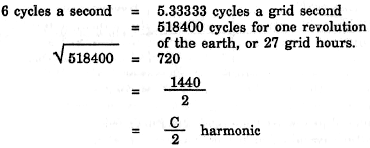
Why? It has been found that one of the basic natural frequencies of
the Earth is six cycles per second. Tesla picked a harmonic of 6
which would be the most practical.
Back to Contents
13.- SPACE COMMUNICATION
THE SCIENTISTS ARE NOW BEGINNING TO AGREE publicly that we are not
alone in the universe. Millions of worlds similar to ours must exist
and the odds are that on many of them life has developed in much the
same way as it has on earth. Some civilizations will be just
beginning, others will be far in advance of our achievements here,
and possibly many of them have reached the stage of traveling
freely across the vast reaches of space.
Our own progress has been
fairly rapid in the last century, and it won’t be long before we
will be ready to try our first venture into deep space. If we do
have neighbors, our first step will be to communicate by means of
transmitted signals before we take the more difficult step of
building vehicles to take us there. In fact, if we could communicate
in some way, we might possibly gain vital information from a more
advanced race that would enable us to carry out a probe into deep
space much sooner.
The problem is, by what method, and with what
type of transmission can this be accomplished most efficiently?
Normal radio transmission is not the answer, as vast amounts of
power and extremely expensive equipment are required to broadcast a
signal for any distance. Even at the speed of light a time factor is
involved if we hope to contact many of the nearest star systems.
Communication is not a very practical prospect if we have to wait
many years for a reply.
The best and most efficient method, as I see it, is to devise a
system whereby the communication frequencies are tuned to the
structure of matter and the harmonic wave-forms that permeate all
space. With the correct aerial system, and frequency ratios to
match, It may be possible to find a short cut to reach far-distant
worlds which interest us.
Our planet is a resonating ball of wave-forms tuned to the unified
fields of space, so what better antenna could we use to broadest
intelligent signals through the cosmos than the earth itself? If a
method could be found to superimpose coded wave-forms within the
natural grid of the earth, then they would permeate through space
within the electromagnetic fields which join all the planetary
bodies of the universe.
To do this, we would have to pick a geometric position on the
earth’s surface which would be harmonically associated with the
structure of the atom. Then we would have to design an aerial system
that would enable us to resonate the whole world. It would then
become a spherical broadcasting antenna of immense potential causing
any signal imposed upon it to be spread throughout the galaxy.
It is possible that unbeknown to the United States Navy, they have
solved the problem. With our present technology, and a few million
dollars, the job can be done.
In the 16 August 1973 edition of the New Scientist, I found an
article headed “New Home For America’s Doomsday Radio”. Project
Sanguine — the transmitters proposed for sending the retaliation
signal to America’s missile submarines following a nuclear
attack—has quietly slipped back into gear, having been held us for
four years by environmental protests. Two new sites have been
selected for the aerials that spread over literally thousands of
square miles and beam their submarine messages through the earth’s
crust. Project Sanguine, as it is known, will if and when complete
enable the President of the United States to activate his second
strike missile submarine force lying hidden in deep canyons on the
ocean bottom. It will provide the only remaining communications link
between a continental America destroyed by a nuclear fire strike and
the deeply submerged submarine fleet which will the hurl retaliation
against its aggressor.
Sanguine will use extraordinarily low frequencies — somewhere between
30 and 100 hertz, which have never before been used for
communications purposes. Their great advantage is that they will
propagate through the earth’s crust, penetrating the ocean bed from
below — providing radio communications with deeply submerged
submarines for the first time.
Sanguine’s buried aerials will have to cover an area of anything up
to 100 miles square, and will have to carry currents so strong that
in early experiments they rang telephone bells, interfered with TV
reception, and electrified fences on the surface above. The navy has
awarded contracts worth three million dollars for design proposals
for a system and expects to place full-scale development contracts
next year.
Sanguine’s use of frequencies previously employed only on national
electricity grids is only an extreme example of a long-term
trend in radio communications with submarines. Conventional mf,
hf and vhf waves are rapidly absorbed by sea-water and cannot be
used. But even before the first world war it was realized that below
about 40 kilo-Hertz attenuation rapidly falls off and communication
becomes impossible. As the frequency is reduced from 40 to 10
kilo-Hertz, attenuation falls from 2.2 to 1.1 decibels per foot. All
naval powers have long had stations operating in the lower part of
this frequency band.
Unfortunately any radio aerial, if it is to be an efficient
radiator, must have a length equal to at least one-quarter of the
wavelength of the radio wave to be transmitted. At these frequencies
the wavelengths are so enormous (say 20 miles) that this is
physically not possible. Very low frequency (vlf) stations are all
of great size and use very high power to compensate for the low
efficiency of their aerials.
By 1969 several Project Sanguine research teams were in existence:
RCA had a 4.3 million dollar contract to run a test facility; the US
Navy had 20 million dollars put on one side for research in the
following year; and there was talk of a final 1500 million dollar
system.
The idea was to bury the aerial cables below the surface in a
22,000) square mile grid measuring 150 miles by 150 miles. The
rectangles of the grid pattern would be eight miles by eight miles,
and at each crossover point there would be a buried amplifier
feeding current into the grid. Maximum current flow would be 300
amps and this would create a magnetic field of one gauss and an
electro-magnetic field of 0.35 volt per meter. The navy has selected
two possible sites for the aerial grid
One is atop the so called
Llano Uplift, a non-conducting rock formation 45 miles north-west of
Austin, Texas. The other is in the Upper Michigan Peninsula where
the bedrock is part of the Laurentian Shield. Total power will be of
the order of 10 megawatts. The information given indicates that the
best area to build the grid antenna would depend on the type of rock
strata below ground level. The right type of strata would act as a
wave guide, it is suggested.
According to my research, the type of rock strata would have no
effect on the transmission of the radio waves. The factor, as I see
it, that would control the efficiency of the system would be the
latitude and longitude of the position chosen. Because of this, I
believe that the site suggested north-west of Austin, Texas, would
be an ideal location for the job.
In my earlier books I had shown a position north west of Austin
which would give a series of grid harmonics. Now, many year later, I
have access to much more information which enables me to calculate a
more accurate position, which is displaced only slightly from the
original.
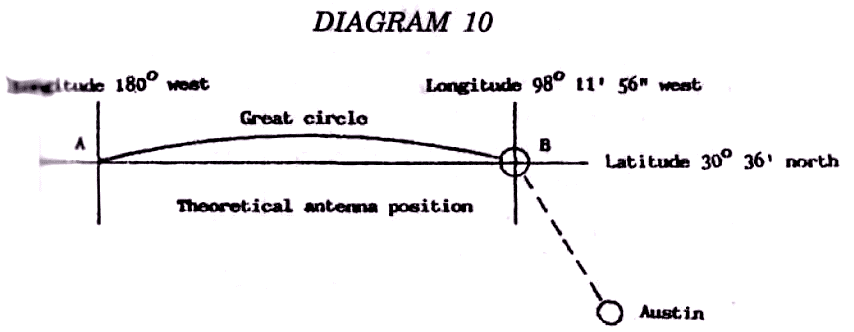
The diagram will show that the latitude sets up a harmonic geometric
which is directly related to twice the speed of light — 288. The
speed of light in free space being 144,000 minutes of are per grid
second, relative to the Earth’s surface. The speed of light
according to grid theory, varies from 144,000 minutes of arc per
grid second in free space, to 143,795.77 minutes of arc per grid
second at the Earth’s surface. (See my work, “The Bridge to
Infinity”) The great circle distance between the antenna position
and longitude 180° west, at the same latitude, is 4116.36 minutes of
arc. A study of all my works will show that the square of this
number give a harmonic value of 169444. Other sections of my
published data will show that this harmonic is directly related to
mass, gravity and communication wavelengths.
A further, most important, fact is that the great circle distance
between the antenna position and grid pole “B” in the north is the
harmonic of twice the speed of light at the Earth’s surface or
2875.9 minutes of arc. Grid Pole “B” is displaced 694.44 minutes of
arc from the north geographic pole, which is the reciprocal harmonic
of the speed of light in free space.
The interaction of all these factors would ensure that all
transmissions from the theoretical position would set up unified
fields harmonized with the geometric structure of matter itself. But
this is not all. The dimensions of the aerials, the spacing and the
area covered, are all vital requirements necessary to tune our world
into the Cosmos.
The length of each side of the Grid Antenna is: 130.1691208 minutes
of arc, (149.89171 statute miles). Therefore the area covered by the
grid would be: 16944 square minutes of arc, (or square nautical
miles). The harmonic of mass, gravity and communication. The number
of rectangular areas enclosed by the grid antenna, not including the
centre square, would be 288, the harmonic of 2C, where “C” equals
the speed of light.
Each small square section would have a side length of 6.944 minutes
of arc, or nautical miles. This value is the harmonic reciprocal of
the speed of light. 6.944 nautical miles is equal to 7.99612 statute
miles (8 miles).
So it appears that if the aerials are spaced at 7.9912 statute miles
and the sides of the square covered by the system are 149.928694
statute miles long, our aerial would be closely tuned to the
structure of the Atom. Any signal transmitted by such a system
should, in theory, travel a great distance into space.
Hello neighbor.
Since publication of this chapter the construction of the antenna
system has become an environmental issue and the project has been
postponed. Latest information suggests that the project may be
shifted to a site near Crystal Falls in Wisconsin. The given aerial
length and site position also indicate similar harmonic
associations.
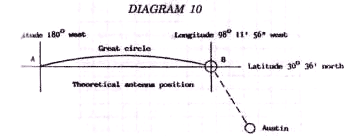
Showing the geometric relationship of the underground antenna to
grid harmonics,
Latitude displacement to north pole = 59.4°
Latitude displacement to equator = 30.6°
Difference = 28.8°
Relative displacement = 288 harmonic 2C
Distance A B 4116.36 minutes of arc.
This value squared = 169444 harmonic
The value 169444 has been found to have connections with the
harmonics of mass, gravity and communications. The number of
rectangular areas enclosed by the grid antenna not including the
centre square is 288, the harmonic of 2C, where C equals the speed
of light. The number of amplifiers, shown by dots each aerial
intersection, is 324. This harmonic is shown in various ways
throughout the book. 8 x 6.9444 = 55.555.
DIAGRAM 11
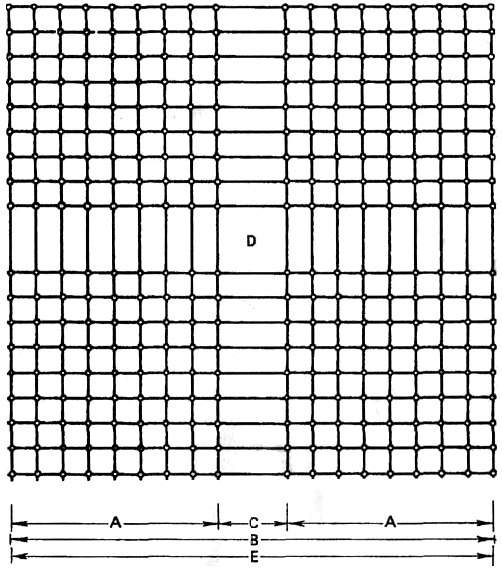
Showing theoretical grid structure of underground antenna for
resonating the earth Dimensions of grid antenna in minutes of arc:
(A) 55.555 (55.555 squared = 3086.358025, the reciprocal of 324)
(B) 130.1691208
(C) 18.489
(D) Centre of grid aerial position
The square of 130.1691208 is equal to 16944
Back to Contents
14.- WHERE HAVE ALL THE FLYERS GONE?
FIVE DECEMBER, 1945. A FLIGHT OF FIVE AVENGER torpedo-bombers of the
United States Navy took off from Fort Lauderdale, Florida, and flew
out over a fairly calm sea. The weather conditions were clear. The
time was exactly ten minutes past two when the leader roared down
the run-way closely followed by the four other aircraft in the
formation. Cruising off at 215 mph, the flight was slowly lost to
view as the bombers winged their way out on an easterly course over
the Atlantic.
The plan filed by the fight leader showed that the proposed course
would take the formation 160 miles east towards the Bahamas, then
north for 40 miles, and then finally back on to a direct course that
would bring the five aircraft back to the naval air station. In less
than two hours the flight would be completed, the planes back on the
ground.
But those two hours were to drag on into a nightmare for the crews
of the aircraft, and they were not to see their base again. That
flight has gone down in the annals of Air Force history as the
greatest air mystery of our time.
Word came from the formation at 3:45 p.m. when a strange radio
message was received in the operations control tower at Fort
Lauderdale. The flight leader spoke in a bewildered manner; he was
obviously worried. He radioed:
“We seem to be off course. I’m not
sure of our position.”
More calls were received over the next hour, and each time the
leader seemed increasingly at a loss as to what was happening to his
flight — and as to where it was.
Around 4 o’clock that strange afternoon a brief radio conversation
was heard by the listeners in the control tower. The flight leader,
by the sound of it, was beginning to panic; he had turned over the
command to another pilot. The last message from the now overdue
flight was received at 4:25 p.m.
“Our position still not certain,” the message said. “Believe we are
about 225 north-east of base.”
With the receipt of this oblique message, a Martin Mariner flying
boat equipped with rescue and survival equipment was hurriedly
made ready and dispatched to the position estimated for the Avengers
in order to guide them home. Meanwhile, the control tower was
desperately trying to raise the flight commander, but no more was to
be heard from him or from any of the other pilots. It was as though
the flight had never taken place.
The anxious tower operators then tried to contact the Mariner that
had been sent off to help the Avengers find their way home. There
was no response. Communication with all six aircraft was lost.
By now the operations personnel were thoroughly alarmed. The
coastguard at Miami were contacted, and almost immediately a
coastguard rescue plane was sent off to follow the path of the other
aircraft. After a thorough search of the last estimated position the
coastguard pilot reported back that no sign of the six missing
planes could be found.
Surface craft were sent out, and the area was searched through out
the night. By morning there were twenty vessels methodically
scouring the sea, and soon they were joined in the air by 240 search
aircraft, flying in a pattern from Florida to the Bahamas. For two
days an unceasing search was kept up. The area, scrutinized by sea
and air as it had never been searched before, extended up to 300
miles from the coast over the Atlantic, and 200 miles into the Gulf
of Mexico.
Not a single trace of the six missing planes was found. The search
area was then shifted to the inshore areas and around the sinister
Everglades in the faint hope that the aircraft had. for some
inexplicable reason, flown inland. Before it was over the search
operation covered some quarter of a million square miles. to become
the most intensive air-sea search ever undertaken. But the results
remained negative. The six aircraft had disappeared as though they
had vanished from this earth, or into another dimension.
At last, with the search crews exhausted, the Navy reluctantly
called a halt to the hunt. But search teams continued to rake
through land areas, the beaches, and the Bahamas Islands them selves.
For weeks all debris cast up on the beaches, every item of flotsam,
was minutely examined in the dying hope of finding some tiny clue,
some tiny part of any one of the six missing planes. Nothing was
found.
Months later a naval board of inquiry formally stated that
no trace of the missing planes or their crews had been found, and
that no adequate theory could be put forth to explain their
disappearance.
An analysis made afterwards to try to determine the most probable
position of the aircraft at the time they disappeared only helped to
deepen the mystery further.
Had the flight of Avengers continued on a direct course to the east
the air-crews would eventually have made contact with Great Asaco
Island. If they had gone northeast they would have flown ever Grand
Bahamas Island, which is about twenty-five miles in length. Had they
continued in a south-easterly direction, they would have sighted
Andros Island, or any one of a great number of smaller islands
scattered about that area. In fact, the only completely open areas
were almost directly north or south, and it is most unlikely that
either of these courses was followed by the missing six aircraft,
since they were known to have flown off from the airfield in an
easterly direction, in accordance with their flight plans.
At no
time did any of the crew members indicate that land was within sight
in the radio messages received. In other accounts of this incident
it has always emerged that the crews were confused and apparently
disorientated — almost as though they were flying in a void. They
seemed not to know whether they were flying straight and level or
upside down — sea and sky appeared to be as confused as if the crews
had stumbled through a hidden doorway and had entered a topsy-turvy
world with its own rules.
The only possible explanation seemed to be that for some unknown
reason the formation had been flying along a circular course within
the ring of the surrounding islands; otherwise, it was argued, at
some stage they would surely have sighted land. Since there were
five aircraft in the missing formation, the chances off the
navigation equipment in every one of them being faulty were so
remote as to be an impossibility. All equipment had been thoroughly
checked out and passed as fully serviceable before the exert else. In
the event of any disaster, of whatever nature, at least one of the
five aircraft would have had time to send out a distress signal. All
aircraft and crew were equipped with survival gear for use in the
event of a crash landing or an enforced ditching in the sea. The
same thing was true of the missing Martin Mariner. Moreover, this
particular aircraft was bulging with survival equipment.
If all six aircraft had crashed somewhere, or gone into
the water, some trace, some item of wreckage, would eventually
have been picked up. Yet nothing has ever turned up — not the
tiniest trace.
The records of the incident are still open, and to this day no
logical explanation has ever been put forward to account for the
mysterious events of that December day.
In my earlier publication Harmonic 695, I had put forth the theory
that the aircraft had flown into an area of space-time instability
due to the partial destruction of the world grid, in ancient times.
Now that I am aware that the grid system is a natural manifestation
due to the formation of matter itself, I have checked the known
facts once again and estimated the flight path by computer
analysis.
At the time of my earlier findings I did not believe that our own
scientists had the knowledge to set up any type of experiment which
could have had any effect, what-so-ever, on the flight of the
Avengers; so the disappearance was thought to be caused by forces
beyond our control.
Now, many years later, the evidence at hand indicates, without much
doubt, that the scientists did have a great deal of theoretical
knowledge concerning the structure of space-time and that various
experiments were being carried out in order to verify the unified
nature of our reality.
The flight plan filed by the flight leader, on close analysis by
computer, now reveals a strong possibility that the Avengers were
part of an advanced scientific experiment, set up by our own
scientists. If this were so, then the crews of the aircraft were
probably not aware of it. If anything went wrong, or, if indeed the
experiment was a success, they would, under the circumstances, be
deemed expendable. The fact that the radio transmissions from the
aircraft gave no indication that the crew members were aware of the
cause of their predicament suggest that the experiment, if it took
place, was known only to those who set it up.
The filed flight plan showed the following possibilities:
The proposed course would take the formation 160 miles east towards
Great Abaco Island, then north for 40 miles and then finally back
onto a direct course that should take them to the Naval air station.
If we take these coordinates and transpose them into very close grid
equivalents of minutes of arc, or nautical miles, then:
160 statute miles (flight plan) could be:
159.93256 Statute miles (grid)
Which converts to:
138.8888 nautical miles (minutes) grid Which is equal to:
(69.4444 x 2) or twice the speed of light reciprocal harmonic
(694444)
40 statute miles (flight plan)
Could be:
39.983139 statute miles (grid)
Which converts to:
34.7222 nautical miles (minutes) grid Which is equal to:
(69.4444/2) or half the speed of light reciprocal harmonic (347222)
The return, or third, leg of the journey would equal:
165.583 statute miles.
Which converts to:
143.79577 nautical miles (minutes) grid.
The speed of light at the Earth’s surface (average) is: 143,795.77
minutes of arc per grid second.
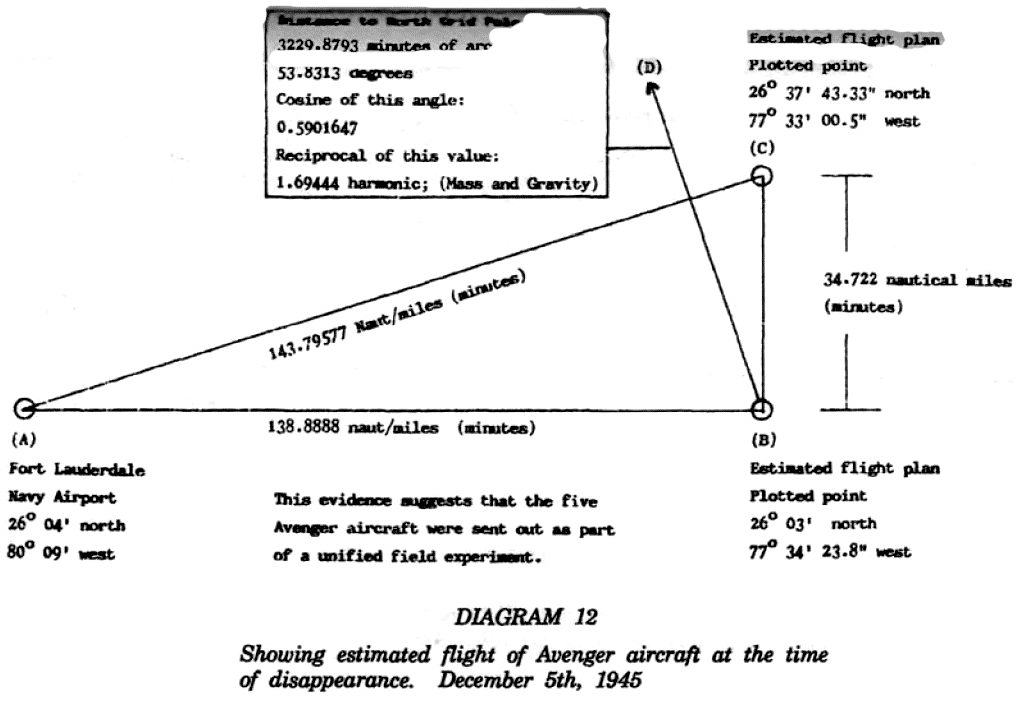
A glance at diagram 12 will show that the filed flight plan closely
fits the theoretical flight plan which allows direct association
with the harmonics of the unified field.
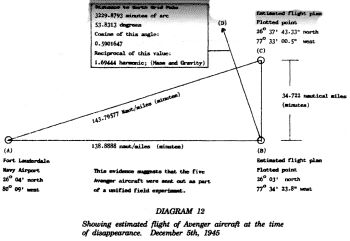
In the diagram (A) represents the take-off point at Fort Lauderdale,
(B) the turning point near Gorda Cay and (C) the turning
point for home, near the Downer Cays. At the first turning point
(B) the aircraft would be at a distance of 3229.8793 minutes of arc
from north grid pole (B).
This converts to:
53.8313 degrees.
The Cosine of this angle equals:
0.59016475
The reciprocal of this value equals:
1.69444 (harmonic 169444)
This harmonic is associated with mass and gravity. If, at the time
the aircraft reached these turning points, a pulsed harmonic
transmission was broadcast from a strategically placed ground
station, or stations, it is possible that a unified field effect
could have been caused at these positions. It is also possible that
advanced electronic equipment could have been placed in the aircraft
without the knowledge of the crews.
Admittedly the theory is pure speculation but the flight plan fits
and I have a feeling that this is more than just coincidence. As I
said in my initial publication, I believe that all the aircraft were
completely disintegrated, or moved through space-time. Where, may we
ask, have all the flyers gone? Do they still exist in some kind of
space warp? Were our own people responsible?
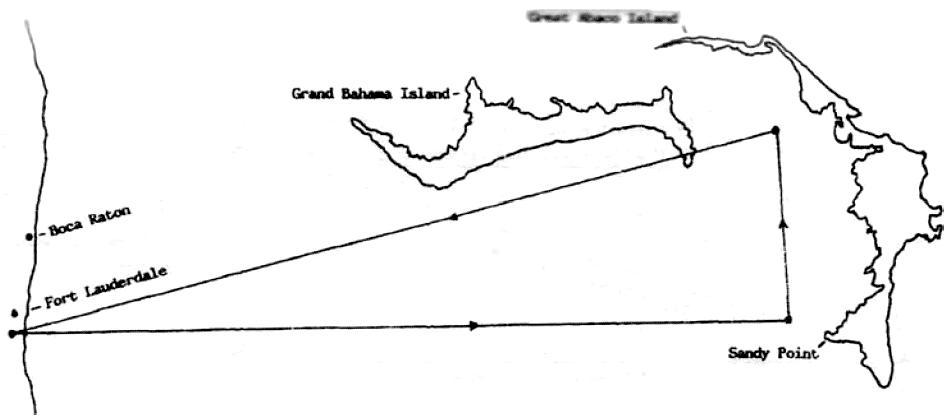
MAP 6
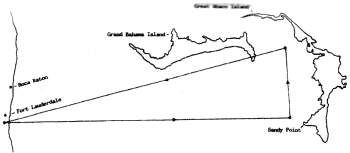
Map showing estimated, intended, flight path of five Avenger
aircraft
from Fort Lauderdale on December 5th, 1945
Back to Contents
15.- PEOPLE WE WOULD LIKE TO KNOW MORE ABOUT
STARTLING THOUGH IT WAS TO HAVE FOUND A network of man-made aerials
built into the UFO grid system, some of the subsequent events were
bizarre.
Up to this time I had been aware of treading on the corns of a few
faceless technicians and other parties who had some connection,
scientifically or politically, with the UFO grid. It had to be only a
matter of of time before the corns were inflamed enough to bring
their possessors out into the open. So far as I was aware, no direct
action had been taken to prevent me from proceeding with
investigations connected with my theories, or to try and stop my
constant probing into the network.
Like all the best ordered secret societies, the group had given no
positive indication that they even existed. So long as the public at
large did not insist upon answers to controversial questions, the
group’s members, whoever and wherever they were, were apparently
content to let matters quietly take their own course, no doubt
hopeful that eventually I would be branded as just another crank,
and that anything I had to put forward would automatically be
discounted.
I was fully aware that there was a possibility that I would be
written off as a crank, but I soon decided that this was a chance I
would have to take anyway. Obviously I had to be fairly careful how
I handled information I was now receiving. If I pushed too hard, I
would almost certainly be regarded as a Grade A lunatic, On the
other hand, if I kept all the information to myself I would lose any
advantage I might have gained, and I would be placing myself in a
position that could prove to be quite dangerous. Other investigators
of UFO phenomena in the past have disappeared or have been victims
of strange accidents as a result of probing too deeply into the
so-called flying saucer enigma.
For these reasons I decided that my best course was to leak information out as it came into my hands, and also to filter out
copies
of all my notes through a loose-knit chain of contacts both within
and outside New Zealand, so that it would be impossible to stop the
truth from spreading. All the evidence so far gathered would be in
the hands of certain newspapermen, so that it could be transmitted
via the wire services immediately any move was made to stop my
investigations.
I had no intention of becoming involved in some weird cloak and
dagger game; certainly I have never regarded my investigations as
either a game or a harmless hobby. I am also deeply aware of just
how serious the “group” is about maintaining secrecy over their
activities.
In fact, I took some pains to keep the “group” informed about the
network I had set up to ensure that all information would quickly be
disseminated in the event of some untoward accident coming my way.
There were a few people whom I was certain had direct connections
with the “group,” if they were not members themselves. Through these
people I let the word go out as to the precautions I had taken. One
of them scornfully suggested that he could not believe any
journalist would sit on such hot news when it might be possible for
him to get a scoop on the news services of the world.
My answer to
him was:
“Test the truth of what I have told you by trying to stop
me in my investigations.”
So far the test has not been made; perhaps
he realized that after all there are more honest and dedicated men
in this world than we sometimes think. At any rate the scheme
appeared to be working very well; I found that the public, instead
of labeling me as crazy, with first-class honors, actively
encouraged my research into the UFO mystery. Letters came every day,
from many parts of the world, after the publication of Harmonic 33.
The majority of them enclosed useful information or offered further
suggestions for lines of investigation.
Only rarely did a letter
turn up in my box that assassinated my character or intimated that I
was off my trolley. It was clear that a large slice of the reading
public knew that there had been some thing going on which they were
not being properly informed about On reflection I think it was this
flood of encouragement that came through my post box, more than
anything else, that drove me on with my investigations. By nature I
have a strong streak of curiosity; but it helps a lot more than I
can estimate to find that there are many other people around who are
anxious to help in any way they can.
When we photographed the first radio transmitter which I found
to have a connection with the UFO grid, though, our “opposition”
must have blown their cool. We had made ten prints of the photos
and these were in my possession when, a few days later, I was
scheduled to carry out an airways flight to New Zealand’s South
Island. On the night of 16 March 1968, I was to stop over in the
capital, Wellington, and on the next day, fly on to Invercargill,
New Zealand’s southernmost city, returning the following day (18
March) via various centers throughout the country.
I was well aware
of the significance of the photographs we had taken, and I
considered it unsafe to leave them at my home while I was absent. I
had stowed them into my airways brief bag, and during my stay in
Wellington I contacted the American Embassy’s air attaché. I had
told him the whole story, stressing that the photographs were in my
possession. Until this time, in fact, I had passed a great deal of
information to the Americans by way of the Embassy. There had been
five personal discussions with the air attaché at his office in
Wellington up to this time.
At first I had thought that the
Embassy’s interest in my research was because I had found something
new. As time went by I realized that this was not the case. On the
contrary, it soon became clear to me that the scientists were well
ahead of anything that I had been able to discover. So the Embassy’s
interest was more in order to keep tabs on what I might be finding —
and to see if I did happen to come upon something that the
scientists did not already know.
I was content to go along with this situation because I believed
that, everything I did, discovered or theorized should be kept in
the open. If, on the other hand, the Americans or anyone else wanted
to keep their findings a secret — well, that was their business. I
felt that once it was known that I had acquired a certain level of
knowledge they would have to admit something of the state of their
own research, even if to do so was only in an attempt to dissuade me
from continuing my own line of research.
The air attaché in fact turned out to be a valuable source of
information, help and encouragement. It was he who assured me
that my calculation of the UFO grid pattern for the global system
was correct. Among other items he passed on to me: intensive UFO
research was being carried out at Wright Patterson Airfield in the
United States. The scientific laboratory there, set up for the purpose, was described as a complex of buildings covering a large area
and staffed by many of the world’s top scientists. Experimental
work was carried out twenty-four hours a day, 365 days a year.
At
one stage the official asked me if I would consider a trip to
America
to visit this base. Naturally I said I would — any time they cared
to put out an invitation. Perhaps the idea was vetoed in the States,
for I heard no more of this. In retrospect it seems to me that
although at that time I was in the very early stages of my UFO
research, perhaps I had already stumbled on to something that was of
deep interest to the American scientists. They must have realized
that I was beginning to uncover information which they themselves
had kept carefully hidden from the general public for many years
The
following night after this visit to Wellington, having takes pains
to inform my Embassy contact that I had the photographs of a
transmitter with me, I stayed at the Grand Hotel in Invercargill
What took place there that night convinced me that there were other
people in New Zealand besides myself who were keenly interested in
our camera work. They are some of the people I would like to know
more about.
After a leisurely dinner my co-pilot and I retired to the lounge for
a chat and a cup of coffee. On this particular night there were two
complete aircrews staying at the Grand. Members of the other crew
were based in Wellington, and for some reason, which is still a
mystery to me, the roistering section of the airline had switched the
Wellington co-pilot on to my flight for the next day, while my
Auckland co-pilot was to return with the Wellington crew on the
early morning flight. We were not informed of this switch until
after we had arrived in Invercargill earlier that afternoon. The
co-pilot originally with me was most upset over this, as it
interfered with some of his personal arrangements and also meant his
getting up very early the following morning.
To verify the situation I telephoned Wellington and was told that
the Wellington co-pilot was to crew the flight with me as far as the
capital, while another Auckland co-pilot would carry on from there
back to Auckland with me. I thought the whole thing rather odd it
meant that three crew members would be chopping and changing to do
the work of two men. However, it was not really my concern so I
okayed the change and told my original co-pilot of his tough luck.
The Wellington co-pilot chatting with me over coffee in the Grand’s
lounge had been interested in my research, he said; so I brought our
the photos of the aerial from the bag in my room to show him
Before he joined the airline as a pilot, this man had been
associated
with the DSIR (Department of Scientific and Industrial Research),
and had carried out duties in the radio research division at McMurdo Sound, in the Antarctic. I though he might be able to tell
me what range of frequencies the aerial arrangement in the
photo-graphs might be operating on.
We were soon deep into a discussion on this point. He tried to
persuade me that the aerial was a completely mundane affair, in
common use among ham operators for normal transmissions. Suddenly we
were interrupted by a tall, conservatively dressed man who had
wandered over from the company of two similarly attired gentlemen
sitting around a table some distance away from us, at the centre of
the lounge.
Just before the stranger came to a halt at our table I had slipped
the photographs back into their large envelope, and this was now
resting on my lap, so I’m sure he was unable, at any time, to see
that the photographs were related to broadcasting equipment.
Moreover, the table at which he had left his two friends was quite
some distance away, and certainly he would have been out of car-shot.
He asked me if we were talking about duck-shooting, and if we were
interested in that sport? Somewhat non-plussed at this gambit, I
told him we had no interest in ducks or any other kind of sporting
birds, and that we were in Invercargill for reasons quite
unconnected with shooting.
Then I asked him if he was staying in the hotel. He said that he
was; he had, he said, a farm some miles distant from Invercargill,
and he and his wife (of whom there was no sign) were in town to
celebrate their wedding anniversary. This certainly seemed odd to
me, and the sensation I was experiencing that this was no ordinary,
casual hotel lounge encounter increased when the stranger drew up a
chair and sat down with us, intent on carrying the conversation on
for some time. I studied him more closely: he was aged between
forty-five and fifty; over six feet tall and well built, although
rather slim for his height.
His features were on the rugged side,
and his face roundish; a small fold of skin under the lower lip gave
one an impression that at some time he might have been in a minor
accident or suffered facial burns that required slight surgery. His
hair was dark, slightly greyed, and thinning; his eyes light
colored and conveying an impression of considerable intelligence.
His hands were long-fingered and strong, but not as rough as one
would expect in a farmer. He wore a dark suit and black shoes. The
suit was of conservative cut, well tailored though from a material I
would describe as coarse, almost cheap. Perhaps this was one of the
factors that made me feel he was odd.
After talking for a while about ducks he suddenly switched the
conversation on to an entirely different channel. He asked if we
were interested in ham radio or radio stations. Trying not to show
my surprise I told him we were not particularly interested;
privately, I began to wonder how I could get rid of him without
being obviously rude. He continued to insist that we must be
interested in radio; he said he had a friend not far out of town who
had a ham radio set-up, and if we were to go with him we would be
very intrigued with the equipment. I tried to tell him that we were
not very interested in radio, and that as it was now after nine
o’clock we certainly did not feel like taking a trip out of town to
see a ham operators gear. He then countered with the information
that he knew someone in a local government radio station, and would
we care to go with him to meet his friend there and discuss radio
matters with him?
By this time my co-pilot was looking distinctly uneasy; suddenly he
stood up and excused himself, disappearing into the TV lounge. This
left me alone with the stranger, wondering how best I could get rid
of him without making a scene about it, and at the same time getting
my envelope of precious photographs into a safe place. Finally I
made it clear to him that I was not prepared to leave the hotel, for
any reason. He at once asked me to write down the name of his friend
at the government radio station on the envelope on my lap so that I
could visit him next time I found myself in Invercargill with
nothing better to do. It seemed to me that he wanted to put a name
on the envelope so that he would be able to claim it as his, if
somehow he could get possession of it. Needless to say I kept a firm
hand on the envelope as he talked on.
From the conversation that followed I gathered that on the previous
evening he had been aboard an American ship which was in the port at
Bluff, and had had a few drinks with the captain in his cabin. He
hinted that if I were interested I could go with him now to visit
the ship. He did not explain how he had met the American captain, or
how he had managed to get aboard the ship. This omission added to my
suspicions, and I made up my mind to get rid of him.
I stood up rather abruptly and excused myself, saying that I had
some urgent business to attend to, and made to walk away. He
became apologetic, and did his best to keep me talking; he said he
hoped he had not embarrassed me or my friend in any way. I left
him then, and walked through the lounge past his two friends, who
were still sitting at their table, downstairs to the main office.
His two companions looked like businessmen; they had been keeping an
eye on us all this time.
At the office downstairs I asked the receptionist for some Scotch
tape and with it I firmly sealed the envelope, the photographs
se-surely inside it, writing my name boldly on the front and back I
had the receptionist place it in the hotel’s safe, explaining that I
would pick it up just before I left the following day. The task
completed, I went back upstairs and let myself into a public
telephone box at the top of the stairs, just outside the entrance to
the main lounge and the smaller TV room.
I put through a toll call
to Auckland and spoke to my wife. I told her some of the odd events
of the night, and asked if she had been disturbed. She told me that
some friends of ours were with her, and that nothing unusual had
happened. Immediately after this brief conversation I went into the
TV lounge to talk to my co-pilot. He told me that the three
strangers had left a short time before by the stairway to the ground
floor and the main entrance of the hotel. Back down the stairs I
went to ask the receptionist who the three men were who had just
left, to ask whether they were staying in the hotel. All I got was a
blank look. Who was I referring to?
There were no men of that
description staying in the hotel; she had been at the desk the whole
time; no one had passed her office, no one had gone out of the main
doors, in full view of her desk and less than ten feet away. Anyone
leaving by the stairs from the first floor would have had to leave
by those doors. There was no other exit. Doors leading into the bars
at the back of the ground floor were locked at this time of night.
The only other means of egress would be from the first floor upward,
by means of the fire escapes. I was beginning to feel as confused as
the girl was looking. I went back up the stairs once more, and asked
my co-pilot if he were quite certain that the men had left by the
main stairs. From his seat he could see the top of the staircase
quite clearly, and he confirmed that they must have left by the main
entrance just a short time before.
How had they come into the hotel — and how did they leave?
How did they pass in front of a receptionist without being seen? Who
were they? And what were they after? I am positive that our
darkly-clad friend was no more a local farmer than I am. I still
wonder, frequently, what would have happened if I had left with
them, and taken that offered trip to the radio station outside of
the city.
A few days later I was again passing through Wellington. I contacted
the United States Embassy and told the air attaché of the incident.
I added that I was aware that I was being kept under observation,
and that if any of the people who contacted me went overseas agents
my advice to him was to see to it that they stopped bothering me.
The New Zealand Government at this time was fully aware of my
activities, and had given me written approval of my research. If
anyone caused me trouble, I told him, I would immediately make known
all the facts, the evidence, the theories — everything I had put
together so far.
The attaché was sympathetic, and asked for more details about my
encounter with the three strangers in Invercargill. Later on he
confirmed that an American training ship had been at Bluff over the
period I was there, but no more information than that was
forthcoming.
The three men were not New Zealanders, I’m sure; wherever they were
from, though, remains their secret. During an operational flying
period it is necessary each day to have a full crew on
stand-by-duties at the airfield to allow for unforeseen crew changes
due to sickness or accidents. One morning in February, 1969, I was
carrying out a four-hour stretch of one of these duties. Over
morning tea with some other crew members in the upstairs cafeteria
of the Mangere Airport, Auckland, terminal building, I was the
victim of another odd occurrence. Not far away from where we sat, at
another table, was an unusual looking couple busily examining an
expensive camera, laughing over its mysteries like a pair of
children. At first I gave them little more than a casual glance, and
was half-turned away from them, talking to a captain having a quick
coffee before flying an airliner south to Wellington.
After some moments of conversation I turned round, for some reason I
have never been able to fathom, to look directly at the two who were
still fussing over their camera. At the precise instant that I
turned to face them the man raised the camera, aimed it at me and
took a photograph. Then, just as quickly, he continued to fumble
with the instrument and turned it back to his companion as if the
incident had never occurred — perhaps hoping that I had noticed
nothing.
I was so surprised by this action that I was at a complete loss a
to what I should do. After all, there was nothing particularly sinister about the event. He could have been a collector of photographs
of airline pilots, for all I was to know. Somewhat embarrassed I
turned back and resumed the conversation with the other skipper, at
the same time wondering why a complete stranger would want to lake
my photograph.
They were certainly an uncommon-looking couple. He was a tall,
gangling sort of individual, with thin, pipe-stem limbs. His most
startling feature was his head: it was almost perfectly spherical,
and it was as bare of hair as a billiard ball. The skin was a
golden-tan color, and very smooth; the color was as I imagine that
of an American Indian to be. I imagined that he would never have any
need to shave. Not only was his head round, it was small in
proportion to the rest of his body. He was dressed in light colored
slacks, and a bright reddish short-sleeved open neck shirt.
In spite
of his thin body he looked to me to be very fit and agile. She was
the exact antithesis of her friend; although slender, she was
shorter than he; her features were long, almost aquiline. She wore
her jet-black hair long, down over her shoulders in an old-fashioned
style. Her eyes were very dark and large, and accentuated by a very
pale, almost pallid, skin. She wore a dark, simple skirt and blouse.
She was an unusual-looking person, but in her way attractive,
although in a crowd she would certainly not attract as much
attention as her companion.
I judged both of them to be in their early twenties. They looked
friendly enough, one might even say jovial; whatever their business,
I cannot say there was at any time anything suggestive of sinister
intent about them.
But they worried me. And when I returned to the crew-room some five
minutes later, leaving them still engrossed in animated conversation
at their table, I couldn’t stop wondering who they were.
After a few moments my curiosity got the better of me. I decided
to go back upstairs and have another good look at them, and, if
possible, talk to them. I went out of the Operation Room door,
which is in a corner of the main foyer of the terminal building, and
pushed my way into the crowd milling about the nearby ticket
counters,
heading for the flight of stairs some twenty yards away. I had only
gone a short distance through the crowd when I nearly bumped into
the tall stranger, who was striding in my direction. We gave each
other a surprised look; and then, like a startled rabbit, he turned
about and scuttled off through the crowd, to disappear into the far
end of the building.
This second encounter took only a few seconds,
and I had no chance of catching up with him without causing some
sort of disturbance. Besides, I had no real reason for pursuing him,
he had done me no harm — at least, none that I knew of. The next
best thing to do, I decided, was to have another look upstairs to
see if his companion was still sitting there. If she were no doubt
he would soon be rejoining her. However, upstairs there was no sign
of her. Like her friend, she had disappeared. After waiting for a
few minutes I went back to the crew-room. It was on the face of it a
quite trivial incident. Most people would have forgotten it within a
few days. Yet even now, quite some time after, I find that the whole
thing is still vividly etched on my mind.
I’m intrigued by the
questions they brought into my life
-
Who were they?
-
What were they up
to?
-
Why did the man take my photograph?
-
Why did he run off, looking
so very startled, when we met in the crowd?
-
And where were they
from?
Until now I have found no real evidence to support the popular
belief that aliens from another world are walking in out midst. Over
the years there have been many stories and some striking accounts of
contact between humans and non-humans. Logic tells us that with all
the evidence that there now exists pointing to sustained contact by
scientists of this planet with beings connected with the UFOs that
visit our skies, there has to be direct communication between humans
and aliens at some level. It follows that there is every likelihood
for aliens to be among us. If it turns out that there are indeed
aliens here already, I would in no way be disconcerted to discover
that the odd couple I encountered in the Mangere Airport cafeteria
are among their representatives.
And if by some chance the round-headed gentleman who took a
photograph of me, or his companion, should chance to read this, here
is a message: I hope you will contact me and satisfy my curiosity.
Why did you take my photograph? And what have you done with it?
Back to Contents
16.- THE SECRET OF LIFE (LAKHOVSKY) AND
DELAND’S MAGNETIC CANOPY
IN MY EARLIER PUBLICATIONS, I DESCRIBED A TYPE of ground aerial
system being used in many orchards in the United States. The
apparatus has proved to be very successful in warding off frost
damage to citrus fruit. A further effect has been the promoting of
healthier trees and better general growth in the areas covered.
I gave dimensions for a similar aerial which would resonate at the
frequencies of light and gravity. Since publication I have received
more information on the American system and have been extremely
interested in the actual dimensions used. The aerial was designed by
John Delrea Deland of Riverside, California, and has been in use
since 1949. The units cover about one acre each and consist of a
steel mast about 32 feet high, made of galvanized pipe in 12-foot
lengths. The first is a two-inch pipe set into a three-foot-deep
concrete base.
Two other pipes of lesser diameter are screwed on to
the bottom pipe to form a vertical mast 30-feet high. At the
masthead, and also at the two pipe joints, a waterproof,
three-quarter inch plywood disc is fitted. At the outer edge of the
discs are seven drilled holes, evenly spaced and parallel to the
mast. The holes are about ¼ inch diameter, 51.42857° apart. Ten hard
copper wires are strung through each of the holes in the discs,
parallel with the mast. At the top disc the wires are extended about
eight inches parallel to the earth. This forms a wire cage around
the mast.
The wires pass through the outer edge of the concrete base
then into trenches which are 18 inches deep and radiate from the
mast centre at angles of 51.42857°. One of the wires in the trench
must be orientated with magnetic north. The wires are run from the
centre of the mast to a distance of 144 feet. They are then attached
to a “magnetic pack” the design of which, according to the
information I have, is a secret. The end of each wire is then
brought above ground and pointed toward its corresponding end at the
top of the mast. The trenches, which form the radius of a circle 288
feet in diameter, are then covered in.
The information sheet says that the device does not raise the air
temperature of the grove. It is thought that a type of magnetic
field of force is set up over the trees by the equipment, which
creates within the trees themselves a condition which prevents
freezing. Citrus fruit lying on the ground will freeze. Fruit still
attached to the tree but touching the ground will also freeze in a
short time The fruit growing on the tree seem to be unaffected.
Protection has been given to trees with temperatures as low as 20°
Fahrenheit. Besides preventing frost damage the trees appear to be
healthier and to have a slightly higher production rate.
No one
seems to know how the apparatus works, and the write up says that
there are apparently forces around us of which we know little. The
first thing I realized when reading this was that the radius of the
circle encompassing the ground aerials was 144 feet or the harmonic
of the speed of light; the diameter of course being 288 or double
the light harmonic.
With a mast height of 30 feet, the angles that
the wire ends make with the ground at the periphery of the circle
were calculated at 11° 35’, or 695 minutes of arc. The pure harmonic
reciprocal of the speed of light is 694444, so 695 is near enough in
a practical sense. See Diagram 22 for layout of the system. Did Mr.
Deland have access to secret knowledge when he constructed his
aerials? Or has the method of construction been passed down through
the ages without anyone really knowing how or why the system works?
I believe that as all physical substance is being manifested in
alternate pulses of matter and antimatter, then such an aerial
system would be subject to these pulses at the frequency of 144000
pulses a grid second. By induction, the tuned aerial would set up a
secondary field which has a harmonic affinity with matter and life
itself. This would increase the strength of the life forces and help
to shield living things from any adverse influences. One of my
fellow-pilots, Mr. D. R. Offwood, became interested in the
information I had on the aerial layout and proceeded to construct a
similar system in a nursery in the South Island of New Zealand, to
test the effects and carry out a series of experiments.
It was agreed that a quarter-size mast would be constructed, as
according to radio theory a quarter-wave aerial should pick up a
fairly strong signal. The aerial was set up and an investigation
into
electro-culture was carried out between September 1972 and June
1973. A full report was written up and presented to me for
publication in 1974.
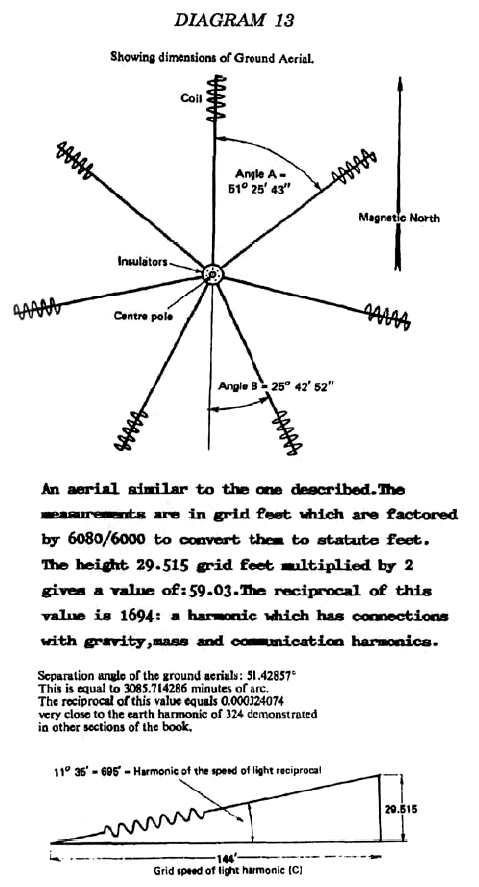
The following is the main body of the report by
Don Offwood, including tables of growth etc:
REPORT ON AN INVESTIGATION INTO ELECTRO-CULTURE AT CHRISTCHURCH
BETWEEN SEPTEMBER 1972 AND JUNE 1973 This report is a record of two
separate experiments I carried out during the spring and summer of
1972-73 in which I attempted to evaluate the reported effect the
magnetic field has on plant growth.
This was done by growing plants inside an area of a wire aerial and
comparing their rate of growth with that of other plants of the same
species planted outside this area of influence. Such aerials are
reported to be available commercially in California and are used to
the exclusion of oil burning smoke-pots in orchards on frosty
nights. It is suspected that the wires are of such arrangement that
they are in harmony with the wavelength of light and the earth’s
magnetic field, and have the effect of concentrating or amplifying
this energy source, which the plants are able to tap, it being the
most natural of energy sources next to the sun.
The aerial was built to quarter-size of the dimensions shown in
Diagram 22, because of the physical problems in building a full-size
one, to the home handyman. The vertical support was an old
galvanized water-pipe, the insulators were made from commercial
formica, the wire was number 10 galvanized, the seven wire coils
having alnico bar magnets placed inside them, north pole uppermost.
This arrangement was set up with one of the legs aligned along
magnetic north.
This aerial was constructed on a nurseryman’s land where the
Waimakariri sandy loam soil had had no special treatment and was of
a uniform nature. The nurseryman who kindly allowed me to use his
land also supplied the lettuce plants, which were 2-3 inches in
size, and uniform. He suggested lettuces for the test, as they are a
quick-growing plant suitable for an experiment of this kind.
They were planted on 3 September 1972; beside the
central pole; at 5 feet and 11 feet; and beside the coil at 30
145 feet, and at 50 feet out from the pole. This latter group were
assumed to be clear of the influence, if any, of the aerial
arrangement.
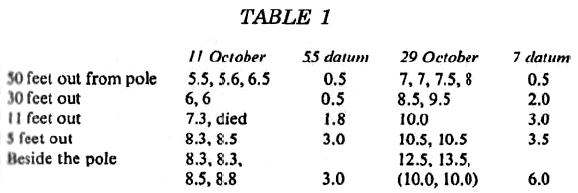
All the plants received water on planting and again that evening, to
help them get established, but after this time the only water they
received came from rainfall. Readings of the average diameter across
each plant were made five and eight weeks after planting and were as
follows.
The dimensions are in inches:
Using 5 ½ inches as a datum for comparison of the measurements on 11
October, and 7 inches for those measurements taken on 29 October,
the datum columns show the average plant size at each position,
which displays the accelerated plant growth exhibited by plants
closer to the centre of the aerial.
For example, the two by the pole finished up 6 inches greater in
diameter than the examples which were clear of the area at the
50-feet station, and had well-developed hearts. The two plants which
grew to 10 inches beside the pole were infected with aphids. As I
had not expected the marked results shown they were unfortunately
rather overcrowded, these two plants succumbing to the larger two.
The results obtained do show a marked improvement in the lettuce
condition the closer they were to the centre of the arrangement. The
two plants by the pole were 73 per cent larger than the plants
outside the test area, although this figure is of course misleading
on so few test examples.
My conclusion is that the test plants exhibited accelerated
growth rate and terminal plant size when planted within
the arrangement of wires described, due to a cause not established
or obvious to any conventional approach.
The reader may find it interesting to consider the following:
Angle of one segment = 51.42857 degrees.
Half this angle = 25.71428 degrees
= 1542.857 minutes
Square root of this value = 39.27922
Harmonic 3927922 is close to harmonic 3928371.
Harmonic 3928371 equals earth field A minus earth field B. All of
the ground aerials related to the north, south, east or west
position exhibit this factor, or a value related to one half or
quarter of it. A further series of experiments was carried out by
Mr. Offwod using a type of wire loop aerial which can be erected
around a single plant or tree to promote growth. I came across this
device quite by chance when browsing through a bookstore in
Auckland. The book was call The Secret of Life by G. Lakhovsky, and
was first printed in 1935, later reprinted in a revised edition by
courtesy of Messrs Heinemann (Medical Books) Ltd — third edition
1963. Very few copies of the book were available locally so I felt
lucky to acquire one for my ever-growing library.
To date, the work of Lakhovsky has been completely ignored by
orthodox science, much I believe to the detriment of many thousands
of ill people in the world today. His research and experiments were
built on the fundamental basis that “every living being emits
radiations.” This had been backed up in recent times by John
Pfeiffer, an American working in the field of radio astronomy.
His
book, called The Changing Universe, published in 1956, states in
part,
“each human being is an emitter of radio waves, a living
broadcasting station of exceedingly low power. The stomach will send
out not only infrared heat waves, but the entire spectrum of light, ultraviolet rays, X-rays, radio waves and so on. Of course all
these radiations are fantastically weak and the radio waves are
among the weakest. But the fifty-foot aerial of the naval research
laboratory in Washington, the most accurately constructed aerial in
existence could pick up radio signals coming from your stomach more
than four miles away.”
The foreword to the book states that “Lakhovsky’s original theories and amazing experimental results in human beings, animals
and plants, as fully set forth in the revised edition, are destined
to become a landmark in the history of radio biology, standing high
above the ruins of orthodox misconceptions of the laws of nature.”
What have we to learn from this remarkable man? He states that the
living cell is an electromagnetic resonator capable of emitting and
absorbing radiations of very high frequency. Life is dynamic
equilibrium of all cells; the harmony of multiple radiations which
react upon one another. Disease, on the other hand, is the
oscillatory disequilibrium of cells originating from external
causes.
Each living cell gives off radiations from its nucleus which has its
own individual oscillating frequency. The geometric makeup of the
cell causes it to act as an electric circuit which has self
inductance and capacity. The natural oscillation of energy in the
cell I believe to be due to the constant interaction of the matter
and antimatter cycle discussed in other sections of this book. A
pendulum-like pulsing occurs between the physical and non-physical
substances. When stronger radiations are imposed upon the cell by
outside influences, then the natural rhythm of the cell is affected
and it begins to break down. If the radiation of the cell can be
restored to its original rhythm then it will resume its healthy
state.
Lakhovsky found that he could accomplish this restoration of
natural rhythm by means of artificially induced oscillating fields.
To do this he employed two different methods. The first, by the use
of spiral loops of copper wire which would set up electro-magnetic
fields harmonically tuned to the life forces. These loops of wire
were placed around the plant or area to be treated, and the natural
bionic rhythm would be intensified by the inductance of the wire
loop. In one of his experiments he artificially inoculated a series
of geranium plants with cancer cells and placed them in separate
pots.
He states:
“A month later, when the tumors had developed, I
took one of the plants at random, which I surrounded with a circular
spiral consisting of copper and measuring 30 cm in diameter; its
extremities not joined together, being fixed into an ebonite
support. I then let the experiment follow its natural course during
several weeks. After a fortnight I examined the plants. I was
astonished to find that all my geraniums, or the stalks bearing the
tumors were dead and dried up, with the exception of the geranium
surrounded by the copper spiral. This had since grown to twice the
height of other untreated healthy plants.” (The tumor was
eventually shed and only a scar on the stem of the plant was
visible.)
When I read of these experiments by Lakhovsky I was sure that
somehow, either by design or by chance, he had constructed his
spiral coils to some geometric dimension which would set up a
natural resonance with matter. Possibly any diameter coil would show
some results, but one that was perfectly tuned would give him the
remarkable results he had with the timorous growths.
By calculation
I discovered that a diameter of 30.02 cm was equal to a diameter of
.972 geodetic feet, which gave a radius of .486 geodetic feet. The
area of the encompassing circle would be .742 geodetic feet. In
fact, the tuned spirals he used were within two hundredths of a
centimeter (which is close enough practically, as this would be much
less than the diameter of the wire used) to an exact dimension
required to set up harmonic resonances tuned to time, and harmonics
associated with the Great Pyramid. Any type of matter in such a
field would be subject to sympathetic vibrations which would restore
harmony to the natural rhythms.
The loop size decided on for the
experiments carried out by Mr. Offwood was 12 geodetic inches, which
we considered at the time to be a dimension which should give a
reasonable result. Although we now know that ultimate efficiency
would not be obtained with a loop of this dimension, the diameter of
the wire used was such that a partial success would have been
expected. As Mr. Offwood himself suggests, a metal hoop of any
dimension would possibly have some effect on growth by concentrating
the magnetic field in a small area, but the perfectly tuned aerial
would give the maximum results.
The following is his report:
The purpose of this part of the experiment was to test a suggestion,
that if an open loop of wire of one grid foot (approximately twelve
and one eighth inches) diameter, was placed around a tree or plant,
then the plant would grow faster than its counterparts. The
suggestion was that these loops would have a similar effect to the
main aerial’s, that is, concentrate the magnetic energy within the
area of its influence. The spiral effect created would extend from
both ends of the wire loop to encompass the plant vertically.
To test this idea I once again asked my nurseryman
friend’s indulgence and advice, and set up a series of wire
loops on four varieties of plants, their unpronounceable
botanical names being,
The plants were all growing in rows. As the table
shows, I varied the thread of the loops, the height of the loop
above the soil, and the pitch of the thread, to see what pattern
emerged, if any.
DIAGRAM
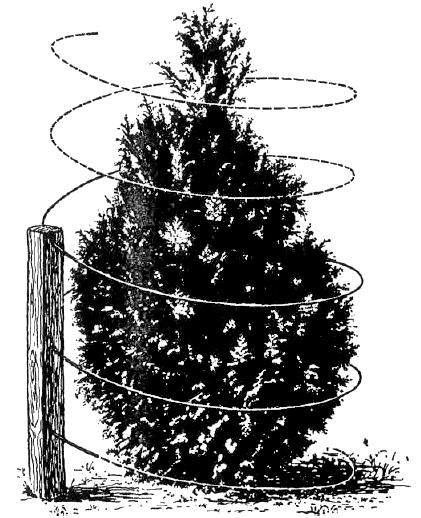
Wire Loop Aerial
The loops were placed in position on 12 September, and
all the plant heights recorded. Subsequent height
measurements were taken on 5 January, 15 March, and finally on 11
May 1973, these measurements being subtracted from the original
height to obtain the growth of the plant on each of these dates. I
then averaged the height increase of all those plants with loops,
those plants without loops, and compared them, showing the result as
a percentage.
On 5 January the average height gain of the plants with a loop was
4.675 inches, while the average gain of those plants that did not
have a loop was 4.640 inches. The difference between these is 0.035
inches, which is a 0.759per cent gain in favor of those plants with
loops. On 15 March the figures had changed to 10.300 inches for
those with a loop, a 9.500 inches without, which gave an 8.42 per
cent advantage to those plants with loops.
The 11 May readings showed that this advantage had
increased slightly to 9.87 percent, as is displayed in table
4.
The reader will note that the three results were all positive, that
is, the plants with loops grew taller than those without loops
during the length of time the experiment was conducted, by the
percentages shown. Another interesting point is that the growth
tendency seemed to accelerate, as shown by the increasing
percentage. I am sure the reader will allow me to use three decimal
points, as to reduce my results down to a more realistic single
decimal point has a very marked effect on the end result.
The results obtained from the other three test species follow with
their associated tables.
As in Row A, all the test plants displayed positive results, that
is, plants with a loop grew taller during the test period. The
tendency for this phenomenon to accelerate was evident in three of
the rows, the exception being row B, which displayed a decrease from
9.190 to 9.010. The small number of plants involved must also be considered as affecting the accuracy of these results and
percentages, as misreading the ruler by a small amount has a
magnified effect on the end percentage. It will also be noted that I
omitted to have some loops of a diameter other than a grid foot
present, to test the possibility that mass of metal of any dimension
would have a beneficial effect. Also the loops were made of
galvanized wire, where I suspect copper might have been better.
I examined my results to compare left-hand to right-hand loops for
any obvious advantage.
In Table 9, the plant growth for left-hand and right-hand loops for
each row on the appropriate dates were averaged.
With two exceptions, if one set of plants started out growing well,
they maintained their advantage. In row B the advantage changed from
right-hand to left-hand, while in row C the change was left-hand to
right-hand. Overall, left-hand threads on the wire loops appeared to
be favored over right-hand by 10-2, but I am unable to offer any
explanation, or draw any constructive conclusion from this, because
of the small number of test plants involved. I could detect no
advantage between those plants having one end of the loop
underground, as against those being clear of the ground; or between
greater or lesser pitch; again this was due to the small number of
test plants involved, and I was therefore unable to determine the
optimum pitch.
In both experiments I showed to my own satisfaction
that when plants are planted within an arrangement of
wires as described they will exhibit a rate of growth superior to those plants not within the area of influence. I
would suggest that under the above conditions, the energy
of the magnetic field tends to amplify in such a way that
any plant within the area is made healthier by this boost in its
life force, and will grow at an accelerated rate.
Work done by Justin Christofleau before 1914 and up to 1927 seems to
show that this boost is of such a nature that it builds up over a
period of time and may not take full effect for a year or more He
attributed his remarkable results to his equipment generating
electricity, which accelerated his plant growth, while I suspect
that the magnetic field will in time be found to be closer to the
cause of this phenomenon.
Lettuces are relatively fast-growing plants, and I was therefore
able to obtain results within a short period, but the aerial’s
effect on an orchard or a pine forest would be worth investigating.
Although of differing dimensions to the aerial described in
Harmonic 695, this aerial did exhibit some of the same dimensions.
suspect that if an aerial or assembly of wires was arranged,
involving several fundamental harmonics, then positive results would
be available.
I have not attempted to write this report in a completely scientific
manner as I am not a scientist. It is purely a record of my
observations and comments on the results, so far as my limited
knowledge of the subject allows.
Donald R. Offwood
February 1975
The results of Mr.Offwood’s experiments show without doubt that a
wire loop aerial does, in a most positive way, influence the growth
rate and health of plants. The next step to take in further
experiments is to make use of perfectly tuned aerials for maximum
results and to try a series of loops constructed from wires of
different metals.
I believe that certain metals which have mass
values close to the harmonic values of light, mass and gravity,
could improve the radiation field produced within the coil. For
instance aluminium, which consists of a combination of isotopes with
mass numbers of 26 and 27, could be produced. If the compound
consisted of measured proportions the average mass value could be
made to match that of the harmonic energy equivalent derived from
the unified equation:
26.944. The radiations from this type of wire should theoretically
be more intense. It is interesting to note that wires made from
aluminum are excellent electrical conductors and that transmission
lines are now being made from this metal.
TABLE 3
ROW A Chamaecyparis lawsoniana ellwoodii
TABLE 4
Three positive results again.
TABLE 5
ROW C Phebalium squameum
TABLE 6
ROW D Choisya ternata
The fact that loops with a left-hand thread were the most efficient
could possibly be due to the experiments being conducted in the
southern hemisphere. The opposite would apply in the northern
hemisphere. This would be similar to the vortexual action of weather
systems, which is also electrical in nature.
Lakhovsky carried out extensive research into cell structure, and in
1923 he constructed a machine called a radio-cellulo-oscillator
which he used in his experiments with plants. As his work progressed
he came to the conclusion that the use of ultra-short waves alone
was not the complete answer as the thermal effects were sometimes
dangerous.
He conceived an idea for a new type of machine that would give “an
oscillatory shock to all the cells in the body of a human being
simultaneously.” By use of damped electrostatic waves thermal
effects were at a minimum and cell injury would not occur. In 1931
Lakhovsky perfected what he called his multiple wave oscillator.
This apparatus was capable of generating an electrostatic field
covering all wavelengths from 10cm to 400 meters. Within such a
field all cells could find their own frequency of vibration within a
range of 750,000 to 3 milliards per second. Added to this, each
circuit gave forth a series of harmonics extending far into the
infrared and visible light regions.
This machine was eventually used in many hospitals in European
countries for the treatment of numerous diseases. This included the
treatment of cancer. No harmful effects have ever been reported, but
many beneficial results were obtained. A completely new branch of
science was opened up, by this man, into the electrochemical
structure of living matter. His research was obviously important to
mankind. Is his work to be lost to us because he was ahead of his
time?
Because of my own extreme interest in the structure of matter, I
intend to build a multiple wave oscillator for my own private
research. Who knows what other secrets may be praised from the
limitless expanse of natural law?
Back to Contents
|