|

posted by Rebecca Sato
June 11, 2008
from
DailyGalaxy Website
Sunspots_2Dark spots, some as large as 50,000 miles in diameter,
typically move across the surface of the sun, contracting and
expanding as they go.
These strange and powerful phenomena are
known as sunspots, but now they are all gone. Not even solar
physicists know why it’s happening and what this odd solar silence
might be indicating for our future.
Although periods of inactivity are normal for the sun, this current
period has gone on much longer than usual and scientists are
starting to worry—at least a little bit.
Recently 100 scientists from Europe,
Asia, Latin America, Africa and North America gathered to discuss
the issue at an international solar conference at Montana State
University.

Today's sun is as inactive as it was two
years ago, and solar physicists don’t have a clue as to why.
"It continues to be dead," said
Saku Tsuneta with the National Astronomical Observatory of
Japan, program manager for the Hinode solar mission, noting that
it is at least a little bit worrisome for scientists.
Dana Longcope, a solar physicist
at MSU, said the sun usually operates on an 11-year cycle with
maximum activity occurring in the middle of the cycle. The last
cycle reached its peak in 2001 and is believed to be just ending
now, Longcope said. The next cycle is just beginning and is expected
to reach its peak sometime around 2012.
But so far nothing is happening.
"It's a dead face," Tsuneta said of
the sun's appearance.
Tsuneta said solar physicists aren't
weather forecasters and they can't predict the future. They do have
the ability to observe, however, and they have observed a
longer-than-normal period of solar inactivity. In the past, they
observed that the sun once went 50 years without producing sunspots.
That period coincided with a little ice age on Earth that lasted
from 1650 to 1700. Coincidence? Some scientists say it was, but many
worry that it wasn’t.
Geophysicist Phil Chapman, the first Australian to become an
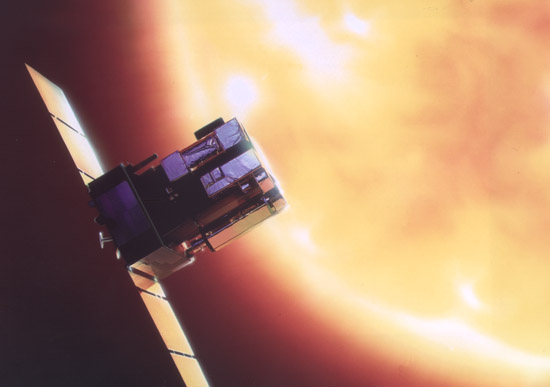
astronaut with NASA, said pictures from the US Solar and
Heliospheric Observatory also show that there are currently no spots
on the sun.
He also noted that the world cooled
quickly between January last year and January this year, by about
0.7C.
"This is the fastest temperature
change in the instrumental record, and it puts us back to where
we were in 1930," Dr Chapman noted in The Australian recently.
If the world does face another mini Ice
Age, it could come without warning. Evidence for abrupt climate
change is readily found in ice cores taken from Greenland and
Antarctica. One of the best known examples of such an event is the
Younger Dryas cooling, which occurred about 12,000 years ago,
named after the arctic wildflower found in northern European
sediments. This event began and ended rather abruptly, and for its
entire 1000 year duration the North Atlantic region was about 5°C
colder.
Could something like this happen again?
There’s no way to tell, and because the
changes can happen all within one decade—we might not even see it
coming.
The Younger Dryas occurred at a time when orbital forcing
should have continued to drive climate to the present warm state.
The unexplained phenomenon has been the topic of much intense
scientific debate, as well as other millennial scale events.
Now this 11-year low in Sunspot activity has raised fears among a
small but growing number of scientists that rather than getting
warmer, the Earth could possibly be about to return to another
cooling period. The idea is especially intriguing considering that
most of the world is in preparation for global warming.
Canadian scientist Kenneth Tapping of the National
Research Council has also noted that solar activity has entered
into an unusually inactive phase, but what that means—if anything—is
still anyone’s guess. Another solar scientist, Oleg Sorokhtin,
a fellow of the Russian Academy of Natural Sciences, however,
is certain that it’s an indication of a coming cooling period.
Sorokhtin believes that a lack of sunspots does indicate a coming
cooling period based on certain past trends and early records. In
fact, he calls manmade climate change "a drop in the bucket"
compared to the fierce and abrupt cold that can potentially be
brought on by inactive solar phases.
Sorokhtin’s advice:
"Stock up on fur coats"… just in
case.
Sources
-
http://www.montana.edu/cpa/news/nwview.php?article=5982&log
-
http://solarscience.msfc.nasa.gov/SunspotCycle.shtml
-
http://www.theaustralian.news.com.au/story/0,25197,23584524-11949,00.html
|