|
|
|

|
by Wallace Thornhill
15 February 2007
Global warming has been deemed a fact.
However, the inconvenient truth is that humans are not causing it.
Al Gore has been given poor advice. Like
Darwin's theory of evolution
and Big Bang cosmology, global warming by greenhouse gas
emissions has undergone that curious social process in which a
scientific theory is promoted to a secular myth. When in
fact, science is ignorant about the source of the heat - the Sun.
The connection between warming and
atmospheric pollution is more asserted than demonstrated, while the
connection with variations in the Sun has been demonstrated.
Dr. Sami Solanski, director of the renowned Max Planck Institute for Solar System Research, said,
Dr. Solanski admitted to not knowing what is causing the Sun to burn brighter. A leading authority, Eugene N. Parker, adds,
This highlights the fundamental problem with the global warming verdict from climate experts. It is based on profound ignorance about how the Sun really "ticks" and what forms of energy are input to a planet's climate. For this they can blame astrophysicists. Although the historical climate records tie climate to variations in the Sun's output, the solar variation is considered too small to have much effect on global warming.
As John Gribbin wrote in New Scientist,
Slowly, the consensus has shifted
politically in favor of this view.
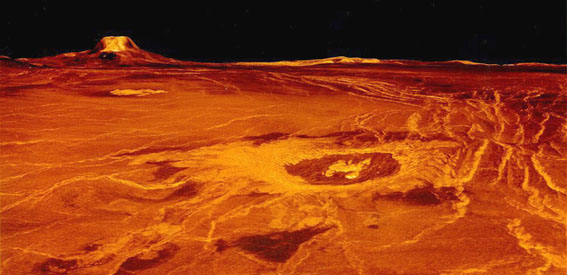
Underlying the bogeyman of the global greenhouse is the belief that something went wrong on our sister planet, Venus, and a "runaway greenhouse effect" occurred, turning it into a furnace hot enough to melt some metals.
It is another of the secular myths of our age. In Venus isn't our twin! I wrote, "Comparisons with the Earth will lead nowhere."
Nothing "went wrong" on Venus or "went right" on Earth. The two planets are not the same age and are only distantly related.
There is no message for us from the study of Venus for an imagined evolution of Earth's climate into a "hothouse."
What do we need to know before an
informed judgment can be made in the global warming debate? What are
the science myths holding us back?
Not such a big advance over Stone Age thinking! It seems very satisfying-and safe. We don't need to put coins in the meter to keep it burning.
However, the reactions which are thought to generate heat in the Sun's core are hypersensitive to temperature variations, and mechanisms to control the reactions are difficult to devise. In view of this, the steadiness of the Sun's output is a puzzle. Furthermore, if thermonuclear reactions generated all the Sun's energy, a certain number of subatomic particles called electron neutrinos would be produced.
And critically - the number of electron
neutrinos coming from the Sun is woefully inadequate.
Astrophysicists grasped this
lifesaver like drowning men and women. It became "proof" of their
"thermonuclear campfire" model overnight. Unfortunately, it cannot
be proven without a neutrino detector close to the Sun. Occam's
razor recommends that we take the neutrino data at face value
and re-examine our assumptions about the Sun.
Not surprisingly, all attempts have failed. It is simply assumed there must be a hidden dynamo because the magnetic fields are there and no one believes they could come from outside the Sun.
The mysteriously generated magnetic fields are called upon to explain most of the puzzling observations about the Sun. It fits the astrophysicists' maxim,
They then show their ignorance of magnetism by describing electric discharge phenomena in terms of the 'snapping' and 'reconnection' of imaginary field lines.
The father of plasma physics, Hannes Alfvén, wrote concerning the mistreatment of magnetism by astrophysicists,
The view of the Sun as an isolated,
self-sufficient, self-immolating, magnetic body is the chief
peculiarity and drawback of the campfire Sun.
Those phenomena suggest that the Sun is an electrical body. The magnetic field of the solar wind shows that electric currents flow within the solar system. The million-degree temperature of the solar corona points to an external power source for the Sun.
The polar plume and equatorial plasma torus show that the Sun, like all stars, is the focus of galactic currents "pinching" naturally into an hourglass form with an equatorial current sheet.
The hourglass shape is made visible in many beautiful planetary nebulae.
A long-standing puzzle is how planetary nebulae acquire their complex shapes and symmetries, since stars and the gas/dust clouds surrounding them are mostly round. The Hourglass Nebula, is a young planetary nebula located about 8,000 light-years away. As revealed by Hubble, it does not fulfill some crucial theoretical expectations. But just as a neon tube is evenly lit from end to end, the nebula remains evenly lit at great distances from the central star.
Credit: R. Sahai & J. Trauger (JPL),
the WFPC2 Science Team & NASA.
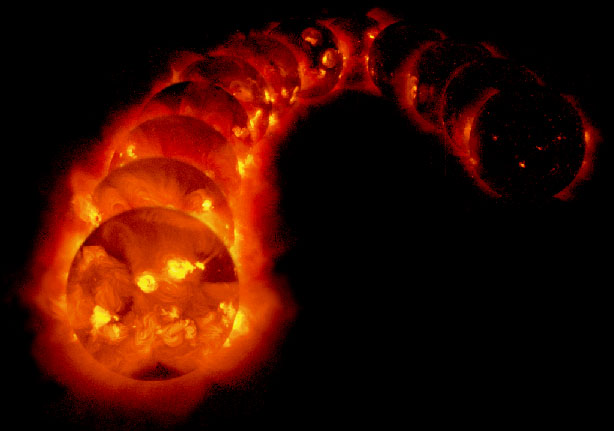
Stars are elements in galactic circuits. They trace the power lines like electric streetlights along the arms of the Milky Way. The solar magnetic and sunspot cycle is due to the quasi-periodic DC power input to the Sun. This variability of power input to the Sun can be clearly seen in X-rays and UV light.
See "The Sun - Our Variable Star."
Above is a montage of X-ray images of the Sun captured 4 months apart between 1991 and 1995 by the Yohkoh spacecraft.
The cyclical
switching of the solar magnetic field is induced by the varying
galactic DC input current.
It has been shown that the Sun's constancy of light and heat output is due to a natural transistor action of the plasma sheaths forming the photosphere and chromosphere of the Sun.
A very small voltage between the body
of the Sun and the underside of the photosphere controls the
enormous current that lights the Sun. Nature, as we have come to
expect, has found a beautifully simple method of steadying the light
output of main sequence stars.
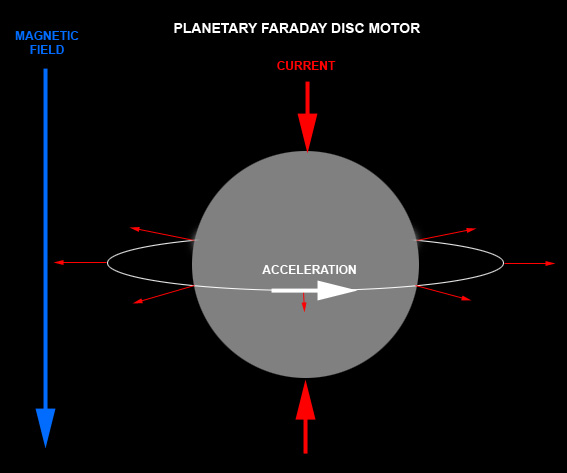
The electrical energy is delivered to stars and planets in the manner of a simple Faraday motor.
Schematic of the
Faraday motor effect upon a planet (or star).
The electromotive power is deposited mostly in the upper atmosphere at mid to low latitudes and gives rise to fast upper atmosphere winds and even "super rotation."
That is, the wind races around the planet faster than the planet turns. It is a phenomenon observed on Venus and Titan and remains unexplained by atmospheric physics, which relies on solar heating. It is the cause of the extraordinary winds on the gas giant planets in the outer solar system, where solar heating is weak. It has implications for the jet streams and weather patterns on Earth as well.
Notably, the polar current streams take the form of twin Birkeland current filaments, which give rise to the enigmatic "double vortexes" seen at the poles of Venus. It is apparent that electrical energy from space doesn't merely light up auroras. It has a profound influence on upper atmosphere winds and storms.
An expert on the dynamics of planetary atmospheres, F.W. Taylor, has admitted,
Meanwhile, electrical energy appears nowhere in any climate model.
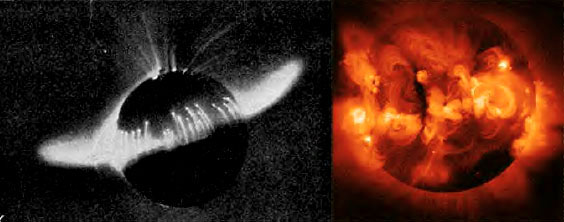
Around 1900, the famous Norwegian scientist, Kristian Birkeland, performed experiments (left) using an electromagnetic terrella [magnetized metal sphere] as one of the electrodes in a gas-discharge apparatus. He created an artificial Aurora around the poles of the terrella, replicating the effects of the solar wind on the magnetic Earth. He also simulated other cosmic phenomena, such as the Sun's corona, sunspots, and the rings of Saturn, using other small metal spheres. Note that the experiments use external electrical power!
The era gives a
measure of how far we must backtrack from the current dead end to
bring astrophysics in tune with reality.
The electrical model of the Sun and its environment answers the question of how the solar cycle can have more effect on the weather than expected from solar heating alone.
Because the planets are minor electrodes in the Sun's circuit, they are subject to the full variation of the galactic electrical input. It explains the simultaneous warming of other planets and changes in their atmospheres.
Even distant Pluto (at the time still a planet) baffled astronomers by continuing to warm up eighteen years after its orbit began to take it further from the Sun. Electrical energy may constitute a major energy source for the outer planets.
And, of course, on Mars there are no
SUVs or farting cows to explain its warming.
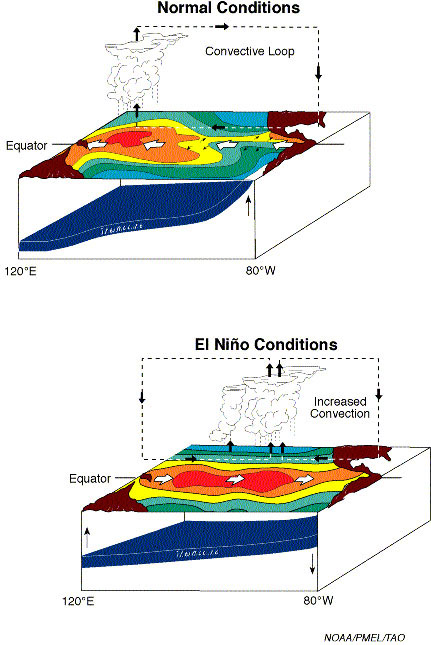
ENSO has signatures in the Pacific, Atlantic and Indian Oceans. Scientists are unable to explain this global weather and climate feature.
In normal, non-El Niño conditions (top panel of schematic diagram), the trade winds blow towards the west across the tropical Pacific. These winds pile up warm surface water in the west Pacific, so that the sea surface is about 1/2 meter higher at Indone
sia than at Ecuador.
During El Niño (bottom panel of the schematic diagram), the trade winds relax in the central and western Pacific leading to a depression of the thermocline in the eastern Pacific, and an elevation of the thermocline in the west.
The weakening of easterly trade-winds during El Niño is evident in this figure as well. Rainfall follows the warm water eastward, with associated flooding in Peru and drought in Indonesia and Australia.
The eastward displacement of the atmospheric heat source overlaying
the warmest water results in large changes in the global atmospheric
circulation, which in turn force changes in weather in regions far
removed from the tropical Pacific.
The contradictory results prompted the Chairman of the World Climate Conference in 2003, Prof. Yuri Izrael, to ask,
Now some geologists are beginning to
take a broader look at climate drivers, from the perspective of
Aristotle's four elements: earth, water, air, and fire. In other
words, it seems that what goes on inside the Earth also affects
climate.
The
association was so significant that Walker called the increased
seismicity along the EPR "Predictors of El Niño."
It would be preferable to find a cause that doesn't rely on tectonics - the science of hypothetical activity within the Earth.
I have already made the connection between earthquakes and solar activity.
The 'weather' beneath the ground is
linked to the weather above. So what is the connection with the
fluctuations in gravity?
That is why cosmology reads like science fiction. This
ignorance of
the real nature of gravity may have significance in relation to
climate.
Like gravity, the London force is always attractive and operates
between electrically neutral molecules. And that precise property
has been the most puzzling distinction between gravity and the
powerful electromagnetic forces, which may repel as well as attract.
Look at any average general physics textbook and you
will find no reference to Van der Waals or London forces.
What a different story might have been told if London's insight had
come a few decades earlier? Physics could, by now, have advanced by
a century instead of being bogged in a mire of metaphysics.
The result, amongst a
group of similar atoms or molecules is that the electric dipoles
tend to resonate and line up so that they attract each other. An
excellent illustrated lesson on the London force, or Van der Waals'
dispersion force can be found here.
They will occur most often in regions having peculiar electrical properties. The common thread can now be seen. The Sun's radiant output remains fairly steady while the electrical power in its galactic circuit has a superimposed cyclic "hum."
The Earth receives the hum plus the static from solar flares, which simply adds "noise" to our average climate and earthquake activity.
A final word about our place in the Universe.
We live with the fable of Newton's clockwork solar system and the constancy of the Sun over past aeons. Scientists chart past climate and blithely assign periodicities to various warming and cooling episodes extending back millions of years into the past. All of the numbers and charts bestow the appearance of being in control of the facts. But it is mere wishful thinking.
Here, science unconsciously takes on the mantle of religion - providing assurance in an uncertain universe.
Credit: www.heartland.org
Where does this powerful urge for certainty come from?
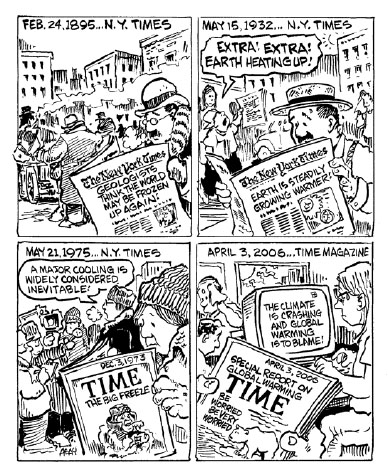
Underlying the global warming debate is an unacknowledged fear - a subconscious, irrational fear of THE END OF THE WORLD. A few decades ago climate experts were warning us that we were facing another ice age. Now we are told that we face a catastrophe of global warming. All the while, there is a Greek chorus of scientists whipping up our innate fear of an apocalyptic cometary impact.
All of these anxieties are irrational. We have no
modern experience of them.
Meanwhile, human behavior will continue to be irrational until we understand our true history and place in an electric and sometimes catastrophic universe.
|