|
Since ancient times spiritual teachers have described paths and practices that a person could follow to achieve health, happiness, and peace of mind.
Considerable recent research has indicated that any sort of spiritual practice is likely to improve ones prognosis for recovering from a serious illness. Many of these approaches to spirituality involve learning to quiet the mind, rather than adhering to a prescribed religious belief.
These meditative paths would include all the mystic branches of Buddhism, Hinduism, mystical Christianity, Kabalistic Judaism, Sufism, and many others. What is hinted at in the subtext of these teachings is that as one learns to quiet his or her mind, one is likely to encounter psychic-seeming experiences or perceptions.
For example, in The Sutras of Patanjali, the Hindu master tells us that on the way to transcendence we may experience all sorts of amazing visions, such as the ability to see into the distance, or into the future, the ability to diagnose illness, and to cure them.
But, we are told not to get attached to
these abilities - they are mere phenomena standing as stumbling
blocks on the path to enlightenment. In this paper we describe the
laboratory evidence for some of these remarkable phenomena, and
their implications for science, mental health, and peace of mind.
They are all in touch with their interconnected mind as well as their community of spirit. As we move into the new millennium, in every area of human activity we are experiencing a climax in which science and religion are finally becoming coherent in the exclamation of a single unified truth.
In my work with remote viewing research at Stanford Research Institute, we observed the in-flow of information that is the hallmark of psychic perception. We also saw an out-flow of intention that plays a part in facilitating distant healing. My purpose here is to show that the in-flow and the out-flow reside on either side of the quiet mind, and that self awareness can arise between these two flows.
We have also noticed that narrowly
focusing on phenomena, and the seeming omniscience available from
ESP may be just a trap that prevents us from discovering who we
really are, and what we should be doing. However, as we describe in
The Heart of the Mind,1 we
are confident that whenever any one person demonstrates an ability
beyond the ordinary, it is can be seen as an inspiration to the rest
of us, as an indication of an immense and still largely undeveloped
human potential.
It has now been demonstrated repeatedly that quanta of light that are sent off in opposite directions at light speed, maintain their connection to one another, and that each little photon is affected by what happens to its twin, many kilometers away.
This surprising coherence between
distant entities is called non-locality. In writing on the
philosophical implications of nonlocality, physicist Henry Stapp
of the University of California at Berkeley says these quantum
connections could be the “most profound discovery in all of
science.”
Our knowledge of these remarkable abilities allows us to awaken each morning in wonder at the fact that our expanded awareness is not limited by either time or space. And it should have become clear to us by now that although we reside in bodies, there is more to us than skin and bones.
Our quiet moments of self inquiry can
reveal what that “more” is.
For two decades SRI's research was supported by the CIA and other government agencies. I was co-founder of this once secret program which began in 1972.
Our task was to learn to understand
psychic abilities, and to use these abilities to gather information
about the Soviet Union during the Cold War. We have found from years
of experience that people can quickly learn to do remote viewing,
and can frequently incorporate this direct knowing of the world --
both present and future -- into their lives.
Shape, form and color are described much more reliably than the target's name, function, or other analytical information. In addition to vivid visual imagery, viewers sometimes describe associated feelings, sounds, smells and even electrical or magnetic fields. Blueprint accuracy has occasionally been achieved in these double-blind experiments, and reliability in a series can be as high as 80 per cent.
For example, the authors recently achieved 11 hits out of 12 trials in such a series.2 With practice, people become increasingly able to separate out the psychic signal from the mental noise of memory, analysis, and imagination. Targets and target details as small as 1 mm can be sensed. Moreover, again and again we have seen that accuracy and resolution of remote viewing targets are not sensitive to variations in distance.
In 1984 I organized a pair of successful
10,000 mile remote viewing experiments between Moscow and San
Francisco with famed Russian healer, Djuna Davitashvili. Djuna’s
task was to describe where our colleague would be hiding in San
Francisco. She had to focus her attention ten thousand miles to the
west, and two hours into the future to correctly describe his
location. These experiments were performed under the auspices and
control of the USSR Academy of Sciences.
This trial was such a stunning success that we were forced to undergo a formal Congressional investigation to determine if there had been a breach in National Security. Of course, none was ever found, and we were supported by the government for another fifteen years.
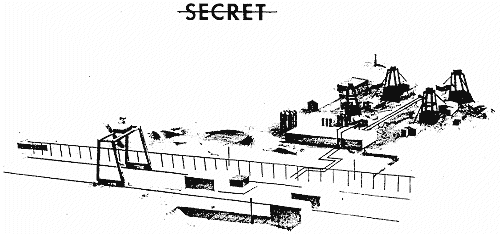
As I sat with Price in these experiments at SRI, he made the sketch shown below right, to illustrate his mental impressions of a giant gantry crane that he psychically “saw” rolling back and forth over a building at the target site!
Above right is Pat Price’s drawing of his psychic impressions of a gantry crane at the secret Soviet research and development site at Semipalatinsk, showing remarkable similarity to a later CIA drawing based on satellite photography shown at left.
Note, for example, that both cranes have eight wheels.
Here is a CIA artist tracing of a
satellite photograph of the Semipalatinsk target site. Such tracings
were made by the CIA to conceal the accuracy of detail of satellite
photography at that time.
The twenty years of remote viewing
research we conducted for the CIA is outlined in Miracles of
Mind: Exploring Nonlocal Consciousness and Spiritual Healing,
co-authored by Targ and Katra.4
In this series we were trying to describe the day-to-day activities of Hal Puthoff as he traveled through Columbia, in South America. We would not receive any feedback until he returned, and I therefore had no clues at all as to what he was doing. I closed my eyes and immediately had an image of an island airport.
The surprisingly accurate sketch I drew is shown below. What we learned from this trial, is that even a scientist can be psychic, when the necessity level is high enough.
Sketch produced by physicist Russell Targ, when he spontaneously took the role of remote viewer in the absence of psychic Pat Price.
This photograph shows the target, which was an airport on an island off San Andres, Colombia.
Targ correctly saw,
"Ocean at the end of a runway."
Recent research in areas as different as distant healing and quantum physics are in agreement with the oldest spiritual teachings of the sages of India, who taught that “separation is an illusion.”
This concept suggests that there is no distance for consciousness, and we have an intuitive inner knowledge of time and space. In fact, we now know that information from the future regularly filters into our dreams - one could fairly say that these precognitive dreams indicate that the future affects our past.
That is, our dream tonight may sometimes
be caused by an event which we will experience at a later time - strongly violating our ordinary understanding of causality. In
research by the authors, who are respectively a physicist and a
spiritual healer, we have been exploring how our mind’s ability to
transcend the limits of space and time is linked to our now
well-documented capacity for distant healing.
It is as though our bodies reside in the familiar four-dimensional geometry of Einstein’s space-time, while our consciousness has access to another aspect of this geometry that allows us to find a mental path of zero distance to seemingly distant locations. This is how a physicist expresses such an idea, while mystics for the past three millennia tell us from their experience that “separation is an illusion - and we are all one in spirit, or consciousness.”
From experimentation in laboratories
around the globe, it is clear that we significantly misapprehend the
physical nature of the space-time in which we reside. It is this
knowledge, together with our experience, that drives our passion to
understand and learn more about the universe and the
transformational opportunities offered us.
He wrote that:
Distant Mental Influence of Living Systems
We do not yet understand the causal mechanism involved, but the results are indisputable, and have obvious implications for our ability to facilitate healing in others. We take for granted the calming effects that a mother’s gentle cooing has on her distressed infant, not really thinking about the effects of her soothing intentions.
How do we know that our thoughts affect others?
A significant body of research now
exists demonstrating that one person’s focused intentions can
directly influence the physiological processes of someone far away.
“Do unto others as you would have them do unto you” takes on new
meaning when you realize we are all truly connected, as the
following research studies show.
They have repeatedly shown that if a person simply attends fully to a distant person whose physiological activity is being monitored, he or she (acting as a sender) can influence the distant person's autonomic galvanic skin responses. In four separate experiments involving 78 sessions, one person staring intently at a closed-circuit TV monitor image of a distant participant, influenced the remote person's electrodermal (GSR) responses.
In these cases no techniques of intentional focusing or mental imaging were used by the influencer.
He or she simply stared at the "staree's"
image on the video screen during the thirty-second trials which were
randomly interspersed with control periods.
In other words, the more shy and introverted people reacted with significantly more stress to being stared at than did the sociable and extroverted people. Quiet introverts may possess, or have developed, a sensitivity of consciousness that others are less aware of.
This experiment gives scientific
validation to the common human experience of feeling stared at and
turning around to find that someone is, indeed, staring at you.
There is also the experience of
presentiment, wherein one has an inner sensation - a gut feeling
that something strange is about to occur. An example would be for
you to suddenly stop on your walk down the street because you felt
“uneasy,” only to have a flower pot then fall off a window ledge and
land at your feet - instead of on your head. That, of course, would
be a useful presentiment.
Researcher Dean Radin at the
Boundary Institute, in Los Altos, California, has shown in his
research that this orienting response is also observed in a person’s
physiology a few seconds before viewing the scary picture! If ESP
were an electro-magnetic phenomenon, this would be called an
advanced wave.
Of course, fear is much easier to measure physiologically than bliss. Here, it seems, your direct physical perception of the shocking picture, when it occurs, causes you to have a unique - five seconds earlier - physical response.
Your future is affecting your past.
These intriguing experiments are also
described in Radin’s comprehensive book
The Conscious Universe.
7
The Pharaohs of ancient Egypt viewed healers as revered advisors. And it was healers who actually founded the world’s great religions: Gautama Buddha, Jesus of Nazareth, and the prophet Muhammad were all gifted healers. The earliest Christians were primarily a healing community.
And
centuries before Jesus, the Hebrew prophets Elijah, Elisha, and
Isaiah were acknowledged healers; and Moses is said to have healed
many Israelites from serpent bites.
In contrast, the progression of Western thought has largely ignored the broad range of mind-to-mind healing that has worked in other cultures. With our reverence for Humanism and Reason, we have much to relearn about the role of consciousness in healing.
Only now are
we realizing the power of the mind to heal through the scientific
method. In recent years, a number of pioneering experiments have
explored the role one person’s consciousness may have on another
person’s health.
Their research hypothesized
that an intensive ten-week distant healing intervention by
experienced healers located around the U.S. would benefit the
medical outcomes for a population of advanced AIDS patients in the
San Francisco area.
Each of them had more than five years experience in their particular form of healing.
They were from Christian, Jewish, Buddhist, Native American, and shamanic traditions, in addition to secular “bio-energetic” schools. Each subject in the healing group was treated by a total of ten different healers on a rotating healing schedule. Healers were asked to work on their assigned subject for approximately one hour per day for six consecutive days, with instructions to “direct an intention of health and well-being” to the subject they were attending to.
None of the forty subjects in the study
ever met the healers, nor did they or the experimenters know into
which group anyone had been randomized.
The treatment group experienced significantly better medical and quality of life outcomes (odds of 100 to 1) on many quantitative measures, including,
Dr. Targ concludes,
The editor of the journal introduced the paper thus:
Two other studies of distant healing have been published in prestigious medical journals. In 1988 Dr. Randolph Byrd published in The Southern Medical Journal a successful double-blind demonstration of distant healing. The study involved 393 of his cardiac patients, at San Francisco General Hospital.10
And in 1999,
cardiologist William Harris of the University of Missouri in Kansas
City, published a similar successful study with 990 heart patients.
His paper appeared in The Archives of Internal Medicine.11
We aren’t even alone in experiencing the effects of
our own thoughts!
They are tuning in to access and affect
the exchange of information.
It is evident that a person need not believe or take on faith anything about the existence of universal spirit, because the experience of God is a testable hypothesis, as we describe below. However, philosophical proof is not our purpose.
Rather, we have become aware that this experience is available to anyone seeking a spiritual life who at the same time desires to remain a critical and discerning participant in the twenty-first century. We can include God in our lives without giving up our minds, if we can transcend our usual analytical thoughts and learn to become mindful.
A scientist might pray, or search for
“the peace which passes understanding” as a way to experience the
truth without conscious thought.
Wisdom teachers throughout history have shown that the experience of God is possible without belonging to a church or following a religion, as long as one’s basic motive is to discover truth.
Dr. Herbert Benson recently proposed that we - our bodies and our brains - are “hard-wired for God.” By this he means that throughout the past twenty-five hundred years - from Buddha, Jesus, and the Baal Shem Tov (the founder of Hassidic Judaism), to such poets as Rumi, Blake, and Emerson - mystics have shared a common experience that is actually available to us all.
In all the mystic paths, the experience of God is celebrated, rather than the belief in God, or the religious ritual.
The Sufi poet Rumi shared his thoughts which arose after experiencing his own divinity:
Whenever we sit peacefully and quiet our mind, we have an opportunity to experience an oceanic connection with something outside our separate self.
To many, that connection
is experienced as an overpowering feeling of love, and it may well
constitute part of our evolutionary process as a species.
The gift of a quiet mind allows us to understand what it means to be in love, like being immersed in loving syrup, as contrasted with being in love with another person. It is possible to reside in love (or gratitude) as a way of life.
This experience is the source of the
often-heard expression that “God is love,” which in an ordinary
context is easily dismissed as a simple cliché, or worse, as not
even comprehensible.
Hindus call it “bliss,” or ananda. And Buddha called it a state of “no-mind,” meaning the absence of thoughts disrupting awareness of indivisible unity. This state is available to us now, while we reside in the world, whether or not we know or follow any religious teachings.
Psychologist Joan Borysenko has written,
The Path Of Self Inquiry
These Logical Positivists proclaimed that nothing meaningful could be said about God, because no experiment could be designed to either prove or disprove (verify or falsify) whatever one might say.
But, by the end of their lives, both Wittgenstein and Ayer were willing to seriously examine the idea that the experience of mystics might actually be considered data - something observable in an experiment. In fact, in Wittgenstein’s last book, On Certainty, he gave primacy to experience over theory.
This pre-eminent logician tells us,
For thousands of years, various wisdom teachers have presented a world view to all who will listen.
They have described a “sit down
and be quiet” practice that is available for all to observe and
experience. They then invite us to examine our experience, and see
if it corresponds with their teaching. Ultimately, this seems like
an acceptably scientific, empirical approach to spirituality.
God is an active personal experience
rather than a distant entity in the sky. Our five familiar senses
bring us data of the material world, while filtering out and
limiting our exposure to the wider, transcendent world of active
awareness available to the quiet mind. The direction of our
attention is the most powerful tool we have to transform our lives.
None of these approaches suggest that we must embrace any body of dogma, or that we need to integrate Santa Claus into a scientific view of the modern world.
They do, however, invite us to look beyond our
thinking mind to discover who we are.
Despite owning more possessions than any people in history, despite our advanced learning, sophisticated communication and technological apparatus, our lives often seem overshadowed by feelings of isolation, despair, and powerlessness. And we feel this during the greatest period of prosperity and good health in history.
We seem unable to change the course of
our individual lives, our communities, or our environment, where
life often seems hopelessly threatened. This frustration occurs
because our wealth and all its distractions cannot substitute for
what is really essential - our ability to take control of our own
minds, and investigate the source of our consciousness.
And from the ancient Hindu Vedas, as well as the contemporary teaching of A Course in Miracles, we learn that we give all the meaning there is, to everything we experience. While we can’t always control the events around us, we do have power over how we experience those events.
At any moment, we can individually and collectively affect the course of our lives by choosing to direct our attention to the aspect of ourselves which is aware - and through the practice of self inquiry, to awareness itself.
We can ask, “Who is aware?” and then, “Who wants to know?”
The choice of where we put our attention is ultimately our most powerful freedom. Our choice of attitude and focus affects not only our own perceptions and experiences, but also the experiences and behaviors of others. Spiritual teacher Gangaji, who points to the path of self-inquiry, reminds us that we are “already completely whole, totally free, and permanently at peace.”
She suggests that we are beings of consciousness, participating in what the authors would call non-local awareness.
She writes:
Mahatma Gandhi taught that,
Heaven and Hell are available for the asking, but no experience can take place in our lives except in our consciousness, and with our agreement.
A master told his student:
We conclude that the scientific and
spiritual implications of psychic abilities are evident in the
continually unfolding mystery of the space-time in which we live.
And a quiet mind has the opportunity for experiencing itself as love
that is timeless, eternal, and unseparated by our bodies.
It has the following to say about the purpose of this surrender - and the life-changing power of transcendence packed into the simple-seeming idea that “I rest in God:”
|