|
'Mound Builders - Edgar Cayce's Forgotten History of Ancient America'
DNA analysis on Native Americans began in the 1980s, but with rapid technological improvements, research intensified in the early 1990s.
Several teams of genetics researchers at prominent American universities have been conducting numerous studies. Although results from early studies showed the expected Siberian-Asia ancestry of the majority of modern Native American tribes, things took an unexpected turn in 1997.
At that point it was found that a small percentage of modern Native Americans have an unusual type of DNA then known to exist only in a few locations in Europe and the Middle East. Subsequent research indicated that the European DNA was not the result of genetic mixing after Columbus. In addition, the same DNA was later found in the bone of an ancient American burial confirming that people carrying this unique DNA had entered America in ancient times.
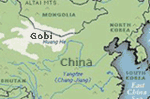
However, in July 2001, this unique gene was also found in a small tribe living in the northern Gobi Desert area.
The DNA research initially seemed to promise solid proof of not only where the ancient Americans came from, but also when they came. However, as might be expected, ancient DNA research has become a highly contentious issue with several competing sides.
Thus, the mitochondria have their own unique DNA, which is simpler and easier to analyze than the human DNA found in the nucleus.
There are 39 different, distinct mtDNA groups into which all humans fit and there are variations on these types.
Thus, two important factors can be determined through analysis of mtDNA.
One way to view mtDNA testing is that it may be able to provide a racial family tree extending back to the beginning of humanity. The current idea in mtDNA analysis is that ancestry on the female side can eventually be traced back to a genetic "Eve." The 39 types of mtDNA were presumably derived from this Eve.
Whether this idea will be completely confirmed by research remains to be seen. However, mtDNA testing has confirmed several oral traditions passed down through many generations in several tribes. For example, the indigenous people of Hawaii and Polynesia have long asserted that their ancestors frequently traveled back and forth and that they shared ancestry.
Genetic testing showed that these two groups were related and confirmed the migratory legends of these peoples.
This means that the Native Americans are derived from four different lineages. These haplogroups were also found in native populations in Central and South America. Later mtDNA research utilizing ancient remains recovered in the Americas validated these four haplogroups.
Three of these haplogroups, A, C, and D are found primarily in Siberian Asia. The B haplogroup, however, is found only in aboriginal groups in Southeast Asia, China, Japan, Melanesia, and Polynesia.
Group B, they assert, probably came to America from the South Pacific or Japan via boats. It is believed the B groups began this migration not long after the A, C, and D groups arrived. However, the majority of the B group arrived about 11,000 B.C. This leaves open the possibility of several migrations by the B group from different locations.
This group, called "X," is present in three percent of living Native Americans, Haplogroup X was not then found in Asia, but was found only in Europe and the Middle East where two to four percent of the population carry it. In those areas, the X haplogroup has primarily been found in parts of Spain, Bulgaria, Finland, Italy, and Israel.
In July 2001, a research letter was published in the American Journal of Human Genetics, relating that a few people with the "X" type had been identified in a tribe located in extreme southern Siberia. These people, called the Altasians, or Altaics as Russian geneticists refer to them, have always lived in the Gobi Desert area.
Archaeologists and geneticists are certain that the presence of "X" in America is not the result of historic intermarriages. It is of ancient origin. In addition, the "X" type has now been found in the ancient remains of the Basque.
It is important to note that not all Native American tribes have been categorized by mtDNA analysis and that relatively few ancient remains have been tested.
The Americas were settled early and many different racial groups came. Several different waves of migration probably occurred. The Initial wave seems to have occurred around 35,000 B.C. However, It may have been far earlier since some of the recent radiocarbon dates that have emerged from areas like California and the southwest point to 50,000 B.C.
But it must be kept in mind that mtDNA analysis is still in its infancy. Not all current Native American tribes and very few remains have been tested. But the picture the mtDNA research findings paint of ancient America is astonishing.
With the X type being present in the Middle East, Europe, the ancient Basques, and America, a migration from the Gobi to all of these areas is doubtful.
This is what has been found.
Both Chinese and Japanese archaeologists take the idea of Mu seriously, and the B haplogroup findings closely match the story Cayce told about the continent. Most of the people of Mu who escaped the destruction in 50,000 B.C. escaped to China, India, and Japan.
Some time later, descendants of these peoples could have traveled to America. While Cayce said that some people from Mu entered the Americas about 50,000 B.C., he did not indicate that date as the time period when the majority of them came.
We only know that it was after 50,000 B.C. and prior to 28,000 B.C.
These migrants came from Atlantis, China, and from "across the Pacific." The 28,000 B.C. date matches well with the haplogroups A, B, C, and D proposed dates of entry into America. The Cayce readings do have references to the Bering Straits, but Cayce did not relate that there were migrations across it. In fact, no one ever thought to ask him about this, so it remains an open question in the Cayce story.
But the A, C, and D haplogroups clearly originated in Siberia just as the archaeologists have speculated. Cayce stated that the "yellow" or Mongol race of humanity originated In the Gobi and gradually spread throughout Asia.
Thus, according to Cayce, haplogroups A, C, and D probably originated in the Gobi and would be the migrations Cayce cited as coming from "across the Pacific".
The majority of these Atlantean survivors went to the Northeastern coastal areas of America and Canada becoming the Iroquois. It should be recalled that Cayce also stated that not all of the Iroquois were Atlantean. The Atlanteans migrating to the Americas merged with the people already present in America by that time.
The Atlanteans became leaders of the tribes. Cayce's story makes it clear that the the Atlanteans had serious disputes among themselves that were reflected in ongoing violent conflict (this was the struggle between the Belial and Law of One groups.) This is confirmed by the Iroquois' ancient history that tells of constant battles resulting in distant displacements of entire tribes to ensure their survival.
The X group also appears to have shown up in ancient Iberia and in the Basques about the same time as well as in the Gobi.
These dates match Cayce's story of the
final two destructions of
Atlantis and the resulting
migrations to these areas.
The word Gobi appears 99 times on the Cayce CD ROM. It appears in under a 100 life readings. Several readings call the Gobi the "Sun Land" and indicate that sun worship dominated (2067-4; 2091-1.)
In March 1935 Cayce referred to a city buried under the sands of the Gobi (873-1), and in 1936 he called this city the "City of Gold." He also stated that this city would probably be discovered in the future. (877-12; 1554-3; 2402-2).
One characteristic of the Gobi civilization was the implementation of a social structure apparently much like the Mississippian Era mound builders had (2067-4; 1505-1). The rulers were held in high esteem and lived in temples.
In a 1940 reading, Cayce referred to terraced buildings and temples in the Gobi (2067-4). A group from the Gobi was identified as having DNA bearing the "X" Haplotype in 2001.
This group may be related to the
Atlantean Genetic type and the Basques.
|

 Gobi
Gobi