|

by Montalk
May 11, 2010
from
Montalk Website
Officially, tuning forks
were invented in 1711 by John
Shore, a British Musician. Unofficially, their existence traces
back to ancient Celtic and Egyptian times.
Nowadays they are used mainly for testing hearing, tuning musical,
keeping time in a quartz watch, and teaching the principles of
vibration and resonance in the classroom. The alternative health
community uses tuning forks for healing purposes.
But what did the ancients use them for? I believe they were mainly
used to cut, drill, and levitate stones. I will provide some
information in this note regarding these applications.
First consider this photo of the
Abernethy
Pictish Stone in Perthshire,
Scotland:

There you clearly see a tuning fork and
hammer. If both are drawn to scale, then the tuning fork is quite
large.
A hammer would be needed to strike so
large a fork. This fork was likely made of bronze, just as bells are
made of bronze, due to the ideal stiffness and resilience of the
material allowing for prolonged vibrations. Other materials like
stone, iron, copper, and wood are unsuitable. Also, the Pict/Celt
civilization traces back to Bronze Age.
To the right of the fork is what looks like an anvil, ax-head, or
horn.
Horns have acoustic applications, as
explained on Wikipedia:
A horn loudspeaker is a complete
loudspeaker or loudspeaker element which uses a horn to increase
the overall efficiency of the driving element, typically a
diaphragm driven by an electromagnet. The horn itself is a
passive component and does not amplify the sound from the
driving element as such, but rather improves the coupling
efficiency between the speaker driver and the air.
The horn can be thought of as an
“acoustic transformer” that provides impedance matching between
the relatively dense diaphragm material and the air of low
density. The result is greater acoustic output from a given
driver.
It’s also worth mentioning that this
stone is positioned right in front of a round stone tower.
If you read the
works of
Phil Callahan you’ll know these
towers, made of highly diamagnetic stone, served exotic/occult
functions. Their inner floor is made of dirt and raised off the
ground at varying levels, which Callahan theorizes was to allow fine
tuning of the resonant frequency inside the tower by varying the
height of the inner space.
Underneath is a tulip growing from a rounded surface with swirl
patterns reminiscent of
cymatic patterns in liquids.
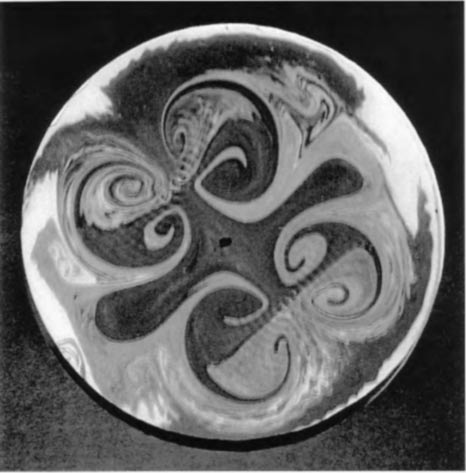
For comparison, here is an image of
liquid being subjected to vibrations (from Hans Jenny’s book
“Cymatics, Volume 1”, page 58):

In the above picture, vibrations form
standing waves in the liquid, which impart vortical currents in the
water that form swirl patterns in dye or oil. These vibrationally induced patterns are
virtually identical to design elements found on Pictish and Celtic
artifacts.
Next, consider these symbols on an Egyptian statue of Isis and
Anubis (from
Cristalinks):

There you see two tuning forks joined to
each other by strings.
The left fork is joined at two
vibrational nodes, the right at three, possibly implying a 2:3
frequency ratio between the two forks which is the musical interval
known as a “perfect fifth” (aka the power chord for you metalheads).
Beneath them is a four-shaped leaf pattern reminiscent once again of
a flower. Then a dish or convex lens. And further down on the left,
that same anvil or bullhorn flare shape.
So, what are the chances that an old Pictish stone in Scotland would
show several of the same symbols as a carving from ancient Egypt?
Both show tuning forks, flower shape, flare shape, and possible
liquid associations (one a cymatic liquid swirl, the other a dish
that can hold liquid).
Only the Pictish stone shows a hammer, and only the Egyptian carving
shows an extra fork connected by strings. These differences merely
suggest different ways of setting the fork into vibration.
Consider the following anecdote reported
in 1997 (from
keelynet):
Some years ago an American friend
picked the lock of a door leading to an Egyptian museum
store-room measuring approx 8 feet x ten feet. Inside she found
“hundreds” of what she described as “tuning forks”.
These ranged in size from approx 8 inches to approx 8 or 9 feet
overall length, and resembled catapults, but with a taut wire
stretched between the tines of the “fork”. She insists,
incidentally, that these were definitely not non-ferrous, but
“steel”.
These objects resembled a letter “U” with a handle (a bit like a
pitchfork) and, when the wire was plucked, they vibrated for a
prolonged period.
It occurs to me to wonder if these devices might have had
hardened tool-bits attached to the bottom of their handles and
if they might have been used for cutting or engraving stone,
once they had been set vibrating.
The technical details in this anecdote
are too clever to be made up, in my view.
The wide U-shape is not something you
ever see in commercial tuning forks, but they are precisely what is
needed to have strings strung between the tines.
Notice how the Egyptian photo above also shows strings and tuning
forks, and that’s from a verified ancient Egyptian artifact. Strings
strung this way (either between forks, or between the tines of a
fork) as on a harp, piano, or guitar, can be tightened to the exact
same pitch as the tuning fork, and thus by bowing or plucking them,
the fork can be set to vibrate without need for a hammer blow.
This feature is likewise never seen in
modern commercial tuning forks. Bowing the string would be ideal, as
it would make for a steady vibration, just as a violin can be bowed
to make an extended note. That the largest forks were 8-9 feet long
indicates some seriously low pitches and/or powerful and prolonged
sounds were required.
Whereas tuning forks can nowadays be vibrated through electronic
drivers that use a pulsing magnetic field to set the tines in
motion, in ancient times simple striking, bowing, and plucking did
the job equally well.
These vibrations may then be applied
toward drilling, shaping, and levitating stones.
Sonic Drilling
You can’t drill and shape stones as you would metal or wood,
especially hard stones like granite, because they are made of
extremely hard mineral particles that overheat and wear down the
tool bit.
Normally it takes a special diamond
cutting wheel and a slowly turning drill bit, lots of cooling fluid,
and very slow progress to drill through granite.
A better method is sonic drilling. Sound vibrations are sent through
a drill bit or even a metal pipe, so that the end in contact with
the stone surface acts as a high-frequency jack-hammer. The drill
barely needs to turn, since it’s the vibrational impacts and
shattering that do the job.
Compared to conventional drilling, this
method is faster, puts less wear on the tool bit, and takes less
energy.
So, conceivably one could turn the handle of a large tuning fork
into a cutting rod, whether a drill tube or drill bit, and thereby
have a sonic drill that can handle hard stones. Even a copper tube
would cut into granite in that case. Or instead of a tube, the end
could be flat like a chisel or spade to cut instead of drill.
To make a tuning fork sonic drill, the resonant frequency of the
cutting rod must match the frequency of the fork it’s attached to.
The way it works is that transverse
vibrations from the tines move the bottom of the U-shape up and
down, which sends longitudinal vibrations down through the cutting
rod.
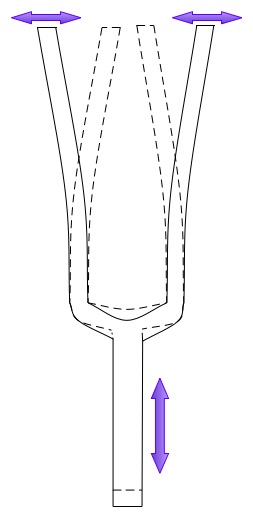
At the rod’s resonant frequency, these
vibrations create standing waves with maximum vibration at the
beginning and end of the rod, and a point of no vibration at the
middle where a perpendicular handle can be attached if needed.
Here are some links on sonic drilling and tuning fork physics:
The frequency of a tuning fork is
approximated by the following equation:
[f = 1/T2 √((A E)/rho)]
(1)
[f] is frequency (Hz)
[T] is length of tine (m)
[A] is cross sectional area of a tine ( [m2] )
[E] is Young’s Modulus of the fork’s material (pascals)
[rho] is density of the fork’s material ( [(kg)/m3]
)
The frequency of a metal rod is:
[f= 1/(2 L) √(E/rho)] (2)
[f= v / (2L)]
[f] is frequency (Hz)
[E] is Young’s Modulus of the rod’s material (pascals)
[rho] is density of the rod’s material ( [(kg)/m3]
)
[L] is length of the rod (m)
[v] is speed of sound in the rod’s material ( [m/s] )
 If
the fork and rod are made of the same material, and if the tines
have a square cross section with width [W] , then setting these
frequencies equal and simplifying: If
the fork and rod are made of the same material, and if the tines
have a square cross section with width [W] , then setting these
frequencies equal and simplifying:
[ L = T2 / (2 W)]
(3)
[L] is length of rod (m)
[T] is length of tine (m)
[W] is width of tine (m)
This simple equation says how long to
make the rod for any given tuning fork size (again, provided the
fork has a square tine cross section and both fork and rod are made
of the same material… if not, then this equation will be slightly
more complicated, but all you do is set (1) and (2) equal and solve
for [L] ).
So let’s plug in some numbers, to get an idea of how a sonic tuning
fork drill would look. Tines 30 cm long and 3 cm thick makes for a
resonant frequency of 1100 Hz and requires a rod 1.5 m long. Here is
a picture drawn to scale (image right):
Notice how long the handle is, relative
to the fork, and how this actually looks like a trident or harpoon,
and can function as such if the tines are sharpened. This is
reminiscent of Neptune, the god of Atlantis. This aquatic symbol
shows up in the Egyptian myth of Horus (falcon god) striking his
enemy with a harpoon, as well the Egyptians associating their
antediluvian ancestors with the harpoon symbol.
The Celts likewise have their legends
about arriving in Europe after fleeing a sinking island to the
northwest (likely Greenland or Iceland).
In other words, an antediluvian ocean-faring civilization with
advanced technology including harpoon-like tuning forks, may have
split up after the cataclysm, some founding Egypt, others becoming
ancestors of the Druids/Celts/Picts.
Stone
Levitation
The
Great Pyramid, ancient megaliths,
Stonehenge, and Edward Leedskalnin’s “Coral
Castle” in Florida are testaments to a secret technology,
one that allowed people with simple methods to move stones up to
several hundred tons in weight.
Everything points to sound being the principal ingredient.
This is
not the same as acoustic levitation demonstrated in physics labs
nowadays, where little ping pong balls and similar light-weight
objects are levitated by the air pressure impact of standing waves
produced by really loud horns. Rather, I mean sound being the
initiator of a process that ends up altering gravity directly.
This is nowhere more evident than in the size of megalithic stones.
Probably because the smaller the stone,
the higher its resonant frequency, and the more difficult it is to
produce a powerful sound at the required frequency using tuning
forks and/or the human voice.
Both forks and the human voice have a
limited frequency range, generally 100-3000 Hz. If you convert that
frequency range into an allowable range of stone sizes, it matches
the range of megalithic stone sizes around the world.
It was only after the loss of this technology that buildings and
stone structures were built of much smaller blocks. You see this in
Mycenae,
Malta,
Macchu Picchu,
Baalbek, and
Egypt, where the
earliest stones are huge and precisely fitted, while the ones added
much later are smaller and usually more roughshod.
This can only be
because earlier ones were shaped and put in place through an exotic
technology that attenuated gravity.
The largest megalith is the
Stone of the Pregnant Woman at
Baalbek.
It is 21.5 meters long, made of red granite, and weighs an estimated
500-1000 tons. Its resonant frequency, like that of a metal rod,
depends on its length and the speed of sound through it. The speed
of sound in red granite is approximately 4500 m/s, giving a resonant
frequency of 105 Hz.
If its width of 4.8 meters is used
instead, the frequency is 469Hz. Another example, the typical Great
Pyramid block has a length of 2.2 meters, and with speed of sound
through limestone being 3000 m/s, its resonant frequency is 682 Hz.
All these are well within the ideal frequency range of metal tuning
forks and the human voice. Tuning forks only go up so high in pitch
before the
viscoelasticity of the material at that pitch is too much
and the ringing dies down very quickly.
Likewise, the human voice only goes so high. If voice is used, it is
likely through the mystical method of
overtone singing, a vocal
manipulation method that produces a clear ringing sound similar to
that of a tuning fork.
Incidentally, overtone singing establishes standing waves inside the
skull and does inside the head what resonant sound does inside a
stone, as described below.
The cross-section of the skull bears
similarity to the top-view of Stonehenge, in the sense of a circular
arrangement of mineral around a cluster of smaller stones in the
center, in this case the smaller stones being the calcine formations
inside the pineal gland.
Furthermore, if you watch (below) the first 15
minutes of
Meetings with Remarkable Men (Gurdjieff autobiography)
you’ll see precisely this method used to make the rocks sing.
Gurdjieff
Meetings With Remarkable Men
Peter Brook, one of the pioneers of the experimental theatre
movement of the 1950s and 1960s,
was the director of Meetings with
Remarkable Men.
Brook tells the story of Asian mystic G. I. Gurdjieff, here played by Dragan Maksimovic.
Gurdjieff devotes his
entire existence, from youth to old age, in quest of the meaning of
life.
He eventually develops a form of meditation incorporating
modern dance.
Terence Stamp, who in Meetings with Remarkable Men
plays Prince Lubovedsky,
himself briefly retreated from his career
after this picture, in favor of Eastern meditation.
And lastly, see
Chapter 18 of Bringers
of the Dawn for discussion on sound being used to psychometrically
extract knowledge from the hollow skulls of deceased spiritual
masters, similar to how, according to the
Cassiopaean Transcripts,
Stonehenge was used to download information into the crown chakra
through overtone singing (termed “tonal rill” in the transcripts).
Piezo-Electro-Gravitation
So how does sound do its thing in a stone?
Well, when a stone vibrates at its
resonant frequency, a standing wave of compression/expansion sets up
within it. What makes stones unique is that they are piezo-electric,
meaning they convert pressure into electricity.
Therefore, applying
sound to a stone converts that sound into electromagnetic or electrogravitational energy.
Imagine that - you hit a large tuning fork with a hammer, apply the
bottom of its handle to the side of a stone, the stone vibrates in
sympathy, standing waves arise within the stone, and those standing
waves turn into electromagnetic or gravitational waves.
How gravitational waves are produced this way is implied in my other
physics Research Notes. In short, longitudinal acoustic waves in
stones create longitudinal magnetic vector potential waves within
the stone, thanks to the piezoelectric effect, and these are
identically gravitational potential waves.
When gravitational potential waves are made to be standing waves,
you have a stable gravitational node or
antinode at the center of
the stone - essentially an artificial vibrating center of gravity.
That alone may affect the stone’s weight (not to mention, may open
portals if the gravitational node is sufficiently intense).
Now, by additionally muting the opposing end of the stone (say
through a non-vibrating rod pressed against it) the node shifts a
bit off center, thereby unbalancing the stone’s center of gravity.
If shifted upwards, the stone will become lighter.
The point of
muting and point of applied vibration can be shifted to direct the
stones.

So, the same technology used to drill,
cut, and shape stones, can also be used to levitate them through an
acoustic-electric-gravitational coupling process.
Here is a photo of Edward Leedskalnin, a Lithuanian stonemason who
single-handedly built
his rock-park in Florida. It’s a mystery how
he was able to lift such heavy stones and even packed up and moved
his entire park ten miles by himself to a new location.
There you see a metal auto axle with
wire wrapped around it, mounted on a branch that functions as an
electrically insulating support.
Was this an electromagnetic tuning
fork that Leedskalnin applied to the his quarried blocks of coral?
Did the fork (or rather the metal rod) vibrate acoustically and also
electromagnetically? Is that cable going up off the right side of
the device the power cable?
Maybe… I’m just including that here
because it’s an interesting photo (below image).

It’s possible, however, that something more is needed to levitate a
stone than mere vibration; maybe the vibration only loosens the
stone a bit from the laws of physics, and then etheric/psychic/conscious power must be applied to make it move.
But I have no doubt that sound applied to stones, the setting up of
standing waves within them, and the piezoelectric effect play a part
in this process.
The point of this Research Note is to show how
ingenious use of simple technology can conceivably produce marvelous
effects that not even modern technology can replicate, because
modern technology has been neutered and kept from accessing the
secrets of etheric energy and gravity.
|