|
by Carole Smith from GlobalResearch Website
The Guardian newspaper, that defender of truth in the United Kingdom, published an article by the Science Correspondent, Ian Sample, on 9 February 2007 entitled:
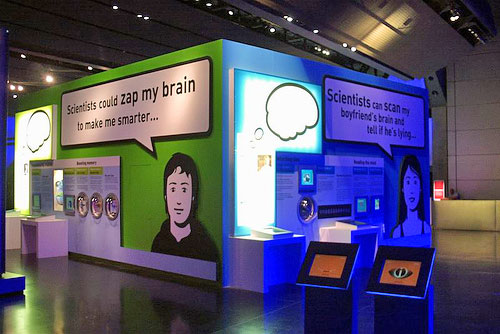
At the same time, London’s Science Museum was holding an exhibition entitled ‘Neurobotics: The Future of Thinking’.
This venue had been chosen for the launch in October 2006 of the news that human thoughts could be read using a scanner. Dr Geraint Rees’ smiling face could be seen in a photograph at the Neurobotics website, under the heading "The Mind Reader".
Dr Rees is one of the scientists who have apparently cracked the problem which has preoccupied philosophers and scientists since before Plato: they had made entry into the conscious mind. Such a reversal of human historical evolution, announced in such a pedestrian fashion, makes one wonder what factors have been in play, and what omissions made, in getting together this show, at once banal and extraordinary.
The announcement arrives as if out of a vacuum. The neuroscientist - modern-style hunter-gatherer of information and darling of the "Need to Know" policies of modern government - does little to explain how he achieved this goal of entering the conscious mind, nor does he put his work into any historical context.
Instead, we are asked in the Science Museum’s program notes:
If Dr Rees has decoded the mind sufficiently for such an announcement to be made in an exhibition devoted to it, presumably somewhere is the mind which has been, and is continuing to be, decoded.
He is not merely continuing his experiments using functional magnetic resolution scanning (fMRI) in the way neuroscientists have been observing their subjects under scanning devices for years, asking them to explain what they feel or think while the scientists watch to see which area lights up, and what the cerebral flow in the brain indicates for various brain areas.
Dr Rees is decoding the mind in terms of
conscious and unconscious processes. For that, one must have
accessed consciousness itself. Whose consciousness? Where is the
owner of that consciousness – and unconsciousness? How did he/she
feel? Why not ask them to tell us how it feels, instead of asking
us.
NEURObotics Exhibition
One gets the distinct impression that we are being softened up for the introduction of radical new technology which will, perhaps, make the mind a communal pool rather than an individual possession.
Information technology seeks to connect us all to each other in as many ways as possible, but also, presumably, to those vast data banks which allow government control not only to access all information about our lives, but now also to our thoughts, even to our unconscious processing.
Does anyone care?
Strapped up with headbands
which pick up brain waves, the game uses neurofeedback, but the
person who is calm and relaxed wins the game. One received the
impression that this calmness was the spirit that the organizers
wished to reinforce, to deflect any undue public panic that might
arise from the news that private thoughts could now be read with a
scanner. The ingress into the mind as a private place was primarily
an event to be enjoyed with the family on an afternoon out:
Uncover a secret store of prototype gadgets
that give you a glimpse into the future of spy technologies and
finally use everything you’ve learnt to escape before qualifying as
a fully-fledged agent!
But there was no-one representing Her Majesty’s government to demonstrate how these very same devices can be used quite freely, and with relative ease, in our wireless age, to conduct experiments on free-ranging civilians tracked anywhere in the world, and using an infinitely extendable form of electrode which doesn’t require visible contact with the scalp at all.
Electrodes, like electricity, can also take an invisible form – an electrode is a terminal of an electric source through which electrical energy or current may flow in or out. The brain itself is an electrical circuit. Every brain has its own unique resonating frequency. The brain is an infinitely more sensitive receiver and transmitter than the computer, and even in the wireless age, the comprehension of how wireless networks operate appears not to extend to the workings of the brain.
The monotonous demonstration of scalps
with electrodes attached to them, in order to demonstrate the
contained conduction of electrical charges, is a scientific fatuity,
in so far as it is intended to demonstrate comprehensively the
capability of conveying charges to the brain, or for that matter, to
any nerve in the body, as a form of invisible torture.
The problem that now arises, at the point of readiness when so much has been achieved, is how to put the technology into action in such a way, as it will be acceptable in the public domain. This requires getting it through wider government and legal bodies, and for that, it must be seen to spring from the unbiased scientific investigations into the workings of the brain, in the best tradition of the leading universities.
It is given over to Dr Rees and his colleague, Professor Haynes, endowed with the disclosure for weightier Guardian readers, to carry the torch for the government.
Those involved may also have noted the need to show the neuroscientist in a more responsible light, following US neuro-engineer for government sponsored Lockheed Martin, John Norseen’s, ingenuous comment, in 2000, about his belief about the consequences of his work in fMRI:
While the neuroscientists report their discovery (without even so much as the specific frequency of the light employed by this scanner/torch), issuing ethical warnings while incongruously continuing with their mind-blowing work, the government which sponsors them, remains absolutely mute.
The present probing of people’s intentions, minds, background thoughts, hopes and emotions is being expanded into the more complex and subtle aspects of thinking and feeling. We have, however, next to no technical information about their methods. The description of ‘shining a torch around the brain’ is as absurd a report as one could read of a scientific endeavor, especially one that carries such enormous implications for the future of mankind.
What is this announcement, with its technical
obfuscation, preparing us for?
He quotes Cephos founder, Steven Laken, whose company plans to market the new technology for lie detection.
Laken cites detainees held without charge at Guantanamo Bay as a potential example.
Silberman also quotes Paul Root Wolpe, a senior fellow at the Center for Bioethics at the University of Pennsylvania, who describes the accelerated advances in fMRI as,
Are we to believe that with the implied
capability to scan jurors’ brains, the judiciary, the accused and
the defendant alike, influencing one at the expense of the other,
that the legal implications alone of mind-accessing scanners on
university campuses, would not rouse the Minister for Justice from
his bench to say a few words about these potential mind weapons?
We can assume that the government would certainly not give the go-ahead to the Science Museum Exhibition, linked to Imperial College, a major government-sponsored institution in laser-physics, if it was detrimental to surveillance programs. It is salutary to bear in mind that government intelligence research is at least ten years ahead of any public disclosure.
It is implicit
from history that whatever affords the undetectable entry by the
gatekeepers of society into the brain and mind, will not only be
sanctioned, but funded and employed by the State, more specifically
by trained operatives in the security forces, given powers over
defenseless citizens, and unaccountable to them.
We know therefore that they are using light, but fMRI has been used for many years to attempt the unraveling of neuronal activity, and while there have been many efforts to record conscious and unconscious processes, with particular emphasis on the visual cortex, there has been no progress into consciousness itself.
We can be sure that we are not being told
the real story.
It can distinguish between materials with varying water content – for example fat versus lean meat. These properties lend themselves to applications in process and quality control as well as biomedical imaging.
Terahertz can penetrate
bricks, and also human skulls. Other applications can be learnt from
the major developer of terahertz in the UK,
Teraview, which is in
Cambridge, and partially owned by Toshiba.
A different approach did in fact, elicit a response. When informed of the use of terahertz at Heathrow and Luton airports in the UK to scan passengers, the news that passengers would be revealed naked by a machine which looked directly through their clothes produced a small, but highly indignant, article in the spring 2007 edition of the leading human rights organization, Liberty.
If the reading of the mind met with no
protest, seeing through one’s clothes certainly did. It seems
humans’ assumption of the mind as a private place has been so
secured by evolution that it will take a sustained battle to
convince the public that, through events of which we are not yet
fully informed, such former innocence has been lost.
With the discovery of light to disentangle thousands of
neurons and encode signals from the complex circuitry of the brain,
present programs will not even present the symptoms which simulated
schizoid states. Medically, even if terahertz does not ionize, we do
not yet know how the sustained application of intense light will
affect the delicate workings of the brain and how cells might be
damaged, dehydrated, stretched, obliterated.
In addition to scanning for explosives, we may also assume their integration into hand-held communication systems.
As far back as 1996 the US Air Force Scientific Advisory Board predicted that the development of electromagnetic energy sources would,
The surveillance technology of today is the surveillance of the human mind and, through access to the brain and nervous system, the control of behavior and the body’s functions.
The messaging of auditory hallucinations has given way to silent techniques of influencing and implanting thoughts.
The development of the terahertz technologies has illuminated the workings of the brain, facilitated the capture of emitted photons which are derived from the visual cortex which processes picture formation in the brain, and enabled the microelectronic receiver which has, in turn, been developed by growing unique semi-conductor crystals. In this way, the technology is now in place for the detection and reading of spectral ‘signatures’ of gases.
All humans emit gases. Humans, like explosives, emit their own spectral signature in the form of a gas.
With the reading of the brain’s electrical frequency, and of the spectral gas signature, the systems have been established for the control of populations – and with the necessary technology integrated into a cell-phone.
|