|
by Wallace Thornhill from ThunderBolts Website
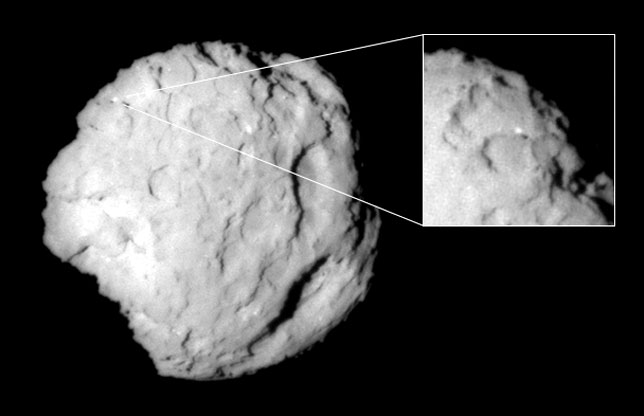
Recent mages of comet Wild 2 may
reveal the telltale sign of electric discharge in the form of
unexplained “bright spots”.
A few have adjacent dark spots that may be shadows cast by the material shooting up from the surface.
Credit: Courtesy NASA/JPL-Caltech
From an Electric Universe point of view, these are the sparks where electric currents from the sun impinge on the more negatively charged surface of the comet. This is where electricity is peeling away the surface of the comet's nucleus.
The material removed from the comet is funneled away in tight jets that twice surprise conventional expectations.
The conventional model expects to find an
even distribution of evaporated volatiles in the coma and tail of
comets. Instead Stardust finds dense concentrations of particles in
the jets themselves and fewer particles than expected in the coma
and tail.
They instead developed the "dirty
snowball" theory of comets, which says that comet displays can be
explained by ice and volatiles (compounds with low melting points)
evaporating under the heat of the Sun.
These arcs also cause the (surprising) dark color
of every comet we've seen up close. They produce the (surprising) x-
rays that the ROSAT x-ray observatory discovered. And they create
the (surprising) streams of rocky particles that pummeled the
spacecraft, Stardust.
These tiny sparks on Wild 2 could light
a fire of discovery for astronomy.
Dec 29, 2004
to watch video, click above image large file
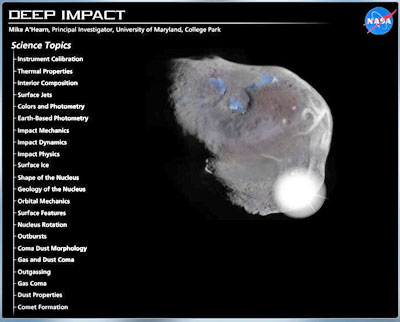
The Deep Impact craft is scheduled for launch between January 12 and January 28, 2005.
Its mission is an unprecedented encounter with a comet nucleus. The target is Comet Tempel 1. NASA plans to fire an 820-pound copper "impactor" toward the nucleus, which is expected to strike the surface at about 23,000 miles per hour. According to NASA scientists, the result should be a release of energy equivalent to that of exploding 4.8 tons of TNT, creating a deep crater.
Fittingly, the scheduled date for the celestial fireworks is July 4, 2005
But all of NASA’s expectations for the encounter are tied to current ideas about comets. The conventional view is that comets are inert chunks of ice and dust, or "dirty snowballs," evaporating in the heat of the Sun.
The alternative view is that comets discharge
electrically as they move through a radial electrical field of the
Sun. No middle ground between the two views seems possible, and if
it happens that the Deep Impact projectile strikes a solid
rock the snowball theory of comets is finished. Mainstream theorists
will be left without an explanation for a comet’s coma and tail.
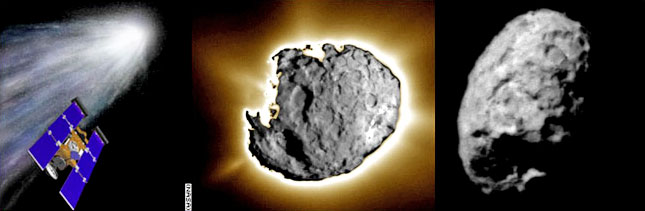
Credit: Stardust Team/JPL/NASA
Indeed, NASA has already encountered dry cometary nuclei.
The surface of comet Borrelly, visited in 2001, proved to be bone dry, prompting investigators to suggest that water must be hidden beneath the surface. Nor did the Stardust flyby of comet Wild 2 in January 2004 identify water on the surface of the nucleus.
The problem with the supposition of subsurface ice is that only a
few inches of dry non-volatile surface material would be sufficient
to insulate the “ice” from the heat of the Sun. Meanwhile the
observed high speed jets are far more energetic than could be
reasonably expected even if there were no insulating material.
Nevertheless, the confidence of investigators was unshaken by what
they saw, for surely the presence of water on comet nuclei is a
fact!
These “spark discharges” finely
machine rocky material from the surface to form a “cathode jet” of
negatively charged dust together with surface matter that has been
torn apart to release ionized atoms and molecules, including oxygen.
A few years later, scientists discovered
an unexpected “forbidden oxygen” line at 1128Å in the spectrum of
Comet Austin. That line is consistent with the presence of an
intense electric field and/or densities in the coma many orders of
magnitude higher than those predicted from standard cometary theory.
The probe Vega 2 found the H2O (water) production by comet Halley was one fifth of the OH production. But scientists had supposed that OH was formed by photo-dissociation of H2O at some distance from the nucleus.
The report in Nature in May 1986 reads:
Such a discovery is most simply explained if the parents of OH were a combination of solar protons (hydrogen) and negative oxygen ions electrically removed from silicates and other minerals in the nucleus.
The greater abundance
of OH would then be expected. It then becomes clear that the water
we see is being produced through electrical exchange: Negatively
charged oxygen from the comet nucleus combines with the positively
charged hydrogen ions from the Sun, via the solar wind.
A principal investigator also spoke of energetic bursts “like a thunderbolt.”
The electrical model of cometary discharge does explain the observations:
This model explains a great number of puzzles about recent comet discoveries.
Often the events most disconcerting to conventional theory are the things most quickly forgotten.
While moving between the orbits of Saturn and Uranus (14 times farther from the Sun than the Earth), Comet Halley experienced an outburst between the orbits of Saturn and Uranus that caused dust to stretch over some 300,000 km.
At that distance from the Sun, the
surface should be in deep freeze at –200 degrees C. But it happened
at a time when the Sun was at maximum activity. This does not mean
that the Sun was producing significantly more heat but rather that
there was a marked increase in the charged particles from the solar
wind. And the vast cloud of dust from the comet fits the electrical
machining model but not the sublimating ices model.
The capture of electrons from the
negatively charged comet by positively charged hydrogen ions in the
solar wind is, of course, nothing else than an electric discharge,
nature’s highly efficient means of X-ray production.
An electric field sufficient to cause electrical discharging on a comet beyond the orbit of Saturn would have the electric potential to power the Sun.
We could no longer ignore the cosmic electricians’ claims:
All theories about the evolution of the planetary system, including our earth, would have to be reconsidered from the ground up.
The nebular hypothesis of planetary origins, claiming that the Sun and planets emerged gravitationally from a primordial cloud, could no longer maintain its intellectual monopoly.
The fabled residue of the hypothesized nebula, the “Oort cloud,” called upon to send comets into the inner solar system as theorists need them, would instantly lose its rationale. And no longer could it be maintained that the planets have moved in clockwork fashion for billions of years.
Even the
accumulated evidence of electrical dramas and planetary upheaval in
the human past would demand a reconsideration.
We have good reason, therefore, to speak
of the imminent prospect of a domino effect being unleashed, one
that will set in motion one of the great revolutions in human
thought and perception.
|