|

by Andre Gsponer and Jean-Pierre Hurni
from
UNIGE-CentreUniversitaireD'Informatique-LeCUI
Website
Introductory note
The extraordinary success of Dan Brown's bestseller
Angels and Demons, and the not less extraordinary reaction of
the CERN laboratory Spotlight on Angels and Demons,
demonstrate how difficult it is to have a rational discussion on the
military implications of so-called pure scientific research, i.e.,
of the kind that is carried out at CERN.
The point is that for over twenty years reputable scientists have
tried to open a debate on the very serious military implications of
the antimatter research carried out at CERN and at similar
laboratories around the world. This has led to a whole series of
technical-level publications, mostly in scientific journals, as well
as to a number of papers in leading journals such as The New York
Times (Huge production of antimatter planned, 27 August 1985, p.
C1 and C3) and Nature (Antimatter underestimated, 26 February
1987, p. 754), which however have received very little attention.
As an example of a general-level publication (with references to
more technical publications) calling for a debate on the prospect of
antimatter bombs, and on the role of laboratories such as CERN in
the research related to these weapons, we are posting the paper
below which was first published in French (La Recherche, Paris),
then twice in English (The World Scientist, New Delhi, and Bulletin
of Peace Proposals, Oslo), then further translated in full or in
part into other languages including Finnish, Russian, Polish, etc.
Concerning Dan Brown's book, as well as CERN's reply to it, there
are numerous (technical and political) mistakes in both. In
particular, the most important technical mistake is to suggest that
large quantities of antimatter are needed to make a very powerful
bomb: this is wrong. As is explained below, and confirmed by
numerous professional publications (see three recent ones at the end
of this Web page), tiny amounts of antiprotons are sufficient to
initiate huge thermonuclear explosions.
Indeed, on the order of one microgram of
antiprotons (or antihydrogen) is enough to trigger a multi-ton or
multi-kiloton thermonuclear explosion!
At CERN (the European Laboratory for Particle Physics), on the
evening of the 17 to the 18 of July 1986, antimatter was captured in
an electromagnetic trap for the first time in history. Due to the
relatively precarious conditions of this first successful attempt,
it was only possible to conserve the antiprotons for about ten
minutes.
This was, nevertheless, much longer than the Americans
Bill Kells of Fermilab and Gerald Gabrielse of the University of
Washington had hoped for.
When these researchers return to CERN for another attempt, an
improved apparatus will permit them to literally 'bottle' several
tens or hundreds of antiprotons. Ultimately, the perfection of this
technique will allow them to carry home a substance infinitely more
rare and difficult to obtain than a piece of the Moon. They would
thus be able to complete, in their own laboratory, a most important
experiment for the theory of the unification of the fundamental
physical forces, that of comparing, with a precision greater than
one part per billion, the masses of the proton and antiproton.
Some other American Scientists, this time coming from the Los Alamos
military laboratory (where the atomic bomb was perfected during the
Second World War), are also at work in Geneva. In a few months time,
using many more resources and more sophisticated equipment, they
also expect to capture and bottle antiprotons, but in much greater
quantities.
They will, as the group from the University of Washington, strive to
divulge the difference in mass between the proton and its
antiparticle. But, they will also attempt a number of complex
manipulations such as, the production of antihydrogen, the injection
of antiprotons into superfluid helium, the search for metastable
states in ordinary matter, etc. Various crucial experiments that
should, in the near future, help to determine whether or not
antimatter could become a new source of nuclear energy for civilian
and military applications. For the more delicate experiments, they
could certainly bring their vintage 1987 or 1988 bottles of
antimatter to Los Alamos.
There, up in the peaceful mountains of
New Mexico, they could perfect nuclear weapons free of radioactive
fall-out, beam weapons projecting thermonuclear plasma jets, gamma-
or X-ray lasers, or other still more secret weapons, all triggered
by antimatter.
A concept more than
40 years old...
Paradoxically, as futuristic and revolutionary as these weapons may
seem, the military importance of antimatter
[1], provided it can be produced, is as old as the
science-fiction that has been talking about it.
For instance, it is
quite possible that Edward Teller, the father of the American
H-bomb, already had ideas of eventual military applications when he
published in 1947, with Enrico Fermi, an article treating the
capture of negative particles heavier than electrons by matter
[2]. It is just as
significant to notice that since 1945, about half of Teller's
non-classified publications and many articles published by Andrei Sakarov, the
father of the Soviet H-bomb, are concerned in one way
or another with antimatter.
In fact, in 1950, two years before the explosion of the first
H-bomb, the ignition by antimatter of a mixture of deuterium and
tritium was already being studied. However, as shown for example in
an article by A.S. Wightman [4]
(studying specifically the problem of the capture of antiprotons by
deuterium and tritium), or in an article by J. Ashkin, T. Auerbach
and R. Marschak [5] (trying
to calculate the result of the interaction between an antiproton and
a nucleus of ordinary matter), the major problem at that time was
that there wasn't any experimental data on which one could make a
precise prediction of what would happen, for example, when a proton
and antiproton met.
Nevertheless, well founded theoretical
arguments already permitted a good understanding of the two
essential characteristics of such a so-called annihilation reaction,
a reaction in which the masses of a particle and its antiparticle
are totally transformed into energy.
These two characteristics are still valid today and entirely justify
the interest in antimatter. The first, is that the release of usable
energy per unit mass is greater in annihilation than in any other
nuclear reaction. One proton-antiproton annihilation releases 300
times more energy than a fission or fusion reaction. The second, is
that when antimatter is brought in the proximity of matter,
annihilation starts by itself, without the need of a critical mass
as in fission, and without the ignition energy needed in fusion.
In short, an ideal nuclear trigger, provided that methods to produce
and manipulate sufficient quantities of antimatter be found. But, at
that time, the how and when antimatter could be produced wasn't
known, and a number of fundamental questions about annihilation were
still outstanding. Consequently, for several years, applied research
concentrated on more promising near term techniques, though less
elegant for the theoreticians.
Thus the problem of igniting the H-bomb
was resolved by using an A-bomb as a trigger, and the existence of
the antiproton remained theoretical until 1955.
The production
of the first antiprotons
Historically, the first antiparticle ever observed was the
antielectron, also called positron. It was discovered in 1932 by
Carl David Anderson, who while observing cosmic radiation, noticed a
particle of the same mass as the electron, but of opposite charge.
Evidently many attempts were made to discover the antiproton, using
the same method, but without success.
With the detectors available at that
time and knowing only its mass and electrical charge, it was
practically impossible to identify with any certitude the antiproton
within the cosmic radiation. It had to be artificially produced. For
that an accelerator, much more powerful than anything built up until
that time, was needed. Briefly, this is how antimatter is produced:
protons are accelerated close to the speed of light, and then
projected at a target. The ensuing collision is so violent, that
part of the energy is transformed into particle-antiparticle pairs.
Once this accelerator was built in 1955 at Berkeley, antiprotons
were "seen" for the first time.
By injecting them into a liquid hydrogen filled detector, the energy
liberated in the explosive encounter of an antiproton and a proton,
was seen to rematerialize into a scatter of other particles,
essentially
pions, shooting off in all directions, and carrying away
with them most of the annihilation energy.
But Edward Teller and his student Hans-Peter Duerr didn't stop there
[6]. In 1956, they forwarded a hypothesis: If instead of
annihilating with a simple hydrogen nucleus, the antiproton
annihilated with a proton or neutron situated in the heart of a
complex atom, such as carbon or uranium, the nucleus in question
would literally explode. This would result in a very large local
energy deposition, thus bringing to light again, in theory, many
civilian and military applications of antimatter.
Thirty years passed by before the complex of machines necessary to
accumulate and slow down antiprotons was conceived. The only system
of this type in the world [7]
is at CERN (Fig.1).

Figure 1 :
Portable
antimatter reservoir
Antiprotons produced at CERN can be
``bottled'' in a Penning trap, and sent by surface or air mail
to an industrial or military laboratory. The largest component
in this ``bottle'' is a liquid-nitrogen Dewar required to cool
the Penning trap itself, located at the bottom of the equipment,
at the height of the
antiprotons's injection/extraction system.
(Pennsylvania State University.)
Finally, it was possible to study, on a
large scale, the meeting of antiprotons with nuclei. As a result, it
has been possible to demonstrate that the energy deposition,
although less than Teller (or others more recently
[8]) had hoped
for, is sufficient to assure the feasibility of military
applications of antimatter. On the other hand, due to its very high
cost and the enormous amount of energy needed to produce it, it has
also become clear that antimatter could never become a usable source
of energy for a power-plant.
Thanks to the results of CERN, we were able to publish in August
1985, an estimation of the number of antiprotons needed to start
thermonuclear reactions, be it to ignite an H-bomb or to trigger the
micro-explosion of a thermonuclear fuel pellet
[9]. We thus
discovered that it is possible to build a H-bomb, or a neutron bomb,
in which the three to five kg of plutonium are replaced by one
microgram of
antihydrogen.
The result would be a bomb so-called
"clean" by the militaries, i.e., a weapon practically free of
radioactive fall-out, because of the absence of fissile materials
(Fig.2).

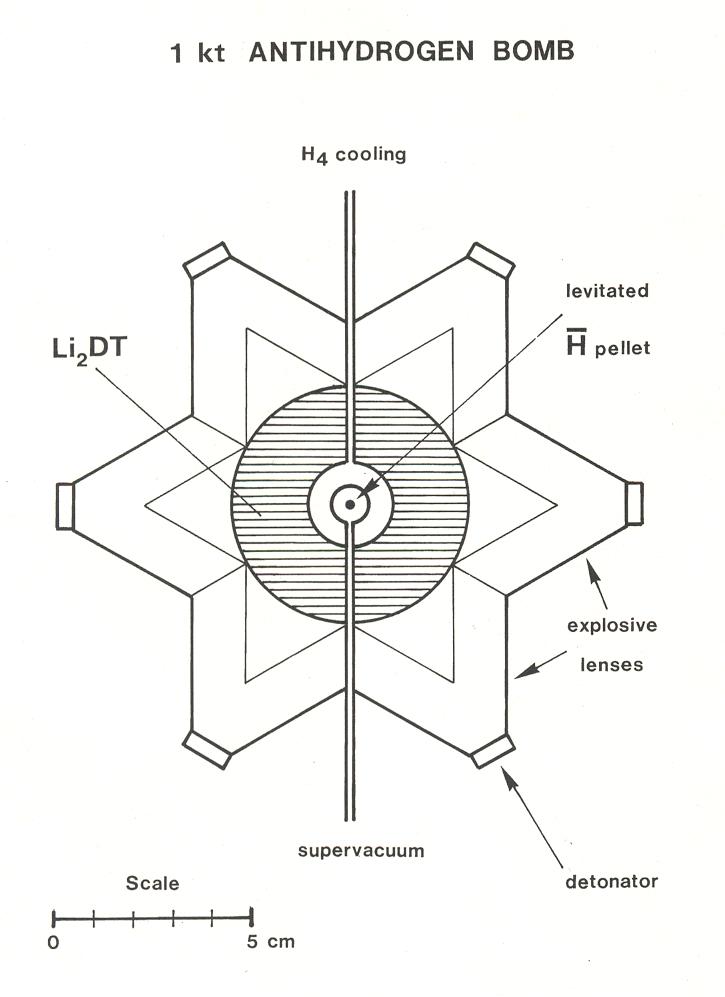
Figure 2 :
Antimatter
triggered hydrogen bomb
It is possible to construct a
thermonuclear weapon in which the three to four kilograms of
plutonium, necessary for the ignition, are replaced by one
microgram of antihydrogen. In this hypothetical bomb, the
antimatter is in the center in the form of a pellet a tenth of a
mm in diameter. It is surrounded by, and isolated from, the
thermonuclear fuel (a 100 g hollow sphere of Li2DT). After
compression by explosive lenses, the fuel comes into contact
with the antihydrogen.
Annihilation reactions start
spontaneously, providing the energy to ignite the thermonuclear
fuel. If the chosen degree of compression is high, a bomb with
increased mechanical effects is obtained, and if it is low, a
neutron bomb (see La Recherche September 1983).
In both cases the electromagnetic
pulse effect and the radioactive fall-out are substantially
lower than that of a conventional A- or H-bomb of the same yield
(1 kt).
The revived military
interest
For such a military use to be realistic, a technology capable of
producing enough antiprotons for at least one antimatter trigger per
day is needed. This corresponds to a minimum production rate of 1013
antiprotons per second, six orders of magnitude higher than that at
CERN today (107 antiprotons per second). But, in theory, there exist
numerous ways to increase this rate [9].
What we were unaware of, was that since
the summer of 1983, the
RAND Corporation had been carrying
out a study for the U.S. Air Force, "examining the possibilities for
exploiting the high energy release from matter-antimatter
annihilation" [10]. Similar
concerns had equally sprouted-up in the Soviet Union
[11]. The RAND study was
completed in 1984. The version published in 1985 constitutes a
serious evaluation of the development possibilities of such an
undertaking, in view of military applications.
According to this document, a definitive evaluation of the
possibility to produce and manipulate 1013 antiprotons per second,
and the construction of transportable antiproton reservoirs, should
be realized within the next five to seven years; many important
technological problems being able to be studied with ordinary
particles instead of antiprotons.
This same report mentions four main
categories of applications: 'propulsion' (fuel for ultra-fast
anti-missile rockets), 'power generators' (light and ultra-compact
for military platforms in orbit), 'directed energy weapons' (antihydrogen
beams or pumped lasers relying on very short duration energy
release) and '"classified additional special weapons roles"'
(various bombs triggered by antimatter).
In addition to the advantages related to its extremely high energy
density and ease of ignition, annihilation has two important
characteristics: the release of energy in a matter-antimatter
explosion is extremely fast (ten to a thousand times shorter than a
nuclear explosion), and most of the energy is emitted in the form of
very energetic light charged particles (the energy to mass ratio of
the
pions emitted in annihilation is
two thousand times higher than the corresponding ratio for the
fission or fusion reaction products).
With the help of magnetic fields, very
intense pion beams can be created, to the order of 100
mega-amperes per microgram of antiprotons. Such beams, if directed
along the axis of an adequate device, can drive a
magneto-hydrodynamic generator, generate a beam of electromagnetic
waves, trigger a cylindrical thermonuclear explosion, or pump a
powerful X-ray laser. In the last case, for example, the pions'
energy could be used to transform in a very uniform plasma, a long
cylinder of a substance such as selenium, whose ionized atoms have
excited states favorable to the spontaneous emission and
amplification of coherent X-rays.
But this is only one of the many
concepts that permit, thanks to antimatter, to conceive X-ray lasers
having efficiencies ten to a thousand times higher than those pumped
by any other known energy sources.
A certain number of experiments, that can only be carried-out with
antimatter, are necessary to perfect these applications.
As long as antiprotons made in Europe
(on Swiss Territory), could be bottled and brought back to the
United States, the RAND Corporation concludes that a
production/accumulation facility, such as the one at CERN, although
desirable, wouldn't in the near future have to be built in the
United States [12].
Fundamental
research or military research?
In view of its considerable strategic potential (for instance,
antimatter seems to be a particularly interesting pump source for
the
Star War's X-ray lasers), it's not at all surprising that Soviet
and American Scientists interested by the eventual applications of
antimatter are eager to come to CERN, which at present has at least
a five year lead in antimatter technology. In this context, it also
wouldn't be surprising if a blunder was made...
In effect, for the teams of American physicists coming from weapons
laboratories, the official justification for their coming to CERN,
is to carry-out fundamental research, pure scientific research. In
the beginning of July 1986, these same Americans were supposed to go
to Madrid, where a full session of the Fourth International
Conference on Emerging Nuclear Systems was dedicated to
antimatter energy concepts. At this same conference we were to
present the point of view that the only realistic applications for
annihilation energy were in the military domain
[13].
To everyone's surprise, the Americans didn't come. Ten days before
the conference, they announced their withdrawal without giving any
convincing explanations. The participants quickly realized that the
American Authorities had undoubtly reevaluated the military
importance of antimatter, and had probably prevented the Los Alamos
Scientists from coming to Madrid [14].
Thus exposing that scientists working at
CERN, and coming from a non-European weapons laboratory, had
other than fundamental research interests, that were obviously
militarily sensitive.
Strategic and
political consequences
Whether antimatter triggered thermonuclear weapons are realizable or
not, or whether other weapons using annihilation energy are feasible
or not, the fact that a relatively small quantity of antimatter can
set off a very powerful thermonuclear explosion creates serious
problems for the future of the strategic balance. In fact, the arms
control treaties presently in force deal only with fission related
devices and materials [15]:
atomic bombs, nuclear reactors and fissile materials.
By removing the fission fuse from
thermonuclear weapons, antimatter triggered H-bombs and neutron
bombs could be constructed freely by any country possessing the
capacity, and be placed anywhere, including outer-space.
Then again, even if technical obstacles prevented, for example, the
actual construction of battle-field antimatter weapons, antimatter
triggered micro-explosions would still allow small and middle sized
thermonuclear explosions to be made in the laboratory. This
possibility would considerably reduce the need for underground
nuclear explosions, thus rendering ineffective any attempt to slow
the arms race by an eventual comprehensive nuclear test-ban treaty
[16].
A nuclear test laboratory of this type
could be based around a large heavy-ion accelerator
[16], which would provide a
means of massive antimatter production, as well as a driver to study
the compression and explosion of thermonuclear fuel pellets.
References and
notes
[1] J. Grinevald, A. Gsponer, L.
Hanouz et P. Lehmann: La quadrature du CERN. Editions d'En Bas,
CH-1017 Lausanne (1984).
[2] E. Fermi and E. Teller: The capture of negative mesotrons in
matter. Phys. Rev. 72 (1947) 399--408.
[3] A. D. Sakharov: Oeuvres scientifiques, Editions anthropos,
Paris (1984).
[4] A. S. Wightman: Moderation of negative mesons in Hydrogen I:
Moderation from high energies to capture by an H2 molecule.
Phys. Rev. 77 (1950) 521--528. (Note: part II of this paper has
never been published.)
[5] J. Ashkin, T. Auerbach and R. Marschak: Note on a possible
annihilation process for negative protons. Phys. Rev. 79 (1950 )
266--271.
[6] H.-P. Duerr and E. Teller: Interaction of antiprotons with
nuclear fields. Phys. Rev. 101 (1956) 494--495.
[7] At the end of 1986 an antiproton production and cooling
system will be put into operation at Fermilab, near Chicago.
However, there are no definitive plans to construct a
deceleration system such as LEAR (Fig.1). As far as the Soviet
Union is concerned, few details are available on the status of
their projects with antimatter.
[8] M.R. Clover et al.: Low energy antiproton-nucleus
interactions. Phys. Rev. C26 (1982) 2138-2151.
[9] A. Gsponer and J.-P. Hurni: Antimatter induced fusion and
thermonuclear explosions. Atomkernenergie--Kerntechnik 49 (1987)
198--203.
[10] B.W. Augenstein: Concepts, problems, and opportunities for
use of annihilation energy. Prepared for the United States Air
Force, RAND Note N-2302-AF/RC, June (1985).
[11] N. A. Vlasov: Annihilation as an energy process. Soviet
atomic energy 44 (1978) 40--45.
[12] Reference 10, page 43.
[13] A. Gsponer and J.-P. Hurni: A href="http://www.arXiv.org/abs/physics/0507114">The
physics of antimatter induced fusion and thermonuclear
explosions. Proceedings of the 4th International Conference on
Emerging Nuclear Energy Systems, Madrid, June 30/July 4, 1986
(World Scientific, Singapore, 1987) 166--169.
[14] The titles of the withdrawn communications were as follows:
-
W.Saylor, S. Howe, D. Holtkamp,
M. Hynes (invited paper): Antimatter production factory -
systems tradeoffs.
-
M.H. Holzscheiter: Antiproton
storage - A new concept for future energy systems.
-
L.J. Campbell: Antiproton
storage in condense matter - The promise, the prospects.
-
S. Howe (invited paper): Use of
antimatter annihilation products to produce usable power for
space based applications.
N.B.: Steve
Howe, of the Los Alamos National Laboratory, who authored
two out of the four withdrawn communications, is the
"physicist and follow scribe" mentioned by Dan Brown in the
acknowledgments of his book Angels and Demons.
[15] A. Gsponer, B. Jasani and S.
Sahin: Emerging nuclear energy systems and nuclear weapon
proliferation. Atomkernenergie/Kerntechnik 43 (1983) 169--174.
[16] C. Deutsch: Inertial confinement fusion driven by intense
ion beams. Annales de Physique 11 (Février 1986) 1--111.
Appendix:
Production and storage of antiprotons
Relativistic
quantum theory predicts the existence of two types of
elementary particles appearing on an equal footing with respect to
the fundamental equations. Thus, for each particle there exists an
antiparticle having the same mass and spin but opposite electrical
charge. Furthermore, particles and antiparticles can appear or
disappear in pairs, due to the transformation of energy into matter
and vice-versa.
Antiprotons and positrons are probably the only forms of antimatter
that will be able to be fabricated, in substantial quantities, in
the near future. They are produced by accelerating protons (or other
particles) to energies such that, when they collide with a target, a
part of the energy is transformed into particle-antiparticle pairs.
In practice, when using a fixed target, as a function of invested
energy, the maximum antiproton production yield occurs when the
protons are accelerated to an energy of about 120 Gev.
Since less than one collision out of
thirty produces an antiproton, and since the mass of an antiproton
corresponds to only 0.94 GeV, the energy efficiency is very poor.
From this point of view, a better solution would be to use a
collider-ring in which the antiprotons would be produced by the
head-on collisions of protons turning in opposite directions. In
theory, an even higher yield could be obtained if conditions similar
to the original "Big Bang" could be recreated in the laboratory,
conditions in which proton-antiproton production becomes
spontaneous.
Such conditions might be found in
quark-gluon plasmas, which could be produced in high-energy
heavy-ion collisions, which are presently the subject of intense
research [C].
Once the antiprotons are created (with a whole spectrum of
velocities and directions), the following step consists of capturing
them before they interact with matter. This is a problem much more
difficult to resolve than that of production. It took almost thirty
years before a solution was found at CERN. This required the
invention of "stochastic cooling", a technique to decrease the width
of the antiproton velocity distribution (see La Recherche April 1984
p.508-511).
It is then possible to concentrate the
collected antiprotons into a very small beam, to accumulate them in
storage rings, and finally slow them down to energies such that they
can be brought to a standstill in electromagnetic traps.
In a
Penning trap, particles are radially confined by a magnetic
field, and axially by an electrostatic field. A cylindrical trap of
this type served as host during the recent experiments at CERN in
which antiprotons were bottled for the first time. It also trapped
continuously a single electron for more than ten months at the
University of Washington. To store antiprotons for years, one needs
a vacuum better than 10-18 torr.
This is obtainable only in enclosures
that are sealed (after filling) and cooled to the temperature of
liquid helium. It is therefore practically impossible to measure the
vacuum level, so that doing the experiment itself is the only way to
verify the technique. If this method is successful, it will be
possible to make transportable bottles with a capacity of 1012 to
1013 antiprotons [E].
Then the decisive stage for the practical applications of antimatter
will begin: will it be possible to develop adequate simple and
compact storage techniques? For this, two major approaches are being
considered. The first consists of making antihydrogen by combining
antiprotons with positrons, and then trying to form solid
antihydrogen pellets which could be stored and manipulated with the
help of various electromagnetic and optical levitation techniques.
Very high storage densities would be obtained, but only in cryogenic
enclosures and extremely good vacuums.
The most appealing approach would be to store the antiprotons in
ordinary matter. In fact, if all antimatter particles have a
tendency to spontaneously annihilate when coming into contact with
matter (be it the effects of electromagnetic attraction in the case
of positrons and antiprotons, or
van der Waals forces for antihydrogen), the existence of metastable states of antiprotons in
condensed matter can not be ruled out a priori
[F].
For example, if a very low energy
antihydrogen atom is diffused into a solid, it moves about until its
positron annihilates with an electron. The antiproton may then take
the place of this electron, and under some conditions, remain
confined at certain points within the crystalline structure. At
present the kind of substance to be used isn't known, but an
enormous variety of chemical compounds and crystal types are
available for the search of an optimum material.
Other less obvious solutions could still be discovered. For example,
antiprotons might, as electrons do when placed in liquid helium,
form a bubble at the center of which they could subsist indefinitely
[F].
Also, similar to the electron pairs
responsible for superconductivity, antiprotons might possibly form
Cooper pairs if placed in a metal, becoming thereby unable to lose
kinetic energy by shock, and thus to annihilate.
References (for Appendix)
[A] A. Gsponer and J.-P. Hurni:
Antimatter induced fusion and thermonuclear explosions.
Atomkernenergie--Kerntechnik 49 (1987) 198--203.
[B] G. Chapeline and R. Moir: Some thoughts on the production of
muons for fusion catalysis. LLNL Report UCRL-93611 submitted to
Journal of Fusion Energy (January 15, 1986).
[C] T.A. DeGrand: Are antibaryons a signal for phase transition
in ultrarelativistic nucleus-nucleus collisions? Phys. Rev. D30
(1984) 2001--2004.
[D] G. Gabrielse, H. Dehmelt and W. Kells: Observation of
cyclotron motion of a single electron. Phys.Rev.Lett. 54 (1985)
537--539.
[E] W. Kells: Remote antiproton sources. IEEE Trans. Nucl. Sci.
NS-32 (1985) 1770--1772.
[F] M.V. Hynes: Physics with low temperature antiprotons. in
Physics in the ACOL era with low-energy cooled antiprotons,
Editions Frontières, Gif-sur-Yvette, France (1985) 657--664.
Publication
data for the above paper
-
Les armes à antimatière, La
Recherche /17/ (Paris, 1986) 1440--1443.
-
Antimatter weapons, The World
Scientist (New Delhi, India, 1987) 74--77.
-
Antimatter weapons, Bulletin of
Peace Proposals /19/ (Oslo,1988) 444--450.
-
Antimateria-aseet, in
Antimateria-aseet (Kanssainvälinen rauhantutkimuslaitos,
Helsinki, 1990, ISBN 951-9193-22-7) 7--18.
Recent
publications on antimatter triggered thermonuclear explosions
-
Lawrence Livermore National
Laboratory, Livermore, U.S.A.:
On the Utility of Antiprotons as Drivers
for Inertial Confinement Fusion by L. John Perkins,
Charles D. Orth, Max Tabak, 2004
-
Los Alamos National Laboratory, Los
Alamos, U.S.A.:
Controlled antihydrogen propulsion for
NASA's future in very deep space by M.M. Nieto, M.H.
Holzscheiter, and S.G. Turyshev, 2004
-
Ioffe Physical Technical Institute,
St. Petersburg, Russia:
The typical number of antiprotons
necessary to heat the hot spot in D-T fuel doped with U
by M.L. Shmatov, 2005
|