|
Contents
Overview
The significant - nay, unprecedented - weather changes, currently alarming
millions here on Earth, are ultimately part of an overall, mysterious
transformation that is affecting the Sun, a number of other planets and many
of their satellites… all across the solar system.
As noted in Part 1, in this Report we shall be citing specific scientific
papers backing up these "system-wide," apparently systemic changes - evidence derived from published, mainstream sources, compiled by researchers
at major institutions, who obviously (from the authors’ own comments)
haven’t themselves fully grasped the magnitude (to say nothing of the
underlying cause) of what they’re seeing… or, why they’re seeing it right
now.
The "cause and effect" of these remarkable planetary transformations, we
believe, is explained by appealing to a new form of Physics - not yet
embraced by most of mainstream science. In fact, this is an "old Physics" - once the centerpiece of 19th Century, pre-quantum reality. At its most
fundamental, it is a Physics based on the literal accessibility of "higher
dimensions."
This "higher dimensional/hyperdimensional" description is not just an
abstract concept, left over from a few mathematicians a hundred years ago - but is a serious, quantifiable new model, regarding the real domain of
energies that invisibly flow into and out of our "three-dimensional"
reality… literally creating in the process all of physical matter… as well
as its observed, three-dimensional, highly complex interactions.
In addition to its fundamental hyperdimensional component, this "new
Physics" is intimately coupled to a modified concept of a spatial "aether."
This "aether," however, is distinctly different from another old 19th
Century concept - an "electromagnetic aether," proposed then as a medium
(analogous to air or water) necessary to carry rhythmic light and radio
vibrations across "empty space." This "new aether" also has no connection to
the now popular term "zero point energy" - the current quantum mechanics
description of vacuum processes proposed by mainstream physics to generate
matter and energy from empty space.
This new, modified aether is, in fact, a "massless, non-electromagnetic aether"
- a charge-free transfer medium pervading all of space, and
conveying "hyperdimensional energy" from more complex, higher dimensions…
into "our" dimension.
In the model of Hyperdimensional Physics proposed by one of us (Hoagland),
it is the innate rotation of mass in three dimensions (or, the gravitational
revolution of "one mass around another mass, via an orbit") that opens up a
literal "rift," or "gate," between dimensions. "HD energy" flows through
this gate, modifying the massfree aether in this dimension - creating a
variety of observable and measurable physical effects, including the cyclic
appearance of matter and energy in our dimension.
The overall quantity of
energy "gated" into this dimension is directly proportional to "the total
amount of angular momentum" in the spinning or gravitating system involved…
In an orbital system, this total quantity is also "modulated" - by the
constantly changing geometric relationships between the various masses in
their orbits; certain "tetrahedral" angles (60 and 120 degrees), allow
maximal energy transmission between dimensions; while other angles (90 and
180 degrees) interfere with that transmission and restrict it… These
geometric effects are due to the inevitable "resonance and dissonance
effects" of interfering wave patterns in the underlying aether "matrix."
The simplest solar system analogy would be "multiple ripples on a pond" - with the overlapping
"energy ripples" being the vast range of frequency
alterations of the underlying massfree aether, caused by the
hyperdimensional energy entry into our dimension via the rotating Sun, its
rotating and orbiting planets… and their rotating and orbiting moons (see
illustration, below).
In other words - the entire "solar system" functions as a real, hyperdimensional, interconnected, resonant (or at times, dissonant) system…
The dramatically changing planetary effects we are about to recount in this
Report, we believe, are a direct result (in the Hoagland Model) of these
complex spins and geometrically-changing orbits of the solar system’s
currently known planetary members, and their quantifiable effects on this
underlying resonant aether pattern… augmented (in this Model) by additional,
yet undiscovered planets that are also affecting the pattern
- but which are
orbiting far beyond the boundaries of the presently known solar system…

Figure 1 - Hyperdimensionally resonant solar system. (Hoagland)
By far the most complete laboratory work on the basic properties of this
underlying, critical "HD transfer aether" - required in Hoagland’s Model to
transmit the hyperdimensional information into our dimension - has been
carried out by Dr. Paulo and Alexandra Correa. A comprehensive overview of
their extensively documented research and experiments can be viewed at
aetherometry.com.
The late Dr. Eugene Mallove, former Head Science Writer at
MIT, and former President of the New Energy Foundation, as well as Editor in
Chief of its scientific journal, Infinite Energy, described it thus:
"What is Aetherometry and how to begin to understand it? It comprises the
study and measurement of the aether - not the static, electromagnetic "luminiferous
aether" of the 19th Century, but a dynamic non-electromagnetic aether that
is amenable to measurement through the deflection of electroscope leaves,
mercury thermometers, Geiger-Muller tubes, oscilloscopes, Tesla coils,
Faraday cages, and other commonly available instruments and circuit
elements. Of course, anyone who is a close-minded believer in Einsteinian
relativity - the Special or General theories - would find little or no
reason to investigate Aetherometry…"
While the Correas’ work is entirely separate from our own, both authors
strongly believe that there is a fundamental connection between a "massfree aether," and the equally demonstrable hyperdimensional energies it is
conveying into our three spatial dimensions.
Further experimental work - including some unique "HD aether measurements" the
Enterprise Mission
intends to carry out during the up-coming Venus Transit of the
Sun, June 8,
2004 - will advance efforts to ultimately prove or disprove such a critical
connection.

Figure 2 - The new "massless aether" experiments. (Correas)
Hoagland’s "magnum opus" - The Monuments of Mars: A City on The Edge of
Forever (North Atlantic Books, Berkeley, 1987) - proposed the first 20th
Century restatement of the old 19th Century Hyperdimensional and Aether
Model, coupled with the specific discovery of hyperdimensional planetary
features identified via contemporary telescope and spacecraft observations.
Hoagland showed that "geometric resonant energy fields" within these nearby
planets directly affect their observable "atmospheric signatures," as well
as the critical location of major surface features - such as the latitude of
the largest shield volcanoes.
Specifically, the focus was on the simple geometric solid known as a
"tetrahedron" - a four-sided object, with each side as an equilateral
triangle. Like the other four "Platonic Solids" - the "octahedron, cube,
dodecahedron and icosahedron" - the tetrahedron will fit perfectly inside
of a sphere. If one of its tips is aligned with the north pole of a
rotating, planetary sphere - then the other three points will all emerge at 19.5 degrees, south of the equator.
Similarly, if a tetrahedron is
hypothetically placed inside with one tip pointing towards the south pole,
the other three "vertices" will emerge at 19.5 degrees north of the equator:

Figure 3 - Tetrahedral geometry within rotating sphere. (Hoagland)
As explained in a series of
Hyperdimensional Physics papers authored by Hoagland et al., many planetary energy phenomena are seen to
emerge directly at this critical 19.5-degree latitude on a variety of
planets. Gaseous worlds reveal uniquely energetic "cloud bands" at these
latitudes and giant spiraling vortexes at the exact tips of the tetrahedral
geometry - such as the Great Red Spot on Jupiter, and the
Great Dark Spot
on Neptune.
Solid planets tend to demonstrate the largest volcanic
"upwelling, hotspot activity" at those latitudes - such as the Big Island
of Hawaii on Earth, and Olympus Mons on Mars…

Figure 4
Resonant "tetrahedral energy pattern" inside spinning Jupiter,
producing Great Red Spot. (Hoagland)
In this Report, we will combine
Richard C. Hoagland’s
Hyperdimensional Physics Model,
with David Wilcock’s
Convergence Model, as expressed in his third book,
Divine Cosmos. We
believe this synthesis can most easily explain the "mysterious" solar system
changes currently occurring.
When this paper refers to "the Hyperdimensional
Physics Model," both of these sources are being drawn from in that
definition. It is outside the scope of this presentation to fully identify
and prove all the postulates of these overlapping HD Models (or their
individual variations), so these cited documents should be consulted for a
more complete understanding of both authors’ work. For someone reading this
who tends toward the non-technical, here are a couple of additional
analogies.
Magnetism is not a directly visible energy… but we know it is there,
because of its effects on other things. By the same token, beneath the
surface of a body of water, you can’t tell which direction the currents are
flowing… except by observing other physical things that the water is moving
- such as particles of sand or sunken leaves.
Hyperdimensional energy is
not directly visible either - but we can see its effects throughout the
entire solar system, such as through the emergence of anomalous dust, gas
and ionized particles, as well as otherwise-inexplicable geometric phenomena
in certain fluid (planetary atmospheric) systems, which appear to be the
result of pressure currents caused by resonant vibrations in some hyperdimensional/massless aether
"fluid". (See "The Matrix is a Reality" by
Wilcock)
So, on to our examples.
Return
The Sun
Since at least the late 1970s, the Sun’s overall radiation emissions (as
measured by increasingly sophisticated satellites) have increased by 0.5%
per decade, which one NASA scientist said "could cause significant climate
change" if such effects were to continue over several decades.
[14]
Another NASA scientist found that between 1901 and 2000, the Sun’s magnetic field
has increased in strength by 230 percent.
[15] In 1999, a third NASA
experimenter observed high increases in the amount of helium and heavier
charged particles released during solar events, showing that a real change
is occurring in the solar wind component of the Sun’s energetic output,
neatly paralleling the other observed changes..
[16]
Prior to 2003, the two strongest solar flares on record were rated at a
previously unheard-of X20, and occurred in 1989 and 2001. Then, in November
2003 a flare occurred that some estimate to be at least 200% more powerful
than any ever seen before, at a whopping X40 … or higher.[17] As is expected
in such events, a coronal mass ejection soon followed - releasing a huge
expanding bubble of billions of tons of electrified gas into the solar
system.
These and other events in late 2003 caused one
NASA scientist to say that the Sun is now more active than in living memory,
and
"there has been
nothing like this before."
[18]
Figure 5
|

Largest,
Brightest-Ever X40 Solar Flare, 11.5.03, (L) |

Subsequent CME (R).
(NASA-ESA)
|
|
Despite all of the above evidence, the case for a fundamental solar change
was never truly complete until late last year, with a study that
coincidentally emerged just three days before this massive solar explosion
occurred.
Ilya Usoskin, a mainstream geophysicist, used polar ice core
samples to prove that the Sun has been more active since the 1940s than in
the previous 1,150 years combined. [19] The Sun’s subsequent fury, just days
later, only served to underline and emphasize the point.
Considering that
the Sun contains fully 99.86 percent of the mass of the solar system, making
the planets look like grains of sand by comparison, these continuing changes
will undoubtedly affect everything within the Sun’s formidable magnetic, radiative and gravitational grasp…
Return
Return to
Cambios Sol
Mercury
Despite huge surface temperatures, Mercury seems to have ice in its polar
regions. This is blamed on comet-based ice that crash-landed into
"permanently shadowed craters," which NASA scientists admit is a "problematic" assumption to make; the ice supposedly has survived for
millennia, whereas a NASA probe landing at the pole is only expected to
survive one week in the heat.
[20]
Mercury also has an unexpectedly dense
core of iron, consisting of almost half of its entire mass,
[21] and a
strong dipole magnetic field as well. Scientists would like to know how
these anomalies are possible. [22]
Return
Venus
The amount of sulfur in Venus’ atmosphere was found to have
decreased
"dramatically" between 1978 and 1983. [23] Unfortunately, no study we have
yet located assigned a percentage figure to this planet-wide change. But in
order to earn the word "dramatic," it could well have been a 1000-percent
decrease (or more!) of sulfur compounds… in only five years.
This huge atmospheric "global change" is currently blamed on a hypothetical
"giant volcanic eruption," which released these sulfur compounds all at once
into the Venusian atmosphere, sometime just before 1978 (when a fleet of US
spacecraft synchronistically arrived to measure the immediate aftereffects).
This anomalous sulfur then mysteriously settled out of the Venusian
atmosphere at a very rapid rate. Importantly, this "volcanic"
model cannot
be proven, as this alleged eruption was never seen - either by Earth-based
telescopic observations in this timeframe, or by the just-arrived Venus-orbiting
spacecraft. Despite this striking lack of actual observational confirmation
of such a planet-wide event, NASA simply doesn’t suggest any other possible
cause for such a massive, mysterious, global transformation of the entire
atmosphere of Venus in only half a decade…
[24]
Even more interestingly, Venus’ overall night-side "airglow" brightness
increased by a whopping 2500 percent in roughly the same timeframe - between 1975 and 2001.
[25]
The new airglow is green in color, which
indicates oxygen atoms, and these oxygen emissions are as strong on Venus as
they are in Earth’s own oxygen-rich aurora (!); so one possible explanation
is that there has been a massive increase in the oxygen content of Venus’
atmosphere.
[26]
We also have yet to find a single study that mentions this "dramatic" global
decrease of atmospheric sulfur in 1978-83, while simultaneous mentioning the
airglow brightness increase, even though the sulfur study was published in
Scientific American and other mainstream scientific sources - as there is
no current "mainstream model" that can explain both of these changes as
being part of one unified phenomenon.
The last of the six Venus images presented here (below), lower-right pane,
shows a curiously geometric pattern associated with this overall 2500%
airglow brightness increase - a linear feature that reaches almost halfway
across the visible atmosphere of the planet.
This anomalous "geometry"
suggests to us that hyperdimensionally-forced "fluid changes" in the
Venusian atmosphere could somehow be associated with this dramatic
brightening, based on the HD model as described above and in our previous
works.

Figure 6 - Green nightglow of Venus, ANU 2.3m CASPIR, Sep. 20-26th 2002.
(Jeremy Bailey / AAO)
A careful study of this 2002 image reveals that the geometric atmospheric
formation observed in the lower-right pane may be caused by a
tetrahedrally-shaped "energy field." A picture is worth a thousand words,
and Figure 7 says it all.
(The position and angular relationships of the
linear formation mate precisely with the edge of a hypothetical tetrahedron
"inscribed into the sphere" of Venus.)

Figure 7 - Green nightglow of Venus (L) and Tetrahedral Geometry (R).
(Bailey/AAO/Wilcock)
(If you now go back and look at
Figure 5, you can see that the unprecedented
X40 solar flare is also at a perfect "tetrahedral" point, like the white and
red area at the bottom left tip (node) of the tetrahedron in this image - only the solar flare is on the right, not the left.
Many such "tetrahedral
energy node emissions" are visible throughout the solar system, such as the
300-year-long Great Red Spot on Jupiter and the Great Dark Spot on Neptune,
and were first brought to public attention through Hoagland’s HD model.)
Planetary scientists cannot explain this remarkable and totally inexplicable
recent change in the intrinsic atmospheric brightness of Venus - they
honestly admit it’s "a total surprise," with "no easy explanation."
[27]
[28]
One NASA/Caltech scientist even went so far as to say that "something
weird is going on in the upper atmosphere of Venus," adding that "the bottom
line is that we just don’t know what’s going on."
[29]
Yet another sign of a massive overall increase in the energetic behavior of
Venus was revealed in 1997. A tail of charged plasma trailing behind
Venus
was measured to be 60,000 percent longer in 1997 - stretching almost to the
Earth - than where it was first discovered in the late 1970s.
According to
one NASA/JPL scientist, this tail is "a really strong signal, and there’s no
doubt it’s real."
[30]

Figure 8 - Huge Charged Plasma Tail from Venus Extends to Earth (New
Scientist, 1997)
All of these changes in the Venusian environment can be seen as part of a
larger, hyperdimensional charge-up affecting the entire solar system - which will become increasingly clear as we continue with more data.
Return
Mars
Between the mid-1970s and 1995, Mars developed significant new cloud cover,
had an overall reduction in atmospheric dust content, and revealed a
"surprise … abundance" of ozone in its atmosphere.
[31]
NASA’s Mars Global
Surveyor unmanned spacecraft was damaged in 1997 by an unexpected 200% local
increase in the density of Mars’ atmosphere.
[32]
In 1999, a hurricane
appeared on Mars for the first time in over 20 years (Figure 9), and was
300% larger than any previously seen.
To compare it to the Earth, this
hurricane was 400% larger than the state of Texas.
[33]

Figure 9 - Giant Hurricane on Mars (NASA/HST 1999)
Though many would like to believe that a fast-acting "global superstorm" is
science fiction, a powerful global dust storm engulfed the entire planet of
Mars in only three months of 2001, as Figure 10 (below) clearly
demonstrates.
The official Hubble Space Telescope website described this
event as the "biggest global dust storm seen on Mars in several decades,"
with unusually energetic behavior, including a speed of travel across Mars’
equator that was "quite unheard of in previous experience". The description
"in several decades" implies that this is the biggest storm in at least 40
years, if not more.
Especially interesting is a statement describing this as
part of an "abrupt onset of global warming in Mars’ thin atmosphere," the
study of which a NASA scientist from Cornell described as "the opportunity
of a lifetime."
[34]

Figure 10 - Planet-Wide Dust Storm on Mars, June 26, 2001 (L)
and Sep. 4,
2001 (R). (NASA/HST/WFPC2)
In 2001, mainstream media awoke to "Global Warming" on Mars, including
dramatic year-to-year losses of snow cover at the south pole, with rapid
erosion of specific icy features.
[35]
Interestingly, NASA admitted earlier
that an underlying geometric structure was somehow involved in the retreat
of the icecap. A hexagon-shaped pattern in the ice can clearly be made out
in the middle image from January 1997, and is also visible (though rotated
counterclockwise a bit) in the left image from October 1996.

Figure 11 - Mars’ North Polar Cap Retreat, Showing Hexagonal
"Wave Structure," Oct. 1996- March 1997. (NASA/HST/WFPC2)
Also interesting is that this Martian geometry has appeared on at least two
previous occasions as well, in 1995 and 1972.
According to NASA, there is a,
"marked hexagonal shape of the polar cap at
this season, noted previously by HST in 1995 and Mariner 9 in 1972; this
may be due to topography [the shape of Mars’ lithospheric crust], which
isn’t well known, or to wave structure in the circulation."
[36]
In this case, we wholeheartedly agree with NASA.
There does indeed seem to be a geometric wave structure affecting the
retreat of Mars’ icecaps as the planet generally heats up. Many scientists
are not familiar with three-dimensional wave structures, but they form when
any fluid is vibrated.
[37]
Remember, in the Hyperdimensional Model, the "fluid" that we are looking for
is not normally detectable - it is a hyperdimensional force that "bleeds through" into our reality via the
three-dimensional, massless aether… the invisible "fluid" permeating all of
space which, in turn, then reorganizes visible structures of matter and
energy in this dimension. In this case, the HD transfer path is strong
enough to reorganize the "cold" pattern of change in Mars’ icecaps along
resonance/geometric lines, just as the same HD geometry may be organizing
the "hot," rapidly-increasing green oxygen emissions in the Venus’
atmosphere.
Overall, Mars satisfies our model quite well. Ozone is up and dust is down,
both indicating that increased ionization is taking place - a sign of
energetic bleed-through in the HD model.
The atmosphere is noticeably
cloudier and denser, a massive hurricane and a surprisingly fast-moving
planet-wide dust storm have dazzled NASA scientists, and "Global Warming"
has been announced from more than one major mainstream Martian study. The
retreat of Mars’ surface icecaps is seen to be literally shaped by an unseen
geometric "wave structure."
Again, these changes are not unique to Mars - they are occurring simultaneously throughout the solar system; the
formidable data on Jupiter makes this developing trend emphatically
apparent.
Return
Jupiter
Equally mysterious geometric effects have been discovered in Jupiter’s
atmosphere, and reported with little fanfare by NASA. Though the scientists
refer to the atmospheric structure in Figure 12 as a "quasi-hexagon," it is
also possible within the limitations of the current data to perceive a
five-sided pentagon in the Jovian polar cloud structures.
What makes this so
stunning is that this stable, slowly-rotating feature of Jupiter’s northern
polar region creates a "sharp temperature drop" within its neat, geometric
boundaries, keeping "the polar atmosphere and stratospheric haze isolated
from the rest of the atmosphere."
(One of us - Wilcock - believes it is
possible that we are seeing one face of another embedded, resonant 3D
geometric shape, known as a "dodecahedron," which is a twelve-sided object,
shaped like a soccer ball, where each side is a perfect pentagon.)
Using
Photoshop, he added in the geometrically-perfect "exposed pentagon" for
reference on the left image:
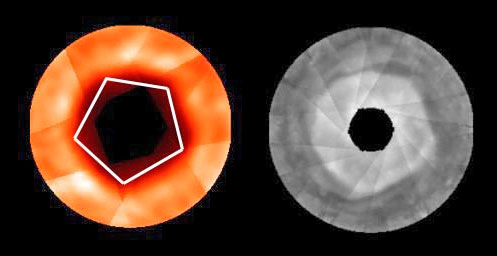
Figure 12 - Jupiter’s Arctic Polar Vortex (NASA/JPL/HST/University of
Hawaii 1999) with Added Pentagon on Left (Wilcock 2004)
NASA discussed this anomalous formation openly, and even mentioned geometry,
but only went so far as to suggest that it was a "quasi-hexagonal shape"
inside instead of making any mention of its equally possible pentagonal
structure.
[38]
Remember when we were discussing the mysterious appearance of ice at the
polar regions of sun-baked Mercury? At that time, we hinted that there might
be a hyperdimensional "shielding effect" that is protecting this region from
the natural heat of the sun, introducing its own mysterious "refrigerator"
mechanism. In Wilcock’s interpretation of the Jovian clouds, the pentagonal
"wave geometry" seems to be another signature of equally anomalous cooling
in the Jovian polar regions, whereas we saw the already low-temperature polar areas of Mars contained by a hexagonal surface pattern.
It seems
reasonable to conclude from this growing evidence that a planet’s surface or
atmospheric heating pattern can be more affected, at times, by its resonant
internal aether "geometry," than by direct external solar radiation.
If Jupiter is indeed experiencing a hyperdimensional "charge-up," in the HD
model we might expect to see a literal vortex phenomenon appear at some time
near one of the nodes (points) of this northern pentagon. A movie made from
about 1,200 images of Jupiter taken by NASA’s Cassini spacecraft in late
2000 reveals exactly this - a dark vortex as large as Jupiter’s Great Red
Spot, at the same latitude (60 degrees N) as the pentagon’s points!
This
node developed a bright spot in the center and then elongated along a
straight-line pattern, consistent in its size and angle with the pentagon,
with yet another parallel straight line appearing closer to Jupiter’s pole.
A Space Daily article mentions this as "unexpectedly persistent polar
weather patterns on the giant planet," where "the movie shows that the small
spots last a long time and move in organized patterns."
[39]
No comment is
made, however, on how the lines that are formed are anomalously straight and
parallel - rather than following the usual curved paths of typical cloud
movements (See Figure 9.)

Figure 13 - Straight-line formations in Jupiter’s northern hemisphere.
(NASA/JPL/SwRI, 2002)
The NASA text for the movie itself describes "the birth and motion of a dark
vortex wider than Earth," where
"a dark patch appears and within two weeks
becomes a well-defined oval about the same size and shape as Jupiter’s
southern hemisphere Great Red Spot. While this dark vortex is nestled
inside the auroral oval, its outer edge begins to circulate in a
clockwise direction as it simultaneously develops a small, brighter,
inner core. It eventually moves out of the auroral region and deforms by
flattening in latitude and growing in longitude. Near the end of the
movie, a second, smaller, dark oval appears nearer to the pole and
deforms in the wind shear."
[40]
A published study by Dr. Carolyn Porco and others on this event noted,
"Other evidence suggest that large oval
formation in the polar regions is a recurring phenomenon … which may be
quasi-periodic, or rare but recurring, and triggered by an unusual
auroral event… However, the evolution of the dark oval is currently
unexplained."
[41]
So, we have the emergence of a giant vortex phenomenon, showing clear signs
of consistent geometry, in a region that NASA already admitted as hosting a
"quasi-hexagonal", i.e. pentagonal, shape in the upper-level clouds. Though
some may clearly wish to argue that this is foolish "pattern seeking," once
again we have clear evidence of an increase in Jupiter’s energetic
atmospheric activity, occurring along internally consistent,
geometrically-defined (resonant "standing wave") patterns…
We are not the only authors to suggest that changes in Jupiter’s vortex
phenomena could be related to an overall energetic increase. A major new
study on Jupiter actually made it into the April 22, 2004 edition of
USA
TODAY, announcing the surprise disappearance of several major oval
formations in Jupiter’s atmosphere (Figure 14) - between September 1997 and
September 2000.
The study demonstrated that without these vortices in place,
internal Jovian heat will not be released as efficiently into space as
before… and Jupiter will likely experience substantial "global warming"
within the next 10 years - a whopping projected temperature increase of 18
degrees Fahrenheit, or 10C. [42]

Figure 14 - Disappearance of white vortexes in Jupiter’s middle latitudes.
(NASA/HST 2004)
The planetary scientist behind this study also notes that the Great Red Spot
has changed from its traditional red to "something more like salmon," and
believes that this color change may also be due to an overall increase in
Jupiter’s temperature. [43]
These changes are theorized to be part of a
70-year cycle, which is believed to have started when the three largest
ovals first appeared in 1939. What we see now may well be just the
beginning. The disappearance of the vortices between September 1997 and
September 2000 may be directly related to the appearance of the even-larger
polar vortex in Jupiter’s northern hemisphere just days later, which was
filmed from October 1st to December 31st 2000. (Figure 13)
The shift in vortex activity from the middle latitudes of Jupiter to the
polar latitudes is just one of a variety of clearly measurable changes that
are taking place in the largest known planet of the solar system. Figure 15
shows a tube-shaped cloud of hot plasma that was first discovered
surrounding Jupiter in 1979.
NASA’s Pioneer 10 and
11 probes detected
nothing of the sort in 1973-74, which means that this major Jovian system
feature, again, emerged in only five years’ time.
[44]

Figure 15 - Plasma tube (torus) in the orbit of Jupiter’s moon Io.
(NASA/HST)
If we remember that this "tube" did not exist at all as of 1974, this next
fact again makes it crystal clear that major energy changes are occurring in
and around Jupiter. In 1994, the multiple fragments of comet Shoemaker-Levy
9 slammed into Jupiter, causing quite a celestial spectacle - as many dark,
atmospheric "holes" were created by the extraordinarily energetic impact
effects in the upper Jovian atmosphere.
With the impact of the "K"
fragment,
a truly amazing thing happened - two arcs of charged plasma burst out of the
planet and maintained a visible structure for about an hour.
Though it seems
hard to believe (and admittedly it is a poor-resolution image), Figure 16 is
exactly as it appears on the official JPL website
[45]:

Figure 16 - Auroral emission arcs from Jupiter after
SL-9 "K" impact, July 19, 1994. (NASA/HST/WFPC2)
"Click" image to enlarge
Even more interestingly, the JPL report states that "Based on comparison
with ROSAT satellite X-ray images of Jupiter also taken at time of the
K
impact, astronomers know that the northern disturbance was brightest near
the time of the K impact, and then faded. If HST images had been taken
during the K impact, they would likely have shown far brighter arcs than
those observed 45 min. later [in the image]."
"Far brighter" is quite an
unsubtle statement for NASA to make. Figure 17 shows us the
ROSAT image that
the JPL report is referring to when making this bold statement.

Figure 17 - ROSAT X-ray images of energy emissions from
Jupiter during "K" impact of Comet SL9. (NASA/JPL 1994)
The way the article is written indicates clearly that these arcs (Figure 16)
were a relatively new phenomenon, never before seen with such intensity,
which appear to have been first observed by the Hubble Space Telescope in
May of 1994. However, a single ring of this type became a stable, ongoing
feature of Jupiter after the July 19, 1994 impact. It was first detected
earlier that May, and filmed over time, with far better resolution, between
May 1994 and September 1995.
[46]
This
ring emanates from the polar regions
of Jupiter over to the polar regions of the closest moon Io, linking the two
together like beads on a bracelet. This tube of energy is equal in its
strength to all the manmade power on Earth. Surprisingly, this ring exerts a
strong enough influence on Jupiter’s polar regions that it actually bends
the cloud flow towards Io.
We have not altered this image in any way - what
you see is exactly as it appeared on the Hubble website [47]:

Figure 18 - Jupiter’s Aurorae and their Ring-Shaped Formation with Io.
(NASA/HST 1995)
Another interesting point about this energy ring is that NASA now knows that
electrons are flowing through it in both directions - north to south and
south to north. NASA scientists call them "bi-directional electrons."
Conventional models have no explanation for this phenomenon, but it fits
perfectly with Wilcock’s basic model as expressed in his third volume,
The
Divine Cosmos, once we understand the importance of
counter-rotating energy fields in all physics.
In 1995, the Galileo probe arrived at Jupiter, and began measuring a variety
of changes. Jupiter’s atmosphere was discovered by NASA scientists to be
hundreds of degrees hotter than anticipated.
[48]
The amount of heavy
elements (such as oxygen) in Jupiter’s atmosphere decreased by a stunning
10% between 1979 and 1995, which is equivalent to 20 Earth-masses of oxygen
"embarrassingly" disappearing in 16 years.
[49] [50]
Radiation emissions
from Jupiter simultaneously increased by about 25% between 1979 and 1995.
[51]
Jupiter’s closest moon is Io, the most volcanically active satellite in the
solar system. Let’s not forget that the impact of Comet SL-9 triggered a
huge energetic increase in Jupiter, beginning on July 19, 1994 with the "K"
impact and the resulting "auroral emission arcs," (Figure 17), one of which
streamed into the north and south poles of Io and revealed itself to be a stable, ongoing feature thereafter. One year later, in July 1995,
Io had
developed a huge, bright, 200-mile-wide feature… not at the polar regions
where the bright arc of energy was entering, but directly along the equator!
This was a more dramatic change than any seen in the previous 15 years.
[52]

Figure 19 - Unexplained 200-mile-wide "Hotspot" on Io Emerges
over 16-Month Period (NASA/HST/WFPC2, 1995)
This circular formation of sudden, inexplicable brightness fits perfectly
with the HD model - in this case, showing us the "pure"
geometry of a higher
energy "octahedral resonance pattern" emerging at one of its points along
the equator of Io.
The HD energy entered into the moon in the polar regions,
and then through the angular momentum of the moon’s rotation, burst out at
the equator at a geometrically-defined point, similar to a lawn sprinkler
throwing off water.
[53]

Figure 20 - Octahedral Geometry in 1994-95 Io Brightness
Increase. (Wilcock, 2004 with NASA/HST, 1995)
NASA’s
Hubble Site said that up until this bright feature emerged at the
equator, "Io’s surface had undergone only subtle changes since it was last
seen close-up by the Voyager 2 probe in 1979."
[54]
However, just one year
later, JPL (Jet
Propulsion Laboratory) said that
"the changes we are seeing on Io are dramatic… The colors of material on the
ground and their distribution has changed substantially since the Voyager
flybys of 1979."
[55] Did this change happen
in one year, or are the Hubble and JPL scientists simply interpreting the
data in different ways? This "dramatic" color change on Io could indicate
that new types of matter are being released from the volcanoes themselves,
in just 17 years.
Even more interestingly, NASA actually admitted in 2000 that Io behaves "as
though it were a fluid,"
[56] which we believe is partly responsible for the
emergence of otherwise-unexplained geometric effects. As a further support
to the fluid concept, "In a 42-hour span, every point on Io goes from high
tide to low tide, with its rocky surface rising and falling by up to 300
feet (90 meters) or more… This constant tidal motion is what triggers the
endless volcanoes."
[57]
Another suggestion of the hyperdimensional geometry of the
octahedron at
work on Io was spotted in 1997. As can be easily seen in detailed images of
Io’s surface, the volcano Prometheus sits directly on the equator,
suggesting (in the HD model) that it is caused by an internal "octahedral"
geometric wave - similar to how Mars, Venus and
Earth all show substantial
volcanic activity at the 19.5-degree "tetrahedral" latitude. According to
NASA, an "intriguing difference" appears in Prometheus between 1979 and
1997: the volcano is "now erupting from a position about 75 kilometers (46.5
miles) west from where the hot spot resided in 1979."
[58]
Volcanoes are not supposed to get up and gallop 46.5 miles along the surface
of a satellite in conventional models, (!), but if Prometheus is a sign of
octahedral vortex activity, it is possible that the geometric wave is slowly
rotating within Io itself. The Hawaiian Islands on Earth, clustering in a
long chain at the critical 19.5-degree latitude, may be another example of
such changes… except that with the Earth’s harder, cooler crust, the old
volcanoes remain in place as the vortex slowly travels.
The comet impact, energy ring and subsequent geometric "pressure release" of
Io in 1995, as well as the volcanic anomalies, are only one aspect of a
larger change on and around Io… though this chain of events may have
signaled an important turning point in Io’s energetic transformation. Io’s
ionosphere became 1000% higher between 1973 and 1996, from 30-60 miles to
555 miles in height.
[59]
Io’s surface became over 200% hotter between 1979 and 1998, sporting a
temperature over three times hotter than the sunlit surface of Mercury - and
according to NASA, "Scientists don’t yet know how to explain what is
happening on Io."
[60]
In 2000, NASA also admitted that "most of the heat
[is coming] from Io itself, rather than absorbed sunshine."[61] New colors
[spectral evidence of new ions in the Io environment, not present before… ]
were seen in Io’s aurorae in 1998. [62] Yet additional new colors were
discovered in 2001. [63][64]
In early January 2001, Io had an inexplicable "bright spot" emerge in
ultraviolet wavelengths during an eruption of its volcano Pele, which sits
at about 19.5 degrees south latitude.
According to NASA,
"silicate lava cannot be hot enough to
explain a bright spot in the ultraviolet, so the origin of this bright
spot is a mystery."
[65]
This same article also
presents "the first image ever acquired of an active [volcanic] plume over a
polar region of Io."
[66]
(See Figure 21.) "Scientists were astounded to discover so large a plume so
near the pole, because all active plumes previously detected on Io have been
over equatorial regions and no others have approached Pele’s in size."
[67]
Volcanoes in the polar regions make no
sense to mainstream scientists, but are an obvious consequence of the
HD
model, since there are geometrically-defined vortexes
there.
On Aug. 6, 2001, a "previously undiscovered and still unnamed volcano"
(read: brand new), released a 310-mile-high plume, "making this the largest
plume ever detected on Io."
[68] (See Figure 21.)
How, in conventional
models, would a brand-new volcano suddenly emerge on the surface of a
satellite and then release the highest plume of gas and dust ever seen
there?
 Figure 21 - New Volcano on Io Releases Largest Plume Ever Seen, Aug. 2001
(NASA)
Figure 21 - New Volcano on Io Releases Largest Plume Ever Seen, Aug. 2001
(NASA)
"Click" image to enlarge
The roughly 60-degrees-north geometric position of the new volcano strongly
suggests that it could be caused by the same pentagonal (dodecahedral) polar
geometry that we see in Jupiter’s northern hemisphere… a geometry that had
fired into action beginning in October 2000, just after the white vortices
finished vanishing from the middle of the planet in September 2000. Perhaps
it took a little less than one year for this hyperdimensional shift of
Jupiter to be "gated" over to Io, causing a very similar energetic effect
there - the most massive volcanic eruption ever observed.
As we saw in Figure 15, a donut-shaped tube of glowing plasma energy fills
the entire path of Io’s orbit. Scientists think this tube is caused by
charged particles spewing from Io’s volcanoes. The charged particles in this
tube became 50% denser between 1979 and 1995. [69]
The overall density of
the tube increased by 200% between 1979 and 1995,
[70] and as we saw
earlier, the tube itself did not exist prior to 1979. A ‘cold’ portion of
the tube separated itself out and became significantly brighter between 1999
and 2000. This most recent change led NASA scientists to conclude that
"sufficient data are probably not available to determine the cause or effect
of the torus (plasma tube) variability."
[71]
This is a very polite way of
saying, "We just don’t know what the hell, scientifically, is going on!"

Figure 22 - Io plasma torus (green) and newly discovered Europa
plasma torus (blue) surrounding Jupiter. (NASA 2003)
Confounding the mainstream models even further, another "large and
surprisingly dense" plasma tube was discovered in 2003 (Figure 22), this
time, sharing the orbit of the moon Europa. In this case, there are no
volcanoes on Europa’s surface that could account for where the charged
particles in the tube are coming from, despite the fact that conventional
Jovian system models insist that volcanoes have to be the main source of the
new plasma.
[72]
Further underlining these dramatic changes, as of about
2003, Europa’s aurora was observed to have "a much brighter region" than it
was "expected" to have, based on a 1998 model (Figure 22). Again, the
picture (below) says it all.
[73]

Figure 23 - Difference between theoretical model of Europa’s brightness
with actual HST observations. (NASA/HST/McGrath et al. 2004)
Jupiter’s third moon, Ganymede, became over 200% brighter in its aurora
between 1979 and the mid-1990s, and certain areas are now up to 700%
brighter than any before seen (Figure 24). [74]
This increase in brightness
may be caused by an observed 1000% increase in the density of Ganymede’s
atmosphere since 1979. [75]
Ganymede also has its own magnetic field, in
defiance of all conventional expectations, leading one NASA
scientist to
say,
"Either something’s wrong with our [internal
dynamo] theory, or our understanding of Ganymede’s history." [76]

Figure 24 - Green Oxygen Aurora Brightness on Ganymede (NASA/HST/McGrath et
al. 2004)
At the orbit of Jupiter’s fourth major moon, Callisto, electron density
measurements made by the Galileo spacecraft found 1000 times more electrons
per cubic kilometer than expected from Jupiter’s own magnetosphere at that
great distance.
[77]
This strongly indicates some type of material (probably
water) is currently being liberated from Callisto, despite no observations
of associated volcanic activity, et cetera. When ionized by Jupiter’s own
radiation belts, this material would release excess electrons in direct
proximity to Callisto’s orbit - another, albeit indirect, indication of
enhanced energy being deposited inside Callisto from "somewhere."
Furthermore, when Galileo was on its way towards Callisto on August 12,
1999, before making its closest approach two days later, it encountered what
NASA called an "unexpected whopper dose of radiation."
One scientist said,
"We anticipated the spacecraft’s star
scanner would detect about 300 to 400 pulse counts of radiation, so
imagine our surprise when the instruments showed Galileo had flown
through 1,400 pulse counts!... Then again, that’s why we’re exploring
Jupiter and its moons - to discover these unusual
phenomena."
[78]
The radiation caused four different spacecraft faults that
were able to be handled by onboard software, which included disabling one
backup spin detector that had been damaged in the event.
This unexpected radiation blast "took place one week after the largest heat
output since 1986 from Jupiter’s volcanic moon Io." It may be significant
that all these events clustered around the Grand Cross astrological event of
August 1999, where many of the planets were in hyperdimensionally dissonant
90 and 180-degree angles to each other.
As we head even farther away from the center of Jupiter, a new "dust ring"
was discovered encircling the planet in 1998 - and, in defiance of all
expected celestial mechanics, its particles orbit in the opposite direction
to Jupiter’s own rotation, and the orbital direction of its major
satellites.
[79] Again, counter-rotating fields are a basic aspect of Wilcock’s hyperdimensional model.
[80]
In the course of our research for this article, we dug up two other Jupiter anomalies that support Hoagland’s hyperdimensional model, based on the
geometry of the tetrahedron inside a sphere, as seen in Figures 3 and 4. We
have put these anomalies at the end of this section since they do not
precisely show a change in Jupiter’s energetic activity, but simply
demonstrate the underlying "new" physics at work.
First, in an article from Science magazine in March 2003, a diagram is shown
of the velocities of Jupiter’s cloud bands, based on latitude. The fastest
and slowest cloud speeds on Jupiter occur at exactly
19.5 degrees north and
south, respectively. These speed anomalies have shown remarkable persistence
- they were there when Voyager 2 visited Jupiter in 1979, and the latest
Cassini data of 2003 continue to show the same phenomena.
According to the NASA scientist working on this,
"The stability of Jupiter’s zonal winds,
given the turbulent nature of its cloud patterns, is a remarkable
feature of its atmosphere."
[81]

Figure 25 - Graph of Highest and Lowest Wind Speeds on Jupiter,
Showing Activity at "Hyperdimensional" Latitudes (Porco et al. 2003)
The "hyperdimensional bleed-through" geometry of the
tetrahedron appears to
be creating the Great Red Spot in Jupiter’s southern hemisphere at 19.5
degrees S and slowing down the speed of the cloud rotations at that
latitude. If this formation does truly exist, then it would also come to a
point at the geometric north pole of Jupiter.
Interestingly, a recent study
has found that in approximately 45-minute intervals, flashes of X-ray
activity are emerging from the geometric north pole of Jupiter… even though
Jupiter’s aurora is not centered on the pole, as we can see in Figure 26.
The energy released by this point is equivalent to a colossal gigawatt pulse
of energy rocketing through the solar system.
[82]
A NASA article discussing this phenomenon says the following:
""We weren’t
surprised to find x-rays coming from Jupiter," he [Dr. Randy Gladstone]
continued. Other observatories had done that years ago. The surprise is what
Chandra has revealed for the very first time: the location of the beacon
- surprisingly close the planet’s pole - and the regular way it pulses…
"The 45-minute pulsations are very mysterious," adds Elsner. They’re not
perfectly regular like a signal from E.T. might be; the period drifts back
and forth by a few percent. "This is a natural process," he adds, "we just
don’t know what it is..."

Figure 26 - Composite Image - Jupiter, Glowing Auroral Ring (Blue) and Polar
X-Rays (Red) (NASA 2002)
With Jupiter, the geometric fingerprints of hyperdimensional energy are very
clear. In the image on the right in Figure 25, we can see that the fine
lines of the X-rays (in false-color red) actually look like the top of a
tetrahedron, other than the large vertical straight-lined area of extra
brightness to the left.
The large circular bright area to the right would be
the top of the tetrahedron, and two lines are seen to extend downward from
it in a triangular fashion, maintaining a 60-degree angle from each other as
we would expect.
This X-ray phenomenon occurs 15 times for every rotation of Jupiter on its
axis. More research will probably provide an answer to what is causing the
cycle, (we do have ideas, such as varying "hyperdimensional"
angles caused
by the orbits of the four main moons of Jupiter,) but the area where the
X-rays are emanating from is clearly geometric… rather than being in
alignment with the center of Jupiter’s electromagnetic aurora.
So, to summarize and review what we have just learned, in just the last 30
years overall, Jupiter and its satellites have undergone a remarkable series
of energetic and hyperdimensional changes. Vortexes are disappearing from
Jupiter’s middle latitudes and reappearing at geometrically-defined points
in the polar regions. A plasma tube in the orbit of the moon Io has shown
remarkable increases in brightness and density. Jupiter’s atmosphere has
experienced huge decreases in heavy elements and increases in helium, and
overall radiation emissions have increased.
A comet impact caused huge, bright arcs to surge out of Jupiter, one of
which connected with Io and remained stable. The HD energy streaming in at
the north and south pole was redirected to a perfectly geometric, single
200-mile-wide point at the equator. New colors were seen on Io’s surface and
the largest volcano ever seen appeared for the first time less than a year
later. Io’s ionosphere became much higher, the surface became hotter, and
new colors were seen in the aurora.
Europa was also found to have a
mysterious tube of energy in its orbital path, and was recently observed to
be far brighter than expected. Ganymede’s aurora also brightened
substantially, possibly indicating an atmospheric density increase. Callisto’s
aurora was fully 1000 times stronger than expected, and nearby
radiation levels were as much as 467% higher than expected.
Another giant
tube of energy was found beyond the orbit of Callisto, and was inexplicably
counter-rotating.
The slowest cloud speeds are at 19.5 degrees south latitude, and the
fastest
cloud speeds are at 19.5 degrees north, in precise alignment with the
Hyperdimensional Model. A whopping gigawatt-sized X-ray pulse emerges from
the exact geometric north pole of Jupiter every 45 minutes, showing us the
top of the same tetrahedral energy field that emerges as the
Great Red Spot…
which is large enough to hold two Earths.
Taken together, these findings demonstrate the remarkable geometric
properties of Jupiter, and an undeniable evolution in the basic nature of
its temperature, composition and energetic behavior as a system.
As we move
on into Part Three of this Report, we will discover that every other
remaining planet… Saturn… Uranus… Neptune…
Pluto… Earth… is showing us
similar types of changes, thus truly demonstrating that we are dealing with
an interplanetary transformation.
We will also see evidence from studies of Earth that show how the changes we experience here are directly correlated
with changes in the greater solar system.
References
[14]
"Since the late 1970s, the amount of solar radiation the sun emits,
during times of quiet sunspot activity, has increased by nearly .05 percent
per decade, according to a NASA funded study.
"This trend is
important because, if sustained over many decades, it could cause
significant climate change," said Richard Wilson, a researcher
affiliated with NASA’s Goddard Institute for Space Studies and Columbia
University’s Earth Institute, New York."
NASA Goddard Space Flight Center. NASA Study Finds Increasing Solar Trend
that can Change Climate. March 20, 2003. URL:
http://www.gsfc.nasa.gov/topstory/2003/0313irradiance.html
[15]
"…according to Michael Lockwood and colleagues at the Rutherford
Appleton Laboratory in England… Analyzing instrument measurements taken
since 1868, they conclude that the sun’s exterior magnetic field has
increased by 230 percent since 1901 and by 40 percent since 1964."
Suplee, Curt. Sun Studies May Shed Light on Global Warming. Washington Post,
Monday, Oct. 9, 2000, pg. A13. URL:
http://www.washingtonpost.com/wp-dyn/articles/A35885-2000Oct8.html
[16]
"A team of researchers led by George Gloeckler, a physics professor at
the University of Maryland, published a paper in the Jan. 15, 1999 issue of
Geophysical Research Letters (GRL) about the unusual composition of the May
2-3 (1998) coronal mass ejection (CME) - a bubble of gas and magnetic field
lines that the sun ejects over the course of several hours… Coronal mass
ejections carry plasma, or ionized gas, away from the sun at speeds
approaching 2,000 kilometers per second…
"We were completely surprised by the highly unusual and unexpected
composition in this CME," Gloeckler says. His team observed, for example,
that the density of 4He+ [a form of charged helium] was almost as high as
the density of 4He++ for several hours. "Such large 4He+/4He++ratios,
persisting for hours, have never been observed in the solar wind before,"
they write. They also observed high increases of helium and heavier ions in
the CME plasma. The unusual composition of the CME lasted an exceptionally
long time, they write… "This is certainly not an average solar wind but an
anomalous situation," Gloeckler says. "Yet such anomalous findings often
lead to deeper understandings of physical processes."
Bartlett, Kristina. ACEing the sun. American Geophysical Union / Geotimes
News Notes, April 1999. URL:
http://www.geotimes.org/apr99/newsnotes.html
[17]
"Craig DeForest, a solar physicist at the Southwest Research Institute,
said… "I’d take a stand and say it appears to be about X40 based on
extrapolation of the X-ray flux into the saturated period… "That estimate
may even be conservative," he said."
Britt, Robert Roy. Solar super-flare amazes scientists. Space.com /
MSNBC.com, Nov. 6, 2003. URL:
http://www.msnbc.com/news/984388.asp?cp1=1
[18]
Dr Paal Brekke, deputy project scientist for the Solar Heliospheric
Observatory (SOHO) Sun-monitoring satellite, told BBC News Online… "I
think the last week will go into the history books as one of the most
dramatic solar activity periods we have seen in modern times… As far as
I know there has been nothing like this before.""
Whitehouse, David Ph.D. What is Happening to the Sun? BBC News Online,
Tuesday, November 4, 2003. URL:
http://news.bbc.co.uk/2/hi/science/nature/3238961.stm
[19]
"Ilya Usoskin, a geophysicist who worked with colleagues from the
University of Oulu in Finland and the Max Planck Institute for Aeronomy in
Katlenburg-Lindau, Germany, has found that there have been more sunspots
since the 1940s than for the past 1150 years.
Sunspot observations stretch back to the early 17th century, when the
telescope was invented. To extend the data farther back in time, Usoskin’s
team used a physical model to calculate past sunspot numbers from levels of
a radioactive isotope preserved in ice cores taken from Greenland and
Antarctica…
Mike Lockwood, from the UK’s Rutherford Appleton Laboratory near Oxford…told
New Scientist that when he saw the data converted to sunspot numbers he
thought, "why the hell didn’t I do this?" It makes the conclusion very
stark, he says. "We are living with a very unusual sun at the moment."
Hogan, Jenny. Sun More Active than for a Millennium. New Scientist, November
2, 2003. URL:
http://www.newscientist.com/news/news.jsp?id=ns99994321
[20]
"Mercury would seem to be one of the least likely places in the solar
system to find ice. The closest planet to the Sun has temperatures which can
reach over 700 K… Nonetheless, Earth-based radar imaging of Mercury has
revealed areas of high radar reflectivity near the north and south poles,
which could be indicative of the presence of ice in these regions (1-3).
There appear to be dozens of these areas with generally circular shapes.
Presumably, the ice is located within permanently shadowed craters near the
poles, where it may be cold enough for ice to exist over long periods of
time…
Water ice on the surface of Mercury is exposed directly to vacuum, and will
rapidly sublime and escape into space unless it is kept cold at all times.
This implies that the ice can never be exposed to direct sunlight. The only
locations on the surface of Mercury where this is possible would seem to be
near the poles, where the floors of some craters might be deep enough to
afford permanent shading. Whether such permanently shadowed craters exist on
Mercury is still problematic…
The Surface Lander, however, will
survive only one week in the harsher conditions on the planet. It will
land near a pole…"
Jong, Diana. Mysteries of Mercury: New Search for Heat and Ice. Space.com,
Dec. 31, 2002. URL:
http://www.space.com/scienceastronomy/mysteries_mercury_021231.html
[21] Woodfill, Jerry. Mercury. NASA/Johnson Space Center Space Educators’
Handbook, Feb. 8, 2000. URL:
http://vesuvius.jsc.nasa.gov/er/seh/mercury.html
[22]
"(In 1974-75,) Mariner 10 revealed several intriguing features of
Mercury, and not all are superficial. Beneath its surface, Mercury is hiding
a core that seems to be denser than Earth’s, unexpected given the planet’s
size (about the same as the Moon). Also unexpectedly, Mercury has a
relatively strong magnetic field…
"What we need to know is how particularly the planet is capable of evolving
so close to the Sun," says Marcello Coradini, ESA’s coordinator for solar
system missions."
Jong, Diana. Mysteries of Mercury: New Search for Heat and Ice. Space.com,
Dec. 31, 2002. URL:
http://www.space.com/scienceastronomy/mysteries_mercury_021231.html
[23]
""Our model shows Venus has changed dynamically in the recent past,"
said Bullock. "Since Venus and Earth have a number of similarities, there
are implications here for our own future." An article by Bullock and
Grinspoon regarding global change on Venus appears in the March issue of
Scientific American…
In 1984, LASP colleague Larry Esposito used data from NASA’s Pioneer Venus
satellite to determine that concentrations of sulfur dioxide in the high
clouds declined dramatically from 1978 to 1983, indicating a massive
volcanic eruption occurred a decade before.
"Venus is the only chance for studying an evolving climate system like Earth
in our own solar system," said Grinspoon…
The model indicates
"the climates of Earth-like planets can undergo abrupt transitions
because of interactions among planetary-scale processes." Studies of
Earth’s ice cores show temperatures can rise nearly 20 F in less than a
decade."
Bullock, Mark et al. New Climate Modeling of Venus May Hold Clues to Earth’s
Future. University of Colorado at Boulder News, Feb. 18, 1999. URL:
http://www.colorado.edu/PublicRelations/NewsReleases/1999/New_Climate_Modeling_Of_Venus_.html
[24]
"Venus has less sulfur dioxide, implying less volcanic activity, than in
the 1970s."
NASA. Aeronautics and Space Report of the President: Fiscal Year 1995
Activities. Curator: Lillian Gipson, Last Updated September 5, 1996. URL:
http://www.hq.nasa.gov/office/pao/History/presrep95/solarsys.htm
[25]
"Measurements to record the nightglow of Venus were carried out with the
Keck telescope just before sunrise on November 20, 1999. Analysis of the
resultant spectrum at the position of the oxygen green line showed
strong emission from the terrestrial atmosphere and a comparable signal
from Venus, with an intensity some 25 times (2500%) greater than the
upper limits set by the (Russian) Venera results (from 1975)."
Resnick, Alice. SRI International Makes First Observation of Atomic Oxygen
Emission in the Night Airglow of Venus. SRI International, Jan. 18, 2001.
URL:
http://www.sri.com/news/releases/01-18-01.html
[26]
"Astronomers observing the night side of Venus were surprised to find
emissions from oxygen atoms as strong as those from aurora in the Earth’s
atmosphere. The discovery is puzzling because the Venusian atmosphere is
very different to our own - it contains very little oxygen and is dominated
by carbon dioxide.
…the Russian Venera orbiters visited Venus in 1975 and found no sign of the
green signal. "We do not understand how the variability can be this large",
said Slanger, although the team speculates that the fluctuations could
be connected with the solar cycle."
Physics Web. Night-time on Venus. Physics Web: Physics news, jobs and
resources. Jan. 18, 2001. URL:
http://www.physicsweb.org/article/news/5/1/10
[27]
"The Soviet probes (Venera 11 and Venera 12 - back in 1975) spotted the
colors that indicated the presence of oxygen molecules - pairs of oxygen
atoms that have bonded together - but not the green color given off by
excited, single oxygen atoms.
In November 1999, researchers from S.R.I. International in Menlo Park,
Calif. and the Lowell Observatory in Flagstaff, Ariz., pointed the 10-meter
Keck telescope on Mauna Kea, Hawaii, toward Venus for eight minutes and saw
the distinctive green glow of oxygen atoms.
"It was a total surprise," said Dr. Thomas G. Slanger, a scientist at S.R.I.
and lead author of a paper in the current issue of Science. The scientists
believe the instruments aboard the Venera spacecraft were working correctly
when they detected the fainter molecular-oxygen glow…
There is also
no easy explanation for what is causing the oxygen atoms to switch on."
Chang, Kenneth. Mysterious Night Glow in the Skies of Venus Puzzles
Scientists. New York Times, Jan. 28, 2001. URL:
http://www.nytimes.com/2001/01/23/science/23VENU.html
[28]
"Astronomers observing the night side of Venus were surprised to find
emissions from oxygen atoms as strong as those from aurora in the Earth’s
atmosphere. The discovery is puzzling because the Venusian atmosphere is
very different to our own - it contains very little oxygen and is dominated
by carbon dioxide.
…the Russian Venera orbiters visited Venus in 1975 and found no sign of the
green signal. "We do not understand how the variability can be this large",
said Slanger, although the team speculates that the fluctuations could
be connected with the solar cycle."
Physics Web. Night-time on Venus. Physics Web: Physics news, jobs and
resources. Jan. 18, 2001. URL:
http://www.physicsweb.org/article/news/5/1/10
[29]
"Accompanying the Science paper by Slanger, et al, is a commentary by
Dr. David Crisp from the NASA/Caltech Jet Propulsion Laboratory.
"I certainly trust those data," stated Dr. Crisp. "Something weird is going
on in the upper atmosphere of Venus."
The first bottom line is
that we just don’t know what’s going on."
Perew, Mark. Evidence of Atomic Oxygen Challenges Understanding of Venus.
Universe Today, Jan. 19, 2001:
http://www.universetoday.com/html/articles/2001-0119a.html
[30]
"Using satellite data, an international team of researchers has found
that Venus sports a giant, ion-packed tail that stretches almost far enough
to tickle the Earth when the two planets are in line with the Sun.
"I didn’t expect to find it," says team member Marcia Neugebauer of the Jet
Propulsion Laboratory in Pasadena, California. "It’s a really strong signal,
and there’s no doubt it’s real."
NASA’s Pioneer Venus Orbiter first found the tail in the late 1970s. Around
70,000 kilometres from the planet, the spacecraft detected bursts of hot,
energetic ions, or plasma. The tail exists because ions in Venus’s upper
atmosphere are bombarded by the solar wind, a stream of plasma that blows
out from the Sun.
But now Europe’s Solar and Heliospheric Observatory
(SOHO), a project partly sponsored by NASA, has shown that the tail
stretches some 45 million kilometres into space, more than 600 times as
far as anyone realised."
Hecht, Jeff. Planet’s Tail of the Unexpected. New Scientist, 31 May 1997.
URL:
http://web.archive.org/web/19970605230452/
http://www.newscientist.com/ns/970531/nvenus.html
(also see
http://www.holoscience.com/news/balloon.html )
[31] Savage, Don et al. Hubble Monitors Weather on Neighboring Planets.
HubbleSite News Center, 1995, no. 16. URL:
http://hubblesite.org/newscenter/newsdesk/archive/releases/1995/16/text
[32]
"On that particular orbit [of the Mars Surveyor probe], the atmospheric
density had suddenly jumped by about a factor of two (200%) above its
value on previous orbits, so that the drag force was proportionately
greater. Such density variations, while unexpected, are not considered
extraordinary for the season on Mars."
Wheaton, Bill. JPL and NASA News. Nov. 1997. URL:
http://www.aqua.co.za/assa_jhb/Canopus/c97bjpl.htm
[33] Villard, Ray et al. Colossal Cyclone Swirls Near Martian North Pole.
HubbleSite News Center, May 19, 1999, no. 22. URL:
http://hubblesite.org/newscenter/newsdesk/archive/releases/1999/22/
[34] Savage, Don / Hardin, Mary / Villard, Ray / Neal, Nancy. Scientists
Track "Perfect Storm" on Mars. HubbleSite NewsCenter, Oct. 11, 2001, no. 31.
URL:
http://hubblesite.org/newscenter/newsdesk/archive/releases/2001/31/text/
[35] Britt, Robert Roy. Mars Ski Report: Snow is Hard, Dense and
Disappearing. Space.com, Dec. 6, 2001. URL:
http://www.space.com/scienceastronomy/solarsystem/mars_snow_011206-1.html
[36] James, Phil et al. Seasonal Changes in Mars’ North Polar Ice Cap.
HubbleSite NewsCenter, 1997, no. 15. URL:
http://hubblesite.org/newscenter/newsdesk/archive/releases/1997/15/image/b
[37] For reference, this next image shows a series of formations that can
appear in water, by simply vibrating it at "pure" (Diatonic) sound
frequencies. The white lines are caused by tiny free-floating particles
suspended in the water, which are gathered up by the pressures of the
three-dimensional waves. Hexagonal structures are clearly visible in the
centers of the top-right and bottom-right panes, and the top-right pane has
two very clear tetrahedrons in it, exactly as they appear on planets in the
HD model. The tetrahedrons look like a snowflake from this angle:

Supplemental - Three-Dimensional Geometric Wave Patterns Caused by Sound
Vibrations in Water (Dr. Hans Jenny)
[38]
"Observations with two NASA telescopes show that Jupiter has an arctic
polar vortex similar to a vortex over Earth’s Antarctica that enables
depletion of Earth’s stratospheric ozone.
These composite images of Jupiter’s north polar region from the Hubble Space
Telescope (right) and the Infrared Telescope Facility (left) show a
quasi-hexagonal shape that extends vertically from the stratosphere down
into the top of the troposphere. A sharp temperature drop, compared to
surrounding air masses, creates an eastward wind that tends to keep the
polar atmosphere, including the stratospheric haze, isolated from the rest
of the atmosphere.
The linear striations in the composite projections are artifacts of the
image processing. The area closest to the pole has been omitted because it
was too close to the edge of the planet in the original images to represent
the planet reliably.
The sharp boundary and wave-like structure of the haze layer suggest a polar
vortex and a similarity to Earth’s stratospheric polar clouds. Images of
Jupiter’s thermal radiation [shown in the false-color image on the left]
clinch that identification…
These images were taken Aug. 11 through Aug. 13, 1999, near a time when
Jupiter’s north pole was most visible from Earth. Other Infrared Telescope
Facility images at frequencies sensitive to the polar haze were taken at
frequent intervals from June to October 1999. They show that the
quasi-hexagonal structure rotates slowly eastward at 1.2 degrees of
longitude per day, a rate consistent with the average wind speeds measured
from movement of visible clouds.
Of particular interest but yet
unknown is how deep into Jupiter’s troposphere the phenomenon extends…"
NASA Planetary Photojournal. PIA03864: Cold Hole over Jupiter’s Pole.
NASA/JPL/HST/University of Hawaii. 1999. URL:
http://photojournal.jpl.nasa.gov/catalog/PIA03864
[39] Space Daily. Seventy-Day Jupiter Movie Pulls Patterns Out Of Chaos.
Space Daily, July 23, 2001. URL:
http://www.spacedaily.com/news/jupiter-clouds-01a.html
[40] NASA. Ultraviolet Movie of Jupiter’s Polar Stratosphere. NASA/JPL/SwRI,
March 13, 2002. URL:
http://ciclops.lpl.arizona.edu/PR/2002C13/PR2002C13A.html
[41] Porco, Carolyn et al. Cassini Imaging of Jupiter’s Atmosphere,
Satellites, and Rings. Science magazine, vol. 299, March 7, 2003. URL:
http://ciclops.arizona.edu/sci/docs/porco-etal-cassini-jupiter-science-2003.pdf
[42] Yang, Sarah. Researcher predicts global climate change on Jupiter as
giant planet’s spots disappear. UC Berkeley Press Release, April 21, 2004.
URL:
http://www.berkeley.edu/news/media/releases/2004/04/21_jupiter.shtml
[43] Britt, Robert Roy. Jupiter’s spots disappear amid major climate change.
USA TODAY / Tech / Space.com, April 22, 2004. URL:
http://www.usatoday.com/tech/news/2004-04-22-jupiter-spots-going_x.htm
[44]
"[In 1979,] the Voyagers saw ultraviolet emissions (in Jupiter’s
magnetic field) from doubly and triply ionized sulfur and doubly ionized
oxygen. Pioneers 10 and 11 did not detect them, so hot plasma evidently
was not present [in Jupiter’s magnetic field] in 1973 and 74."
NASA/JPL. Voyager Science at Jupiter: Magnetosphere. Jet Propulsion
Laboratory, California Institute of Technology. URL:
http://voyager.jpl.nasa.gov/science/jupiter_magnetosphere.html
[45] Clarke, John T. Hubble Sees Auroral Emission Arcs Following the K
Impact. NASA/JPL, Sept. 29, 1994. URL:
http://www2.jpl.nasa.gov/sl9/image271.html
[46] Cambridge University. Hubble follows rapid changes in Jupiter’s aurora.
Cambridge University Institute of Astronomy, Oct. 17, 1996. URL:
http://www.ast.cam.ac.uk/HST/press/32.html
[47] Free Republic. Astronomy Picture of the Day. Hubble Image, Hubble
Image, Photo No.: STScI-PRC96-32, Oct. 17, 1996. URL:
http://209.157.64.200/focus/f-chat/727721/posts
[48]
"A central theme that emerges in the discussion of the middle and upper
atmosphere is the temperature… In the thermosphere, a top question is
about the temperature itself, why it is hundreds of degrees hotter than
was anticipated based on a theory that is adequate for Earth and Titan…"
Bagenal, Fran et al. Jupiter: The Planet, Satellites and Magnetosphere,
Chapter 1: Introduction. URL:
http://dosxx.colorado.edu/JUPITER/PDFS/Ch1.pdf
[49]
"Models give a range in Jupiter’s heavy element abundance between 3 and
13% by mass. This is a huge uncertainty. Oxygen is the third most
abundant element in the universe and is assumed to comprise half the
mass of heavy elements in Jupiter. Up to 20 Earth-masses of oxygen
unaccounted for seems a bit of an embarrassment."
Bagenal, Fran et al. Jupiter: The Planet, Satellites and Magnetosphere,
Chapter 1: Introduction. 2004. URL:
http://dosxx.colorado.edu/JUPITER/PDFS/Ch1.pdf
[50]
"…the Sun has only 2% of its mass in elements other than hydrogen and
helium (the heavy elements), whereas Jupiter has between 3 and 13%...
In 1995, after a long journey, the Galileo probe successfully
measured the composition and structure of Jupiter’s atmosphere. [Since]
the new value for the helium mass mixing ratio… was higher than the
Voyager measurement [indicating an increase in helium content in the
atmosphere], the models… would necessarily yield a smaller quantity of
heavy elements in the molecular region [of Jupiter’s atmosphere.]"
Guillot, Tristan et al. Jupiter: The Planet, Satellites and Magnetosphere,
Chapter 3: The Interior of Jupiter. 2004. URL:
http://dosxx.colorado.edu/JUPITER/PDFS/Ch3.pdf
[51]
"The synchrotron [radiation] emission intensity levels at the time of
the Galileo probe measurements [beginning in 1995] were about 25% higher
than during the Pioneer flybys [of 1979.] (Klein et al. 2001)."
Bolton, Scott J. et al. Jupiter: The Planet, Satellites and Magnetosphere,
Chapter 27: Jupiter’s Inner Radiation Belts. 2004. URL:
http://dosxx.colorado.edu/JUPITER/PDFS/Ch27.pdf
[52]
"This pair of images of Jupiter’s volcanic moon Io, taken with the
Hubble telescope, shows the surprising emergence of a 200-mile-wide,
yellowish-white feature near the center of the moon’s disk [photo on the
right]. This represents a more dramatic change in 16 months than any
seen over the previous 15 years, say researchers. They suggest the spot
may be a new class of transient feature on the moon. For comparison the
photo on the left was taken in March 1994, before the spot emerged."
Spencer, J (Lowell Observatory) and NASA. Hubble Discovers Bright New Spot
on Io. Hubble News Center, 1995, No. 37. URL:
http://hubblesite.org/newscenter/newsdesk/archive/releases/1995/37/
[53] If you look carefully at the image of Io on the left, there is a
diagonal straight-line formation in the upper-left area that fits
beautifully with the position of the upper left line of the octahedron.
Furthermore, some traces of this line are still visible in the July 1995
image on the right. A similar line was seen in Venus’ ever-increasing green
aurora in Figures 3 and 4. Here, the apparent emergence of such a line might
also be construed as a "warning signal" that the octahedral energy flow in
the planet was heating up, before energy burst out at one of the node points
of the octahedron.

[54]
"The [first] photo indicates that Io’s surface had undergone only subtle
changes since it was last seen close-up by the Voyager 2 probe in 1979."
Spencer, J (Lowell Observatory) and NASA. Hubble Discovers Bright New Spot
on Io. Hubble News Center, 1995, No. 37. URL:
http://hubblesite.org/newscenter/newsdesk/archive/releases/1995/37/
[55] Murrill, Mary Beth. Galileo Finds Big Changes on Jupiter’s Volcanic
Moon Io. NASA/JPL/Caltech Press Release, July 18, 1996. URL:
http://www2.jpl.nasa.gov/galileo/status960718.html
[56] Heil, Martha. Jupiter’s Volcanic Moon Io: Strange Shapes in a Sizzling
World. NASA/JPL/Caltech Press Release, Oct. 26, 2000. URL:
http://members.fortunecity.com/volcanopele/news102600.htm
[57] CNN. Images reveal lakes, snow, geysers on Jupiter moon Io.
CNN.com/SPACE, May 19, 2000. URL:
http://www.cnn.com/2000/TECH/space/05/19/io.images/index.html
[58] NASA Planetary Photojournal. PIA00495: Changing volcanoes on Io.
NASA/JPL, Nov. 18, 1997. URL:
http://photojournal.jpl.nasa.gov/catalog/PIA00495
[59] "Sensors on the spacecraft found a very dense region of ionized oxygen,
sulfur and sulfur dioxide at 555 miles on Io that must be pumped into that
region by Io’s relentless volcanic activity," said Dr. Louis A. Frank of the
University of Iowa, principal investigator on Galileo’s plasma science
experiment. "Instead of being swept away by Jupiter’s rotating magnetosphere
as anticipated, the ionized gases surprisingly remain with Io," he said.
"Passage of the Galileo spacecraft through an ionosphere was not expected
because images of the volcanic plumes previously taken with the Voyager
spacecraft indicated that the plume heights extended only to a few hundred
kilometers or less," Frank said. A radio occultation by the Pioneer 10
spacecraft in 1973 indicated ionospheric heights only about 30 to 60 miles
above the surface. "No one expected to see this at 900 kilometers’ [555
miles’] altitude," he added. The difference between what Pioneer saw and
what Galileo has observed indicates that Io’s atmosphere and ionosphere are
variable and may grow and shrink with more or less volcanic activity."
(emphasis added)
Murrill, Mary Beth and Isabell, Douglas. High-Altitude Ionosphere Found at
Io by Galileo Spacecraft. NASA/Goddard Space Flight Center, Release 96-216,
Oct. 23, 1996. URL:
http://nssdc.gsfc.nasa.gov/planetary/text/gal_io_ionosphere.txt
[60]
"PROVIDENCE, R.I. - Hundreds of millions of miles from the sun,
volcanoes on Jupiter’s moon Io sizzle at the highest recorded surface
temperatures of any planetary body in the solar system. Planetary scientists
from University of Arizona, Brown University and five other institutions
report this finding in the cover story of the July 3 issue of the weekly
journal Science…
"The very hot lavas erupting on Io are hotter than anything that has erupted
on Earth for billions of years," says lead author Alfred McEwen, director of
the Planetary Image Research Lab at the University of Arizona. "They are the
highest surface temperatures in the solar system other than the sun
itself."
At least 12 different vents on Io spew lava at temperatures greater than
2,200 degrees Fahrenheit. One volcanic vent may be as hot as 3,100 degrees
Fahrenheit - about three times hotter than the hottest sunlit surface of
Mercury, the closest planet to the Sun…
The latest temperature measurements are more than double the highest
temperatures recorded by the Voyager spacecraft in 1979 and also exceed more
recent measurements made by telescopes…
Scientists were surprised by the extreme temperatures… Scientists don’t know
yet how to explain what’s happening on Io." (emphasis added)
Morton, Carol. Scientists find solar system’s hottest surfaces on Jupiter’s
moon Io. NASA / The Brown University News Bureau, Distributed July 2, 1998.
URL:
http://www.brown.edu/Administration/News_Bureau/1998-99/98-001.html
[61] Heil, Martha. Jupiter’s Volcanic Moon Io: Strange Shapes in a Sizzling
World. NASA/JPL/Caltech Press Release, Oct. 26, 2000. URL:
http://members.fortunecity.com/volcanopele/news102600.htm
[62]
"The vivid colors, caused by collisions between Io’s atmospheric gases
and energetic charged particles trapped in Jupiter’s magnetic field, had
not previously been observed."
NASA/JPL Planetary Photojournal. PIA01637: Io’s Aurorae. Oct. 13, 1998. URL:
http://photojournal.jpl.nasa.gov/catalog/PIA01637
[63]
"Cassini captured several time-lapse image sequences of Io, Europa, and
Ganymede being eclipsed by Jupiter… Io’s [atmospheric] emissions were
detected in previously unseen spectral regions, from 250 to 380 nm and
from 670 to 850 nm."
Porco, Carolyn et al. Cassini Imaging of Jupiter’s Atmosphere, Satellites,
and Rings. Science magazine, vol. 299, March 7, 2003. URL:
http://ciclops.arizona.edu/sci/docs/porco-etal-cassini-jupiter-science-2003.pdf
[64] Some of this effect might be due to increased instrument
sophistication: "Cassini’s camera is also sensitive to shorter wavelengths
than is Galileo’s camera, and it could record more colors using different
filters." This does not account for the new colors seen by the Galileo probe
in 1998, so it is likely a combination of real changes (visible throughout
the solar system) with increased instrument sophistication.
Stiles, Lori. Cassini Captures Light Show on Jupiter’s Moon Io, During
Eclipse. University of Arizona News Service, May 31, 2001. URL:
http://members.fortunecity.com/volcanopele/news053101.htm
[65] McEwen, Alfred. Galileo and Cassini Image Two Giant Plumes on Io.
NASA’s Planetary Photojournal PIA-02588, March 29, 2001. URL:
http://pirlwww.lpl.arizona.edu/missions/Galileo/releases/29Mar2001_g29plumes.html
[66] McEwen, Alfred. Galileo and Cassini Image Two Giant Plumes on Io.
NASA’s Planetary Photojournal PIA-02588, March 29, 2001. URL:
http://pirlwww.lpl.arizona.edu/missions/Galileo/releases/29Mar2001_g29plumes.html
[67] Keszthelyi, Laszlo. Io Reveals Towering Volcanic Plume Never Seen
Before. Daily University Science News (UniSci), March 30, 2001. URL:
http://unisci.com/stories/20011/0330011.htm
[68] NASA Planetary Photojournal. Northern Plume and Plume Deposits on Io.
NASA Planetary Photojournal PIA-02592, October 4, 2001. URL:
http://pirlwww.lpl.arizona.edu/missions/Galileo/releases/4Oct2001_i31plume.html
[69]
"Throughout much of the Io torus passage leading up to the encounter,
Galileo measured ion densities that were about 50% greater than those
observed by Voyager at the same distance [Bridge et al. 1979; Bagenal,
1994]…
The plasma phenomena seen from Galileo (in Jupiter’s magnetic
field in 1995) were, in general, not unexpected, but their strength
exceeded expectations. The plasma was denser than expected in the torus
and in the wake region. The wave amplitudes were greater than expected."
Russell, C.T. et al., Eos, Transactions, American Geophysical Union, Vol.
78, No. 9 (1997), p. 93, 100. URL:
http://www-ssc.igpp.ucla.edu/personnel/russell/papers/Io_Jovian/
[70]
"The observations acquired during the I0 flyby (of the Galieo probe) in
December 1995 witnessed an interaction that was stronger than expected from
Voyager era observations (in 1978-79). Torus plasma densities were about a
factor of two [200%] higher, an intense magnetic field perturbation was
observed (most likely a consequence of an enhanced total electric current),
the plasma flow was very strongly reduced and intense bi-directional
electrons were present in the wake.
A possible cause for the changes
observed might be the variability of Io’s volcanic activity that
modified the neutral atmosphere and resulted in stronger plasma
interactions in a denser torus."
Saur, Joachim et al. Jupiter: The Planet, Satellites and Magnetosphere,
Chapter 22: Plasma Interaction of Io with its Plasma Torus. URL:
http://dosxx.colorado.edu/JUPITER/PDFS/Ch22.pdf
[71]
"In 1998-99, the cold torus (in the orbit of Io) appeared as a bump on
the inside edge of the (plasma) ribbon. In 2000, the cold torus is well
resolved from the ribbon, and brighter than the ribbon at virtually all
longitudes…
Comparison with Cassini and other groundbased
observations may place the variability in context, though sufficient
data are probably not available to determine the cause or effect of the
torus variability."
Schneider, N.M. et al. Substantial Io Torus Variability 1998-2000. NASA
Planetary Astronomy Program, DPS 2001 meeting, November 2001. URL:
http://www.aas.org/publications/baas/v33n3/dps2001/513.htm
[72]
"Using a sensitive new imaging instrument on NASA’s Cassini spacecraft,
researchers at The Johns Hopkins University Applied Physics Laboratory (APL)
in Laurel, MD., have discovered a large and surprisingly dense gas cloud
sharing an orbit with Jupiter’s icy moon Europa…
The cloud’s mass indicates… that Europa, in an orbit some 416,000 miles
(671,000 kilometers) from Jupiter, wields considerable influence on the
magnetic configuration around the giant planet.
Surprisingly, Europa’s gas cloud compares to that generated by the
volcanically active satellite Io," says Mauk. "But where Io’s volcanoes are
constantly spewing materials - mostly sulfur and oxygen - Europa is a
comparatively quiet moon…
…The dense gas torus gives Europa much greater influence than was previously
thought on the structure of, and energy flow within, Jupiter’s huge space
environment, its magnetosphere," he says."
Buckley, Michael et al. Johns Hopkins Applied Physics Lab Researchers
Discover Massive Gas Cloud Around Jupiter. JHU Applied Physics Laboratory,
Feb. 27, 2003. URL:
http://www.jhuapl.edu/newscenter/pressreleases/2003/030227.htm
[73]
"Recent HST/STIS images in the OI multiplets (Figure 19.10) indicate a
more complex pattern of [brightness] emission than would be expected
from [Europa’s] plasma interaction with an optically thin atmosphere.
The [Hubble Space Telescope] OI 1356 image displays the expected limb
glow around the disk plus a much brighter region on the anti-jovian
hemisphere."
McGrath, Melissa et al. Jupiter: The Planet, Satellites and Magnetosphere,
Chapter 19: Satellite Atmospheres. 2004. URL:
http://dosxx.colorado.edu/JUPITER/PDFS/Ch19.pdf
[74]
"Voyager measurements in the plasma sheet [of Jupiter’s moon Ganymede]…
could support [a] glow of 10-40R… However, the [Hubble Space Telescope] STIS
observations display polar limb glow in the range 50-100R, suggesting that
more than [the moon’s own] plasma sheet electrons are involved in the
excitation process.
The latter point is [even] more evident when an
explanation is sought for the hot spots of intense auroral emission seen
in the HST/STIS observations… [of] 300R bright spots."
McGrath, Melissa et al. Jupiter: The Planet, Satellites and Magnetosphere,
Chapter 19: Satellite Atmospheres. 2004. URL:
http://dosxx.colorado.edu/JUPITER/PDFS/Ch19.pdf
[75]
"One other potential solution to understanding the high HST intensities
[of plasma around Jupiter’s moon Ganymede] is to argue that the Voyager…
measurements are not applicable to the Galileo/HST epoch and atmospheric
column densities are [now] perhaps an order of magnitude larger [i.e. 1000%
larger]…
In summary our limited information prevents a definitive
inference of the average O2 column density on Ganymede."
McGrath, Melissa et al. Jupiter: The Planet, Satellites and Magnetosphere,
Chapter 19: Satellite Atmospheres. 2004. URL:
http://dosxx.colorado.edu/JUPITER/PDFS/Ch19.pdf
[76]
"How did it get so hot that liquid iron in its core moves around enough
to make a magnetic field? Either something’s wrong with our theory or our
understanding of Ganymede’s history," said Johnson."
Stenger, Richard. New revelations, riddles about solar system’s most
intriguing satellites. CNN.com / Space, Aug. 23, 2000. URL:
http://www.cnn.com/2000/TECH/space/08/23/moons.of.mystery/index.html
[77]
"Galileo plasma wave measurements [have been reported] that imply the
presence of electrons with a density almost a thousand times [100,000%]
higher than the expected jovian magnetospheric electron density [i.e.
the density of Jupiter’s own trapped electron population, ensnared in
its own magnetic field] at the orbit of Callisto. This density is
comparable with that inferred from similar measurements made in the
vicinity of Ganymede."
McGrath, Melissa et al. Jupiter: The Planet, Satellites and Magnetosphere,
Chapter 19: Satellite Atmospheres. 2004. URL:
http://dosxx.colorado.edu/JUPITER/PDFS/Ch19.pdf
[78] Platt, Jane. Galileo Survives Unexpected Whopper Dose of Radiation.
NASA/JPL/Caltech Press Release, Aug. 16, 1999. URL:
http://www2.jpl.nasa.gov/galileo/status990816.html
[79]
"Scientists have found evidence for a new ring of dust that occupies a
backward orbit around Jupiter, based on computer simulations and data from
NASA’s Galileo spacecraft, it is reported in today’s issue of Science
magazine.
A team led by researchers at the University of Colorado at Boulder reported
that a faint, doughnut-shaped ring of interplanetary and interstellar dust
some 1,126,000 kilometers in diameter (about 700,000 miles) appears to be
orbiting the giant planet...
Surrprisingly, the researchers say, most of the interstellar and
interplanetary dust particles appear to be in a "retrograde" orbit
- that
is, moving in the opposite direction of the rotating planet and its moons,
Colwell said. The reason for the backward orbit of the tiny particles is not
yet clear, he said…
NASA’s Voyager 2 detected an uneven dust ring
around Jupiter in 1979 that scientists believe was created by the
collisions of small moonlets with micrometeoroids in the Jovian system.
But the newly identified ring of dust with smoke-size particles
originating from beyond the Jovian system appears to be much larger,
more sparse and, possibly unique in the solar system."
Platt, Jane. New Class of Dust Ring Discovered Around Jupiter. NASA/JPL
Press Release, Apr. 3, 1998. URL:
http://www.jpl.nasa.gov/releases/98/glring.html
[80] Wilcock’s model incorporates the work of Rod Johnson, who has modeled
the entire quantum realm on counter-rotating geometries, particularly
focusing on the interaction between the tetrahedron and octahedron. In the
HD model we see the same basic phenomena at all size levels in the universe,
from the quantum to the super-galactic, and Wilcock’s most recent
in-progress work extends this into biology as well.
[81] Porco, Carolyn et al. Cassini Imaging of Jupiter’s Atmosphere,
Satellites, and Rings. Science magazine, vol. 299, March 7, 2003. URL:
http://ciclops.arizona.edu/sci/docs/porco-etal-cassini-jupiter-science-2003.pdf
[82]
"March 7, 2002: Every 45 minutes a gigawatt pulse of x-rays courses
through the solar system.
Astronomers are accustomed to such things. Distant pulsars and black holes
often bathe the galaxy with blasts of x-radiation. But this time the source
isn’t exotic and far away. It’s right here in our own solar system.
"The pulses are coming from the north pole of Jupiter," says Randy
Gladstone, a scientist at the Southwest Research Institute and leader of the
team that made the discovery using NASA’s orbiting Chandra X-ray
Observatory.
"We weren’t surprised to find x-rays coming from Jupiter," he continued.
Other observatories had done that years ago. The surprise is what Chandra
has revealed for the very first time: the location of the beacon - surprisingly close the planet’s pole
- and the regular way it pulses…
"The 45-minute pulsations are very mysterious," adds Elsner. They’re not
perfectly regular like a signal from E.T. might be; the period drifts back
and forth by a few percent. "This is a natural process," he adds, "we just
don’t know what it is...."
It’s possible that Jupiter’s south pole is also an x-ray hot spot, blinking
at the same rate as the north - but no one knows because the south pole is
not as easy to see from Earth…
Solving the puzzle will require more data…
Until then Jupiter’s x-ray beacon - relentlessly pulsing, and not where it
ought to be - will likely remain a mystery. (emphasis added)
Phillips, Tony. Puzzling X-rays from Jupiter. Science@NASA, March 7, 2002.
URL:
http://science.nasa.gov/headlines/y2002/07mar_jupiterpuzzle.htm
|
