|

by Clyde A. Winters
from
EuroAfrica-Magazine Website
Dr. Wiercinski (1972) supports
this claim with skeletal evidence from several Olmec sites where he
found skeletons that were analogous to the West African type black.
Wiercinski discovered that 13.5 percent
of the skeletons from Tlatilco and 4.5 percent of the skeletons from
Cerro de las Mesas were Africoid (Rensberger,1988; Wiercinski, 1972;
Wiercinski & Jairazbhoy 1975).
Diehl and Coe (1995, 12) of Harvard
University have made it clear that until a skeleton of an African is
found on an Olmec site he will not accept the art evidence that
there were Africans among the Olmecs.
This is rather surprising because Constance Irwin and Dr. Wiercinski
(1972) have both reported that skeletal remains of Africans have
been found in Mexico.
Constance Irwin, in
Fair Gods and Stone Faces, says
that anthropologist see,
"distinct signs of Negroid ancestry
in many a New World skull..."

Dr. Wiercinski (1972) claims that some
of the Olmecs were of African origin.
He supports this claim with skeletal
evidence from several Olmec sites where he found skeletons that were
analogous to the West African type black. Many Olmec skulls show
cranial deformations (Pailles, 1980), yet Wiercinski (1972b) was
able to determine the ethnic origins of the Olmecs.
Marquez (1956, 179-80) made it
clear that a common trait of the African skulls found in Mexico
include marked prognathousness ,prominent cheek bones are also
mentioned. Fronto-occipital deformation among the Olmec is not
surprising because cranial deformations was common among the Mande
speaking people until fairly recently (Desplanges, 1906).

Many African skeletons have been found
in Mexico. Carlo Marquez (1956, pp.179-180) claimed that these
skeletons indicated marked pronathousness and prominent cheek bones.
Wiercinski found African skeletons at
the Olmec sites of Monte Alban, Cerro de las Mesas and Tlatilco.
Morley, Brainerd and Sharer (1989) said that Monte Alban was a
colonial Olmec center (p.12). Diehl and Coe (1996) admitted that the
inspiration of Olmec Horizon A, common to San Lorenzo's initial
phase has been found at Tlatilco.
Moreover, the pottery from this site is
engraved with Olmec signs.
According to Wiercinski (1972b) Africans represented more than 13.5
percent of the skeletal remains found at Tlatilco and 4.5 percent of
the Cerro remains (see Table 2). Wiercinski (1972b) studied a total
of 125 crania from Tlatilco and Cerro. An Anthropological Study on
the origin of the Olmecs - the presence of African people at the
Olmec sites of Tlatilco and Cerro. Dr. Wiercinski, Head of the
Department of Anthropology at Warsaw University
There were 38 males and 62 female crania in the study from Tlatilco
and 18 males and 7 females from Cerro. Whereas 36 percent of the
skeletal remains were of males, 64 percent were women (Wiercinski,
1972b).
To determine the racial heritage of the
ancient Olmecs, Dr. Wiercinski (1972b) used classic diagnostic
traits determined by craniometric and cranioscopic methods. These
measurements were then compared to a series of three crania sets
from Poland, Mongolia and Uganda to represent the three racial
categories of mankind.
In Table 1, we have the racial composition of the Olmec skulls. The
only European type recorded in this table is the Alpine group which
represents only 1.9 percent of the crania from Tlatilco.
|
Table 1.Olmec Races
|
|
Racial Type |
Tlatilco
Norm Percent |
Cerro de Mesas
Norm Percent |
|
Subpacific
Dongolan
Subainuid
Pacific
Armenoid
Armenoid-Bushman
Anatolian
Alpine
Ainuid
Ainuid-Arctic
Laponoid-Equatorial
Pacific-Equatorial |
-
19.2
7 13.5
4 7.7
2 3.9
2 3.9
2 3.9
1 1.9
1 1.9
1 1.9
1 1.9
-
1.9
52 |
--- ----
3 27.3
--- ----
--- ----
1 9.1
--- ---
--- ---
--- ---
--- ---
--- ---
--- ---
11 |
The other alleged "white" crania from Wiercinski's typology of Olmec
crania, represent the Dongolan (19.2 percent), Armenoid (7.7
percent), Armenoid-Bushman (3.9 percent) and Anatolian (3.9
percent).
The Dongolan, Anatolian and Armenoid
terms are euphemisms for the so-called "Brown Race" "Dynastic Race",
"Hamitic Race", and etc., which racist Europeans claimed were the
founders of civilization in Africa.
Table 2
|
Racial Composition
Loponoid
Armenoid
Ainuid+Artic
Pacific
Equatorial+Bushman |
Tlatico
21.2
18.3
10.6
36.5
13.5 |
Cerro de las Mesas
31.8
4.5
13.6
45.5
4.5 |
Poe (1997), Keita (1993,1996), Carlson and Gerven (1979)and
MacGaffey (1970) have made it clear that these people were Africans
or Negroes with so-called 'caucasian features' resulting from
genetic drift and microevolution (Keita, 1996; Poe, 1997).
This would mean that the racial
composition of 26.9 percent of the crania found at Tlatilco and 9.1
percent of crania from Cerro de las Mesas were of African origin.
In Table 2, we record the racial composition of the Olmec according
to the Wiercinski (1972b) study.
The races recorded in this table are
based on the Polish Comparative-Morphological School (PCMS). The
PCMS terms are misleading. As mentioned earlier the Dongolan ,
Armenoid, and Equatorial groups refer to African people with varying
facial features which are all Blacks. This is obvious when we look
at the iconographic and sculptural evidence used by Wiercinski
(1972b) to support his conclusions.
Wiercinski (1972b) compared the physiognomy of the Olmecs to
corresponding examples of Olmec sculptures and bas-reliefs on the
stelas. For example, Wiercinski (1972b, p.160) makes it clear that
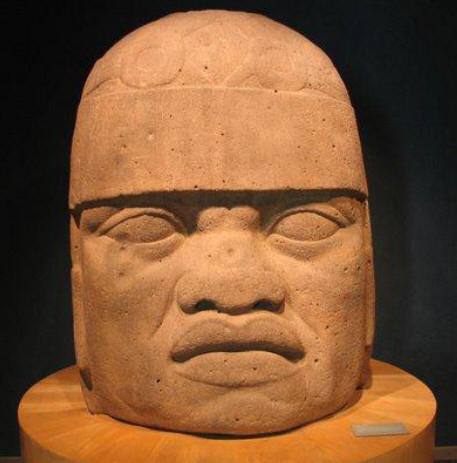
the colossal Olmec heads represent the Dongolan type.
It is interesting to note that the
empirical frequencies of the Dongolan type at Tlatilco is .231, this
was more than twice as high as Wiercinski's theoretical figure of
.101, for the presence of Dongolans at Tlatilco.
The other possible African type found at Tlatilco and Cerro were the
Laponoid group. The Laponoid group represents the Austroloid-Melanesian
type of (Negro) Pacific Islander, not the Mongolian type.
If we add together the following percent
of the Olmecs represented in Table 2, by the Laponoid (21.2%),
Equatorial (13.5), and Armenoid (18.3) groups we can assume that at
least 53 percent of the Olmecs at Tlatilco were Africans or Blacks.
Using the same figures recorded in Table 2 for Cerro, we observe
that 40.8 percent of these Olmecs would have been classified as
Black if they lived in contemporary America.
Rossum (1996) has criticized the work of Wiercinski because he found
that not only blacks, but whites were also present in ancient
America.
To support this view he,
-
claims that Wiercinski was wrong
because he found that Negro/Black people lived in Shang
China
-
that he compared ancient
skeletons to modern Old World people.
First, it was not surprising that
Wiercinski found affinities between African and ancient Chinese
populations, because everyone knows that many Negro/African/Oceanic
skeletons (referred to as Loponoid by the Polish school) have been
found in ancient China see: Kwang-chih Chang The Archaeology of
ancient China (1976,1977, p.76,1987, pp.64,68).
These Blacks were spread throughout
Kwangsi, Kwantung, Szechwan, Yunnan and Pearl River delta. Skeletons
from Liu-Chiang and Dawenkou, early Neolithic sites found in China,
were also Negro.
Moreover, the Dawenkou skeletons show
skull deformation and extraction of teeth customs, analogous to
customs among Blacks in Polynesia and Africa.

Secondly, Rossum argues that Wiercinski
was wrong about Blacks in ancient America because a comparison of
modern native American skeletal material and the ancient Olmec
skeletal material indicate no admixture.
The study of Vargas and Rossum are
flawed.
They are flawed because the skeletal
reference collection they used in their comparison of Olmec skeletal
remains and modern Amerindian populations because the Mexicans have
been mixing with African and European populations since the 1500's.
This has left many components of these Old World people within and
among Mexican Amerindians.
The iconography of the classic Olmec and
Mayan civilization show no correspondence in facial features.
But many contemporary Maya and other
Amerind groups show African characteristics and DNA. Underhill, et
al (1996) found that the Mayan people have an African Y chromosome.
This would explain the "puffy" faces of contemporary Amerinds, which
are incongruent with the Mayan type associated with classic Mayan
sculptures and stelas.
Wiercinski on the other hand, compared his SRC to an unmixed
European and African sample. This comparison avoided the use of
skeletal material that is clearly mixed with Africans and Europeans,
in much the same way as the Afro-American people he discussed in his
essay who have acquired "white" features since mixing with whites
due to the slave trade.
A. von Wuthenau (1980), and Wiercinski (1972b) highlight the
numerous art pieces depicting the African or Black variety which
made up the Olmec people.
This re-analysis of the Olmec skeletal
material from Tlatilco and Cerro, which correctly identifies
Armenoid, Dongolan and Loponoid as euphemisms for "Negro" make it
clear that a substantial number of the Olmecs were Blacks support
the art evidence and writing which point to an African origin for
Olmec civilization.
In conclusion, the Olmec people were called Xi. They did not speak a
Mixe-Zoque language they spoke a Mande language, which is the
substratum language for many Mexican languages.
The Olmec came from Saharan Africa 3200 years ago. They came in
boats which are depicted in the Izapa Stela no.5, in twelve
migratory waves. These Proto-Olmecs belonged to seven clans which
served as the base for the Olmec people.
Physical anthropologist use many terms to refer to the African type
represented by Olmec skeletal remains including Armenoid, Dongolan,
Loponoid and Equatorial. The evidence of African skeletons found at
many Olmec sites, and their trading partners from the Old World
found by Dr. Andrzej Wiercinski prove the cosmopolitan nature of
Olmec society.
This skeletal evidence explains the
discovery of many African tribes in Mexico and Central America when
Columbus discovered the Americas (de Quatrefages, 1836).
The skeletal material from Tlatilco and Cerro de las Mesas and
evidence that the Olmecs used an African writing to inscribe their
monuments and artifacts, make it clear that Africans were a
predominant part of the Olmec population. These Olmecs constructed
complex pyramids and large sculptured monuments weighing tons.
The Maya during the Pre-Classic period
built pyramids over the Olmec pyramids to disguise the Olmec origin
of these pyramids.
References
-
Carlson,D. and Van Gerven,D.P.
(1979). Diffussion, biological determinism and bioculdtural
adaptation in the Nubian corridor,American Anthropologist,
81, 561-580.
-
Desplagnes, M. (1906). Deux
nouveau cranes humains de cites lacustres. L'Anthropologie,
17, 134-137.
-
Diehl, R. A., & Coe, M.D.
(1995). "Olmec archaeology". In In Jill Guthrie (Ed.),
Ritual and Rulership, (pp.11-25). The Art Museum: Princeton
University Press.
-
Irwin,C.Fair Gods and Stone
Faces.
-
Keita,S.O.Y. (1993). Studies and
comments on ancient Egyptian biological relationships,
History in Africa, 20, 129-131.
-
Keita,S.O.Y.& Kittles,R.A.
(1997). The persistence of racial thinking and the myth of
racial divergence, American Anthropologist, 99 (3), 534-544.
-
MacGaffey,W.(1970). Comcepts of
race in Northeast Africa. In J.D. Fage and R.A. Oliver,
Papers in African Prehistory (pp.99-115), Camridge:
Cambridge University Press.
-
Marquez,C.(1956). Estudios
arqueologicas y ethnograficas. Mexico.
-
Rensberger, B. ( September,
1988). Black kings of ancient America", Science Digest,
74-77 and 122.
-
Underhill,P.A.,Jin,L., Zemans,R.,
Oefner,J and Cavalli-Sforza,L.L.(1996, January). A
pre-Columbian Y chromosome-specific transition and its
implications for human evolutionary history, Proceedings of
the National Academy of Science USA,93, 196-200.
-
Van Rossum,P. (1996). Olmec
skeletons African? No, just poor scholarship.
-
Von Wuthenau, Alexander. (1980).
Unexplained Faces in Ancient America, 2nd Edition, Mexico
1980.
-
Wiercinski, A.(1969).
Affinidades raciales de algunas poblaiones antiquas de
Mexico, Anales de INAH, 7a epoca, tomo II, 123-143.
-
Wiercinski,A. (1972). Inter-and
Intrapopulational Racial Differentiation of Tlatilco, Cerro
de Las Mesas, Teothuacan, Monte Alban and Yucatan Maya,
XXXlX Congreso Intern. de Americanistas, Lima 1970 ,Vol.1,
231-252.
-
Wiercinski,A. (1972b). An
anthropological study on the origin of "Olmecs", Swiatowit
,33, 143-174.
-
Wiercinski, A. & Jairazbhoy, R.A.
(1975) "Comment", The New Diffusionist,5 (18),5.
|