|
|
|

|
by Deutsche Welle 2002 from DonsMaps Website
A group of German scientists has deciphered the meaning of one of the most spectacular archeological discoveries in recent years:
The purpose of the 3,600 year-old sky disc of Nebra, which caused a
world-wide sensation when it was brought to the attention of the
German public in 2002, is no longer a matter of speculation.
A lunar year is eleven days shorter than the
solar year because 12 synodic months, or 12 returns of the moon to
the new phase, take only 354 days.
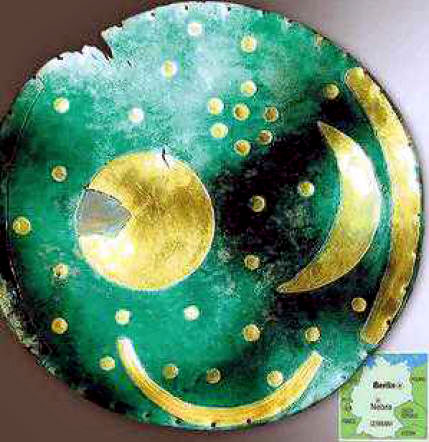
Artist's view of the 3600-year-old bronze disc inlaid with a
gold-leaf sun, moon and stars.
The 32-centimeter-wide (seven-inch) bronze disc with gold-leaf
appliqués representing the sun, the moon, and the stars is the
oldest visual representation of the cosmos known to date. A cluster
of seven dots has previously been interpreted as the Pleiades
constellation as it appeared 3,600 years ago.
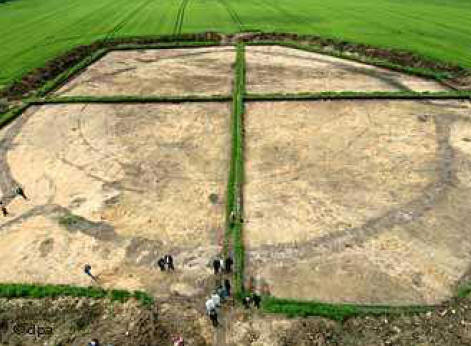
The sky disc of Nebra was found near Europe's oldest observatory in
Goseck
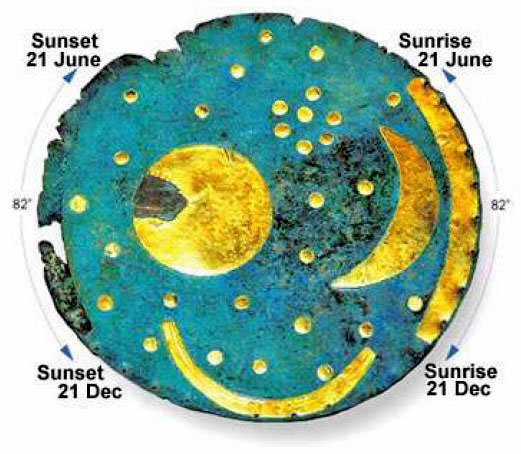
According to astronomer Wolfhard Schlosser of the Rurh University at Bochum, the Bronze Age sky gazers already knew what the Babylonians would describe only a thousand years later.
Ever since the disc was discovered, archaeologists and astronomers have been puzzled by the shape of the moon as it appears on the disc.
In his quest to explain why the Nebra astronomers created a sky map with a four or five days old moon on it, Hansen consulted the "Mul-Apin" collection of Babylonian documents from the 7th and 6th centuries B.C.
These cuneiform writings represent, according to Hansen, a
compendium of "astronomic knowledge from the earliest times." They
also contain a calculation rule for the crescent that looks
strikingly similar to the one from Nebra.
The Bronze Age astronomers would hold the Nebra clock against the
sky and observe the position of the celestial objects. The
intercalary month was inserted when what they saw in the sky
corresponded to the map on the disc they were holding in their
hands. This happened every two to three years.
The disc was found in 1999 by two previously convicted treasure
looters. It was seized by the authorities in 2002 along with other
Bronze Age objects in a police operation in Switzerland.
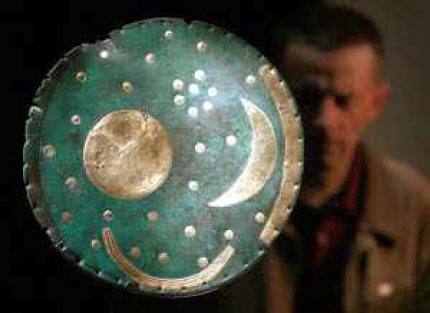
Photo: The Sky Disc of Nebra at the state museum for prehistory in Halle, Germany
(Peter Endig/EPA)
The enigma of a priceless Bronze Age disc seems to have been solved by a Hamburg scientist who has identified it as one of the world's first astronomical clocks.
The 3,600-year-old Sky Disc of Nebra, which surfaced four years ago when German grave robbers tried to sell it on the international market, shows that Bronze Age man had a sophisticated sense of time.
The bronze disc is about 30cm in diameter, has a blue-green patina
and is inlaid with a gold sun, moon and 32 stars. Robbers using
metal detectors found it in 1999 alongside a pile of bronze axes and
swords in a prehistoric enclosure on top of a hill in deep forest
112 miles (180km) southwest of Berlin.
And there are about 1,000 barrows, burial grounds for
warriors and princes, in the nearby forests.
He consulted the 7th and 6th century BC mul-apin collection of Babylonian documents in the British Museum.
It appears that the users of the 3,600- year-old clock made similar calculations. The disc was used to determine when a 13th month should be added to the lunar year, which has shorter months than the solar year.
Herr Maller said:
But the knowledge was somehow lost, and scientists say that the clock would have been used for only about 300 years.
Herr Maller said:
It's the 3,600-year-old Nebra disk, a bronze artifact with markings in gold leaf that may have been used to time plantings and harvests.
The Nebra disk was created 2,400 years later than the Goseck site,
could possibly have been made at the site since it was found on a
hilltop just 25 kilometers away, in the wooded region of Nebra.
A cluster of seven dots has been interpreted as the Pleiades constellation as it appeared 3,600 years ago, scattered other stars and three arcs, all picked out in gold leaf from a background rendered violet-blue - apparently by applying rotten eggs.
The formations on the disc
are clearly based on previous astrological observations and that
astronomical knowledge was tied to a mythological-cosmological
worldview right from the beginning.
The painting was found in the
burial chamber in the pyramid of the Egyptian pharaoh Unas, which is
decorated with stars.
Nearby excavations of wood-and-clay houses have turned up a variety of grains and evidence of domesticated goats, sheep, pigs and cows.
Farmers reached this part of the world some 500 years before they
built the solar observatory. Although these earliest Neolithic
agriculturists most likely measured only the sun's movements, over
millennia they came to quantify the lunar cycle and the positions of
constellations.
The Nebra disk is the
first evidence of such a faith in central Europe.
Equipped with a metal detector and basic household tools, the two
local looters stumbled upon one of the greatest archaeological finds
this century, along with two swords, two axes, chisels and armlets,
and then sold the heist to dealers.
With the next blow, a star shot out from its astronomical
position and in their hurry to secure their booty, the thieves
managed to chip a large part from the main astronomical object.
Authorized archaeologists have been busy excavating the site, and have already unearthed more than 100 treasures. Once the excavation of the site has been completed, a visitor's centre will be established near the area.
The forest where the site is located
is considered one of the most important archaeological sites in
Europe.
With its glittering array of gold-leaf celestial illustrations, the 3 600-year-old bronze disk was hailed as the earliest known diagram of the heavens and the most important archaeological discovery of the twenty-first century ("Star-Crossed Find," News, January/February 2003).
But last year a German archaeologist claimed that the dinner-plate-sized disk was a fake, starting a shrill and often surreal battle over the artifact's authenticity that has rocked Germany's archaeological establishment.
The disk's recent history dates to 1999, when two looters using metal detectors discovered the artifact, along with several bronze weapons and tools, in a wooded area near the German town of Nebra, 100 miles southwest of Berlin.
Amateur archaeologists Reinhold Stieber and Hildegard Burri-Bayer tried to hawk the disk for $400 000 - and were seized by police officers in the basement bar of a touristy Swiss hotel.
After a short trial, the duo, along with the
looters, were found guilty of illegally trafficking in cultural
artifacts. While the plunderers were given suspended sentences and
put on probation, Stieber and Burri-Bayer appealed. And at that
point in September 2003, no one disputed the disk's authenticity.
Newspapers as far away as Taipei
played up his assertions with headlines of "fraud" and "fake," and Stieber and Burri-Bayer's defense lawyers called on Schauer to
testify in the appeals trial, reasoning that if the disk was a fake,
then the pair couldn't be guilty of trafficking in valuable cultural
objects.
He had never examined the artifact before making his claim, nor did he ever publish his findings in a peer-reviewed journal.
The disk's gold inlays can be traced to a Bronze Age mine in Austria, and a nearly inimitable mixture of hard crystal malachite covers the artifact.
Saxon Anhalt state archaeochemist Christian Wunderlich has
also tested Schauer's urine and acid theory, and his research can
show that it is unlikely to have created the disk's slow-growth
malachite veneer.
Still, Schauer stands by his claims, arguing that the faked corrosion is visible in photos of the disk. He also insists that he has support within the archaeological community.
Schauer says that he will publish his findings next year in the German journal Archäologisches Korrespondenzblatt.
Yet Schauer might not be the most unusual figure in the case.
Since 2003, defendant Burri-Bayer has been publishing Ursula LeGuin - like fantasy novels that revolve around a magical sky disk.
In fact, while her lawyers argue that the disk is a fake, her website presents the artifact as authentic, detailing how she once handled,
At the time Archaeology went to press, both sides had rested in the case, but no verdict had been reached.
But most German archaeologists believe that the public relations damage to their field - and the disk - has already been done.
In the future, Wunderlich believes archaeologists should rely more on material science to examine artifacts.
Even so, he adds,
Video
According to Answers.com, in 1556 B.C.E. (approximately 3,564 years ago) Nibiru's solar orbit is noted as 3600 years.
Cecrops rebuilt Athens following a great flood that ended a Golden Age before the rule of Zeus. The name 'Cecrops' in the original Greek means 'face with a tail'. His upper body is represented like a man and his lower half was in serpent or fish-tail form (accounting for the "mermaid/merman" legends).
He was the first king and founder of Athens, Greece and ruled from 1556-1506 B.C.E. Cecrops was a "cultural hero" and taught the Athenians marriage, reading and writing, and ceremonial burial. In the Deucalion flood myth, Zeus released a deluge, the rivers ran in torrents and the sea encroached rapidly on the coastal plain, engulfing the foothills with spray and washing everything clean.
In this Greek flood, no animals were rescued and the waters receded after nine days.
No such deluge or flood myth can be found since this most recent one. Assuming this deluge (like the biblical flood) was also caused by a near-earth encounter with Nibiru, it had to have occurred a short time before Cecrops began his reign.
Nibiru should therefore visibly return soon - possibly by 2012.
The state of Attica in Greece was once called Cecropia after Cecrops. The account of a contest between Athena and Poseidon for possession of Attica took place in his reign, and in some accounts he was the judge, awarding the land to Athena.
|